Seoul redevelopment sites consolidating around major firms
Unsold units accumulate in regions as new orders shrink
'Many members can't even pay association dues'
Industry calls for demand-side measures including temporary capital gains tax relief
![A construction site in central Seoul. [Herald DB]](https://wimg.heraldcorp.com/news/cms/2026/06/24/ams.V01.photo.HDN.P.20260408.P12026040815144261326757244_P1.jpg)
The business environment for regional and small-to-midsize construction companies is deteriorating by the day, driven by a convergence of rising unsold inventory, soaring construction costs and tightening financing conditions. With Seoul's major redevelopment sites increasingly consolidating around large builders, industry observers warn that polarization within the construction sector will only deepen. Given construction's broad downstream ripple effects, voices are growing louder for targeted support tailored to smaller builders — including measures to stimulate regional housing demand and differentiated lending regulations.
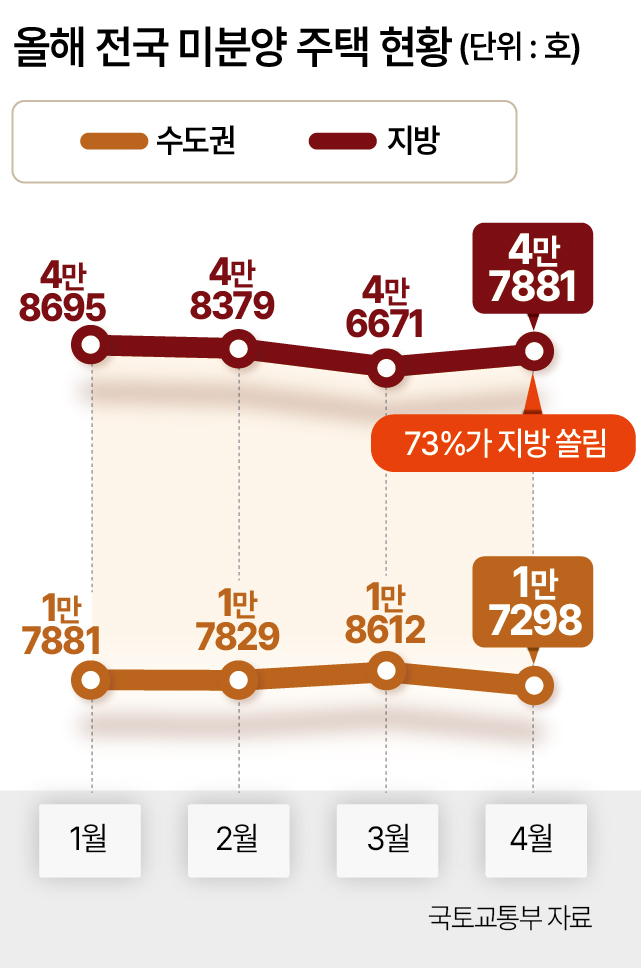
The surge in construction costs fueled by domestic and international uncertainty has compounded the financial strain on smaller builders as unsold units continue to pile up, according to industry sources. Data from the Ministry of Land, Infrastructure and Transport show that as of the end of April, there were 65,179 unsold homes nationwide, of which 47,881 — about 73 percent of the total — were concentrated outside the greater Seoul metropolitan area. Unsold units after completion, considered the most problematic category, stood at 25,166 in regional areas, accounting for 85 percent of the national total of 29,504.
Smaller construction companies tend to have a higher share of regional projects, so they are hit harder than large builders when unsold inventory builds up and cash flow dries up. This is the backdrop for a vicious cycle — unsold units accumulating, incoming funds halting, project financing stalling and new ground-breakings being delayed — that is playing out more acutely in the regions than in Seoul.
"Financial institutions apply particularly stringent loan screening to regional and smaller builders, citing concerns about unsold inventory," an official at the Korea Housing Builders Association said. "Builders in areas with active urban development projects, such as parts of the Chungcheong provinces, at least retain some borrowing capacity, but most are struggling to secure financing and their projects have ground to a halt."
The gap in new orders between the greater Seoul area and regional markets is also widening. Construction orders in the greater Seoul area rose 49.6 percent year-on-year in the January–April period, while the growth rate in regional areas was just 8.6 percent, according to the Korea Construction Industry Institute's outlook for the second half of 2026. That gap signals how sharply the new-order base outside the capital is shrinking.
Sentiment across the construction industry has contracted as a result. The Korea Housing Industry Research Institute said its housing business outlook index for this month stood at 77.1, down 0.5 point from the previous month. The financing sub-index fell particularly sharply, dropping 3.4 points in a single month to 69.6 — and 10.7 points compared with a year earlier. The institute attributed the decline to rising concerns about market interest rates and a deterioration in developer creditworthiness, both of which have raised the bar for bank lending.
Expanding into the Seoul or greater metropolitan market is not a realistic option for most smaller builders, either. Major redevelopment sites in Seoul are already dominated by large construction companies competing for contracts. Smaller builders with some foothold in Seoul have been turning to small-scale redevelopment schemes such as "Moatoun" projects, but even that avenue is limited.
The prolonged conflict in the Middle East, which has pushed up construction costs, and the implementation of the so-called Yellow Envelope Act — which expands the liability of prime contractors — add further burdens for smaller builders. Companies with thinner financial cushions are more vulnerable to rising input costs and expanded legal exposure. The postwar reconstruction market in the Middle East, which has emerged as a potential new revenue source for Korean builders following recent moves toward a US-Iran ceasefire, is also likely to go primarily to large construction companies with established overseas track records.
"There are many construction companies that can't even pay their association dues because they have no new projects," one industry association official said. "The ones still holding on are only those with a solid project base within their region, or a handful of firms that built up financial reserves during the boom years."
![A construction site in central Seoul. [Herald DB]](https://wimg.heraldcorp.com/news/cms/2026/06/24/ams.V01.photo.HDN.P.20260408.P12026040815112262785502210_P1.jpg)
While the government has taken steps to revive the construction sector, industry insiders say those efforts will fall short without targeted support that accounts for the deepening polarization. The industry is particularly emphatic that bold policy measures are needed to stimulate housing demand in regional markets.
Kim Deok-rye, head of the housing policy division at the Korea Housing Industry Research Institute, said proactive measures — such as a temporary reduction in capital gains tax — are needed to boost demand for unsold homes. "If a developer wishes, there should be pathways to convert unsold units into rental housing, or for real estate investment trusts and similar vehicles to purchase unsold homes in bulk, so that builders can move on to their next projects," she said.
She added that without cash flow from unsold inventory, reinvestment becomes impossible. "Policy needs to be designed to expand the supply base and restore demand for unsold housing," she said.
An official at the Korea Federation of Construction Associations also noted that while the Housing and Urban Guarantee Corporation and the Korea Housing Finance Corporation have pledged to expand their project financing guarantee programs, the total volume remains insufficient. "More aggressive policies are needed to supply liquidity to builders — including a significant increase in the volume of purchases and guarantees," the official said.
![“한달 만에 20억 올랐다” 국평 호가 72억원 부른 반포 ‘래미안트리니원’ [부동산360]](https://wimg.heraldcorp.com/news/cms/2026/06/22/news-p.v1.20260622.7e4ad4167a084437b3a64dff00d0ab88_T1.png)
lucky@heraldcorp.com
hope@heraldcorp.com