240 specialty contractors filed for closure last month
Middle East war, high exchange rates pile on pressure
Rate hike would deepen financing burden, widen losses
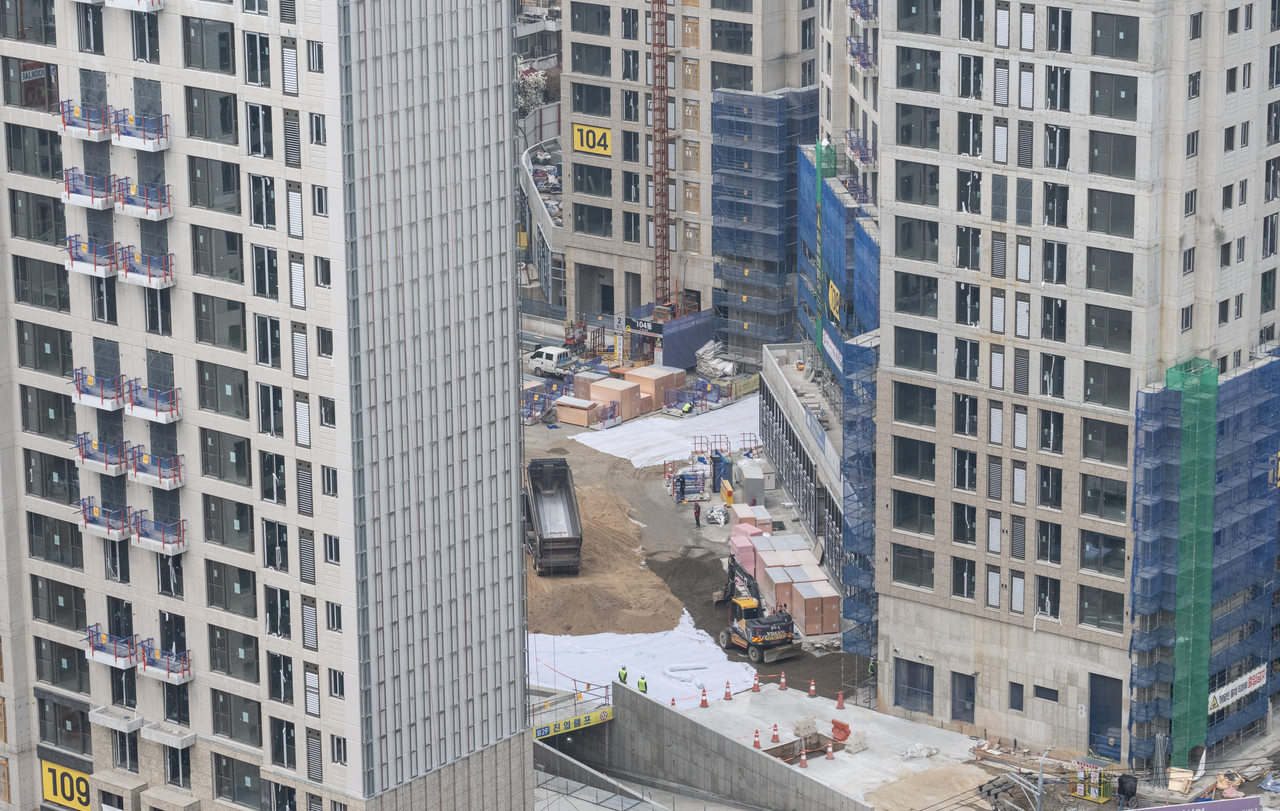
A total of 240 specialty construction companies filed for closure in May alone, up roughly 26 percent from the same month a year earlier. The wave of shutdowns reflects deepening fears of cascading failures among small and medium-sized builders, as a construction slump triggered by high interest rates since the second half of 2022 collides with external shocks including the Russia-Ukraine war, the Middle East war and a high exchange rate. With a benchmark interest rate hike now being floated for the second half of this year, the closure trend is expected to accelerate — smaller firms, far more vulnerable to rising financing costs, stand to be hit hardest.
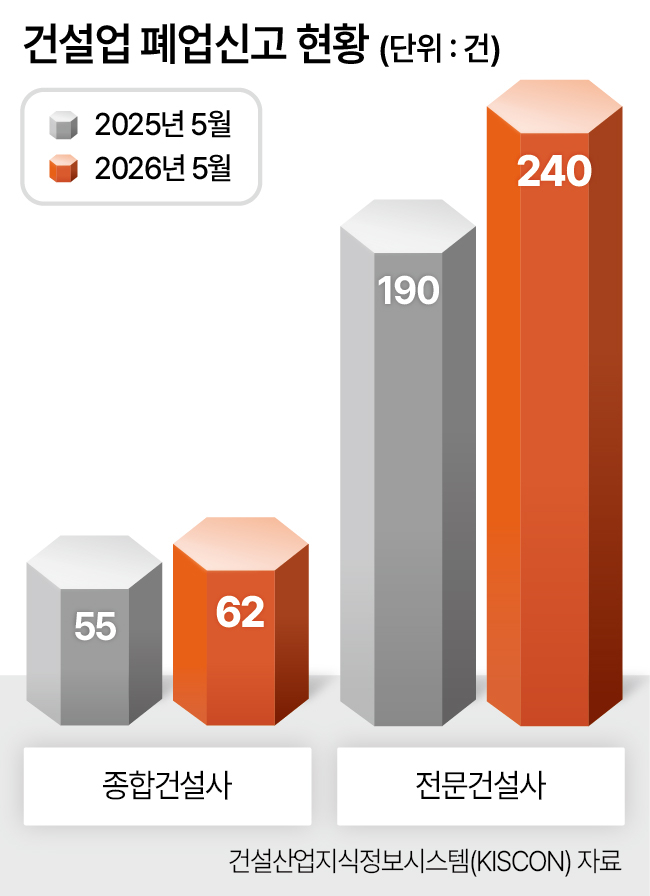
Data released Wednesday by the Ministry of Land, Infrastructure and Transport's Construction Industry Knowledge Information System (KISCON) showed 240 specialty contractors filed for closure nationwide in May — an average of eight per day. The vast majority cited "abandonment of business" as their reason, though a portion of the filings also reflected companies switching to a different industry.
Specialty construction companies, as defined under the Framework Act on the Construction Industry, hold trade-specific licenses and directly carry out portions of construction work on site. They typically operate as subcontractors to general construction firms and are mostly small and medium-sized enterprises.
The May figure represents a 26.3 percent increase from the 190 closures recorded in the same month last year. For the January-to-May period, closures reached 1,436 this year, up 19.8 percent from 1,199 during the same stretch last year. Specialty contractors also far outpaced general contractors in closures over the same period, with the latter recording just 290 filings.
Analysts attribute the trend to a prolonged construction downturn compounded by a surge in raw material costs following the outbreak of the Middle East war in February this year, and rising import prices driven by the high exchange rate — conditions that have pushed financially weaker small firms to the breaking point. Large construction companies have also been capturing a disproportionate share of new contracts, leaving regional and smaller general contractors — and their subcontractors — with little work.
"Construction orders are growing overall, but the gap between large and small builders keeps widening," said Lee Ji-hye, a research fellow at the Korea Construction Industry Institute. "As orders concentrate among the big players, smaller firms are squeezed further. And because smaller companies tend to be concentrated in regional areas, the unsold-unit situation there is making things especially difficult for them."
The financial strain on smaller firms is also visible in the data. A "Construction Brief" report published this month by the Korea Research Institute for Construction Policy found that among construction companies subject to external audits, 44.2 percent were marginal firms — meaning their operating profit was insufficient to cover interest payments, giving them an interest coverage ratio below 1. Small and medium-sized enterprises accounted for 86 percent of that group. "A sharp drop in ground-breakings has significantly reduced the volume of construction work available, and smaller builders have relatively little bargaining power to pass on rising material costs — leaving them fighting for survival," the institute said.
Adding to the pressure is the prospect of a rate hike in the second half of this year. Bank of Korea Gov. Shin Hyun-song signaled last month that a benchmark interest rate increase was possible as macroeconomic indicators recover, saying the construction sector had turned positive and that "the warmth spreading across the broader economy is being felt in facility investment, construction investment and consumption."
A rate hike would raise borrowing costs and increase the burden of existing loan interest — a serious blow to an industry where managing financing costs is central to project viability. The current construction slump took hold in the second half of 2022, when the benchmark rate climbed from 1.25 percent at the start of that year to 3.25 percent by year-end, triggering a contraction in construction investment, a deterioration in project financing and a sharp rise in unsold units. If the current benchmark rate of 2.5 percent rises into the 3 percent range, fears of a wave of failures among small builders are expected to intensify.
"When interest rates rise, financing costs for the construction sector go up, and both investment sentiment and incentives fall," Lee said. "Given how bad conditions already are in regional construction markets because of unsold units, a rate hike would make it even harder for smaller firms to stay in business."
She added that government support measures for the construction industry are needed, including expanding public infrastructure investment and increasing the share of local public works contracts allocated to smaller firms.
As construction costs have surged amid growing domestic and external uncertainty, an accumulation of unsold units has further deteriorated the operating environment for regional and small construction companies. The situation has raised calls for expanded government support for smaller builders.
![“서울 집값? 지방은 딴 세상” 미분양·PF·수주절벽 덮친 중소건설사 무너진다[부동산360]](https://wimg.heraldcorp.com/news/cms/2026/06/24/ams.V01.photo.HDN.P.20260408.P12026040815144261326757244_T1.jpg)
hwshin@heraldcorp.com