Presidential policy chief speaks at Kwanhun Club forum; also says 'just build' on housing supply
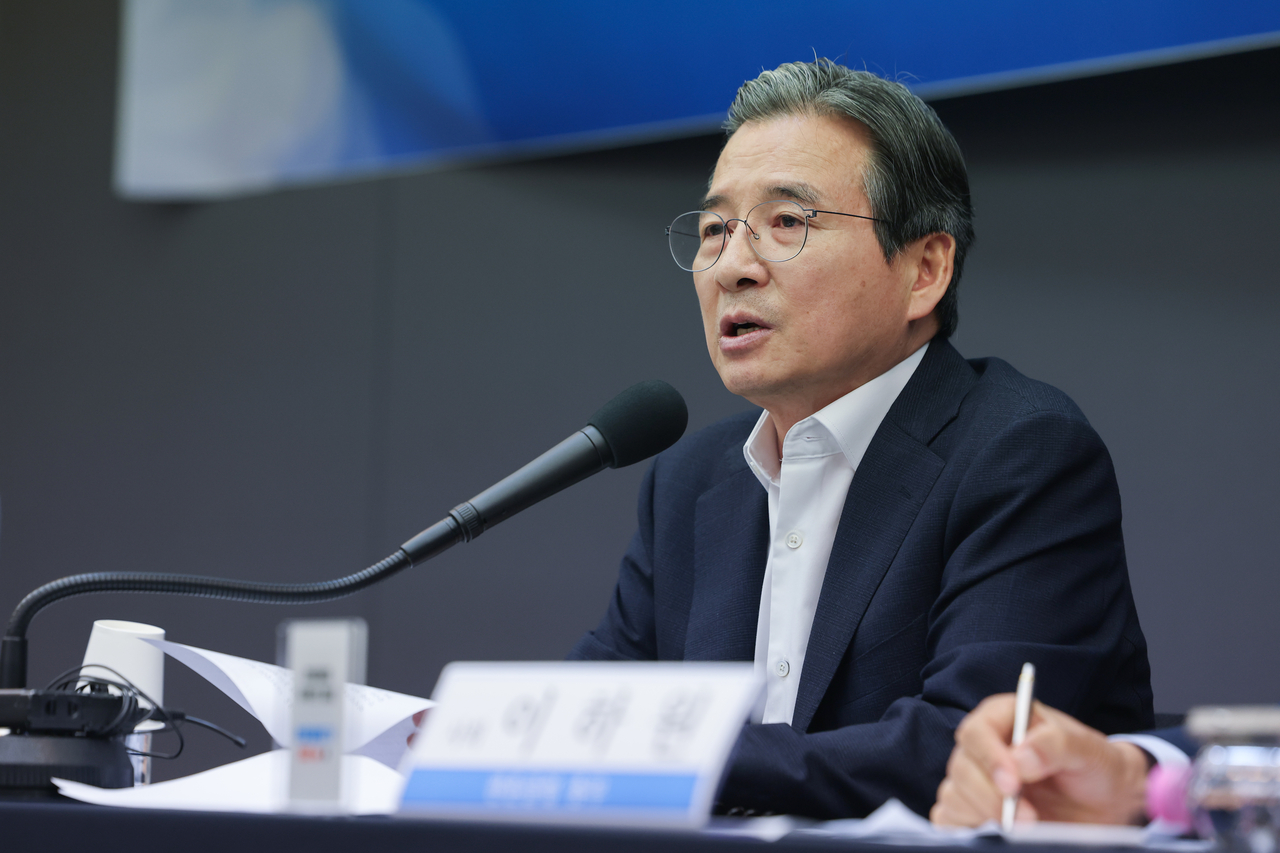
Kim Yong-beom, chief of the presidential policy office, said Wednesday that Samsung Electronics and SK Hynix's plans to build semiconductor factories worth hundreds of trillions of won in the Gwangju and South Jeolla Province region represent entirely new investment — not a relocation of the Yongin semiconductor cluster already under development.
Speaking at a Kwanhun Club forum at the Press Center in Jung-gu, Kim said the planned facilities in Yongin would proceed as scheduled. "This is absolutely not about scrapping what was decided for Yongin and moving it to the regions," he said. "The greater Seoul area is saturated. This is about creating something new — not moving what is already in the metropolitan area."
His remarks came in response to concerns that the southeastern part of the country could be left out, as Samsung Electronics and SK Hynix are expected to announce large-scale investment plans for the Honam region at a presidential briefing session on June 29, to be presided over by President Lee Jae Myung at Cheong Wa Dae.
The two chipmakers are reportedly considering building memory chip production lines (front-end processes), advanced packaging facilities (back-end processes) and AI data centers as part of a semiconductor cluster in the Honam region. The investment is estimated at between 300 trillion won ($195 billion) and 400 trillion won. Samsung Electronics Chairman Lee Jae-yong is separately expected to meet President Lee on Thursday to discuss regional investment plans.
Asked whether concentrating large-scale investment in the Honam region would marginalize the southeast and stoke regional tensions, Kim said the government was already drawing up investment plans for the southeastern region as well. "All the industries that form the foundation of physical AI are in the southeast," he said. "So physical AI will be centered on the southeast."
He added that the government was aiming to match investment to each region's strengths rather than fuel regional rivalry. "Companies with market capitalizations exceeding $1 trillion don't make business decisions that easily just because the government tells them to," he said.
On the question of why Honam investment plans were being discussed while construction in Yongin was still ongoing, Kim said waiting until Yongin was fully built before starting elsewhere would be a misreading of how the industry works. "By then, it would already be too late," he said.
He also said the AI era demands vast amounts of power, land and new industrial ecosystems — areas where regional locations hold a natural advantage. "Data centers, advanced manufacturing, renewable energy and next-generation power grids align with the strengths of the regions," he said.
Kim drew a parallel with South Korea's industrialization era, saying that just as manufacturing once took root in the regions, a new industrial map for the AI age could be drawn there again. "In that sense, balanced regional development should be approached as a new growth strategy," he said.
Kim also expressed deep concern about growing social disputes over how the gains of the AI era are being distributed.
"The country is getting wealthier, but some citizens are being left behind by growth; economic indicators are improving, but anxiety about the future is not easing — this is the problem of K-shaped growth," he said. He called for broader social discussion on labor and social policy suited to the AI age, as well as on how to use surplus tax revenue.
On the labor dispute at Samsung Electronics over record-level performance bonuses, Kim drew a line against government intervention. "This is something that needs to be discussed socially," he said. "The government cannot dictate what to do."
He added that having a union negotiate based on 70 percent of operating profit was unprecedented anywhere in the world. "I think there needs to be a discussion about whether it is even possible to bargain over something bigger than wages — namely performance bonuses," he said.
Turning to real estate policy, Kim said the situation was "extremely challenging." He cited the structural supply difficulties that emerged from the project financing insolvency crisis in 2023, compounded by surging demand fueled by a buoyant stock market and rising liquidity.
"We are pooling our wisdom on how to structurally stabilize the situation, and we are thinking hard about it," Kim said. "This is policy being made under extremely difficult conditions." On the supply side in particular, he struck a forceful note, saying the answer was simply to "just build."
sang@heraldcorp.com
moone@heraldcorp.com