
Ministry of Health and Welfare co-hosts inaugural Future Social Security Forum with government, state research institutes and academia proposing medium- to long-term policy directions in three areas
The Ministry of Health and Welfare said Friday it co-hosted the inaugural Future Social Security Forum at Royal Hotel Seoul in Jung-gu, Seoul, together with the Korea Institute for Health and Social Affairs and the Korean Academy of Social Welfare.
The forum was organized to help the government get ahead of sweeping changes in the policy environment — including the AI transformation (AX), digital transition, demographic shifts driven by the low birth rate and aging population, and the threat of regional depopulation — and to map out medium- to long-term social security priorities.
The forum is part of the implementation framework for the revised Third Basic Social Security Plan, announced May 26, and will continue in-depth discussions through the end of the year across three thematic working groups.
The three working groups will cover AI and digital transition, the division of functions and roles between central and local governments, and basic income, care and healthcare — with participation from relevant Ministry of Health and Welfare divisions, the Korea Institute for Health and Social Affairs, and academic experts.
The inaugural forum centered on three core agenda items, featuring expert presentations and focused discussions.
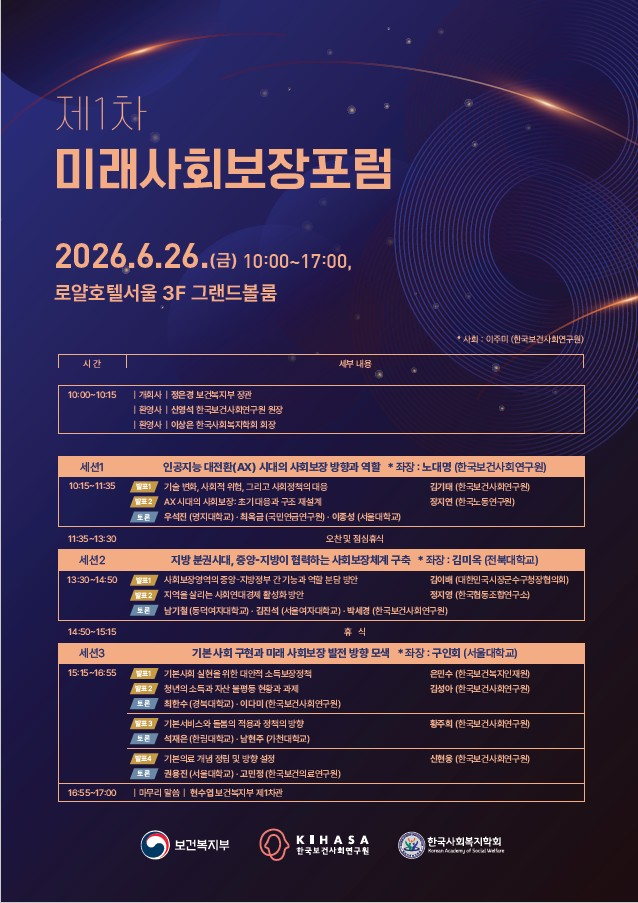
Session 1, themed "The Direction and Role of Social Security in the Age of AI Transformation (AX)," examined the impact of the AX transition on the economy, society and labor market, and explored how the social security system should be restructured in response.
Kim Ki-tae of the Korea Institute for Health and Social Affairs presented on "Technological Change, Social Risk and the Response of Social Policy," while Jang Ji-yeon of the Korea Labor Institute presented on "Social Security in the AX Era: Early Responses and Structural Redesign."
Noh Dae-myung of the Korea Institute for Health and Social Affairs moderated the subsequent discussion, which included Woo Seok-jin, a professor at Myongji University, Choi Ok-geum of the National Pension Research Institute, and Lee Jong-seong, a professor at Seoul National University.
Session 2, themed "Building a Central-Local Cooperative Social Security System in the Era of Decentralization," addressed how to rationally divide functions and responsibilities between central and local governments, and how to revitalize the social solidarity economy to support regional communities.
Kim Yi-bae of the Korean Association of Mayors and County and District Mayors presented on "Dividing Functions and Roles Between Central and Local Governments in the Social Security Sector," while Jeong Ji-young, director of the Korea Cooperative Institute, presented on "Revitalizing the Social Solidarity Economy to Sustain Local Communities."
Kim Mi-ok, a professor at Jeonbuk National University, moderated the discussion, joined by Nam Gi-cheol of Dongduk Women's University, Kim Jin-seok of Seoul Women's University, and Park Se-gyeong, vice president of the Korea Institute for Health and Social Affairs.
Session 3 examined alternative income security models and the direction for building care and healthcare systems as basic services, while also reviewing policy challenges for addressing structural risks facing young people — including income gaps and social isolation.
Gu In-hoe, a professor at Seoul National University, chaired the entire session. On income, Eun Min-su, president of the Korea Health and Welfare Human Resources Development Institute, presented on "Alternative Income Security Policy for Realizing a Basic Society," and Kim Seong-a of the Korea Institute for Health and Social Affairs presented on "Youth Income and Asset Inequality: Current Status and Challenges." Choe Han-su of Kyungpook National University and Lee Da-mi of the Korea Institute for Health and Social Affairs joined the discussion.
On care, Hwang Ju-hee of the Korea Institute for Health and Social Affairs presented on "The Application of Basic Services and Care and the Direction of Policy," with Seok Jae-eun of Hallym University and Nam Hyeon-ju of Gachon University participating in the discussion.
On healthcare, Shin Hyeon-ung of the Korea Institute for Health and Social Affairs presented on "Establishing the Concept and Direction of Basic Healthcare," with Kwon Yong-jin of Seoul National University and Ko Min-jeong of the National Evidence-based Healthcare Collaborating Agency joining the discussion.
The ministry plans to use the forum to identify future social security policy priorities, develop those requiring deeper analysis through commissioned research in partnership with the Korean Academy of Social Welfare and other academic bodies, and finalize a "Future Social Security Policy Proposal" in December.
Health and Welfare Minister Jeong Eun-gyeong said in her opening remarks that "amid rapid changes in the social environment — including the AI and digital transformation, demographic shifts and the threat of regional depopulation — the time has come to prepare a social security system that goes beyond patching existing institutions and proactively addresses the risks of future society." She added that "particularly as the younger generation faces structural risks such as detachment from work, income gaps and isolation, we will continue to discuss ways to guarantee young people's basic livelihoods and support their participation in society."
thlee@heraldcorp.com





