Record sales logged for sub-40 sq. m. units with one or two rooms
Jeonse and monthly rent crunch pushes renters toward buying
Sale prices for micro-apartments rise for 13 consecutive weeks
![Apartment complexes in Sanggye-dong, Nowon-gu, Seoul. [Yonhap]](https://wimg.heraldcorp.com/news/cms/2026/06/26/ams.V01.photo.HDN.P.20210523.202105230000008420985913_P1.jpg)
A first-floor unit with an exclusive use area of 25 square meters is listed at 700 million won ($453,000), but the owner won't knock off even 10 million won because there are so many inquiries. The next time a unit comes on the market, sellers will list it for at least 10 million won more.
— Head of real estate agency A near Munjeong Siyeong complex, Munjeong-dong, Songpa-gu, Seoul
As Seoul home prices continue to climb, buyers in their 20s and 30s are rushing to get a foothold in the market, pushing up prices even for micro-apartments — units of 40 square meters or smaller. Anxiety that prices will rise further has funneled demand toward lower- and mid-priced apartments that are more accessible than high-end properties. With the jeonse and monthly rent crunch deepening, more renters are converting to buyers, raising the barrier to entry for the compact one- and two-room units typically occupied by single-person households and newlyweds.
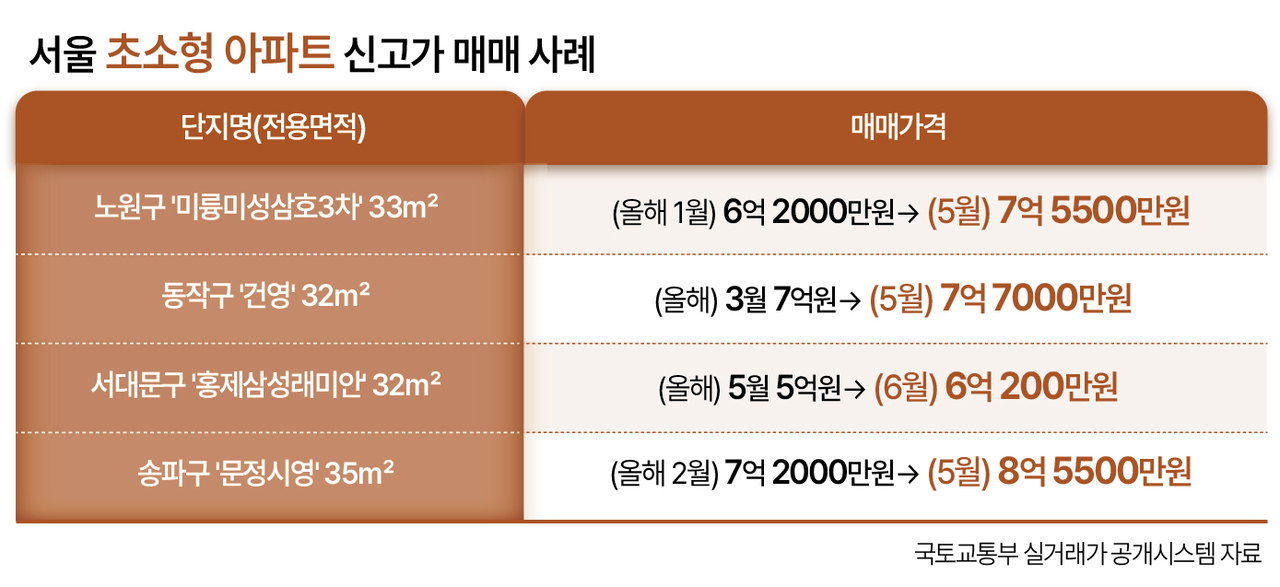
According to the Ministry of Land, Infrastructure and Transport's actual transaction price disclosure system, a 33-square-meter unit at Miryung Miseong Samho 3-cha in Wolgye-dong, Nowon-gu sold for 755 million won on May 29, setting a record high. The same unit type traded at between 620 million and 630 million won in January, meaning the price rose by more than 100 million won in less than six months. Current asking prices stand at 800 million to 850 million won.
A 32-square-meter unit at Geonyeong in Sangdo-dong, Dongjak-gu also set a new high, changing hands for 748 million won on June 5, while a 32-square-meter unit at Hongjae Samsung Raemian in Seodaemun-gu sold for 602 million won on June 16 — the first time the complex crossed the 600 million won mark.
A 35-square-meter unit at Munjeong Siyeong in Munjeong-dong, Songpa-gu sold for a record 855 million won on May 9. The same complex saw a unit trade at 720 million won in February, meaning prices rose by more than 100 million won in roughly three months.
In Eunpyeong-gu, a 39-square-meter unit at DMC SK View IPark Forest in Susaek-dong sold for a record 705 million won on June 11. On the same day, a 40-square-meter unit at Sewoon Prugio Herri City in Inhyeon 2-ga, Jung-gu also set a new high, with a contract signed at 750 million won.
The concentration of buying demand in micro-apartments priced between 500 million and 900 million won — where loan regulations are relatively less stringent than for high-priced units and policy-backed loans can be maximized — is also producing a price-alignment effect among nearby complexes.
The upward trend in micro-apartment prices is expected to continue for now, particularly given the strong buying momentum among people in their 20s and 30s. According to the Court Registry Information Plaza, the number of buyers in their 20s purchasing collective buildings — apartments, row houses, multi-family homes and officetels — in Seoul jumped 50 percent to 1,348 in April from 894 in January. Buyers in their 30s also increased 11 percent over the same period, from 6,128 to 6,812.
Nam Hyeok-woo, a real estate researcher at Woori Bank, said that in outer Seoul neighborhoods where jeonse prices have risen sharply but sale prices have been slow to follow, steady demand from non-homeowning single-person households and newlyweds has consistently centered on apartments priced around 600 million won that qualify for policy loans. "In lower-priced areas of Seoul, tenants are also moving toward buying, suggesting that the price-strengthening trend is spreading," he added.
Against this backdrop, sale prices for micro-apartments in Seoul have risen for 13 consecutive weeks. The Korea Real Estate Board's weekly apartment price trend survey showed prices rose 0.14 percent this week, extending a streak that began in the last week of March. The Gangbuk area posted a gain of 0.22 percent and the Dongbuk area 0.31 percent — both above the city average — reflecting concentrated demand from young Seoul buyers in outer districts where prices remain relatively low.
The Seoul rental market is being restructured around monthly rent, with high monthly rents becoming more prevalent in outer districts as tighter government loan regulations and a shortage of new move-in supply converge.
hwshin@heraldcorp.com