Government unveils strategy to build defense-tech startups modeled on US data-analytics giant Palantir, targeting five companies valued at 1 trillion won or more and 50 firms with annual sales exceeding 100 billion won
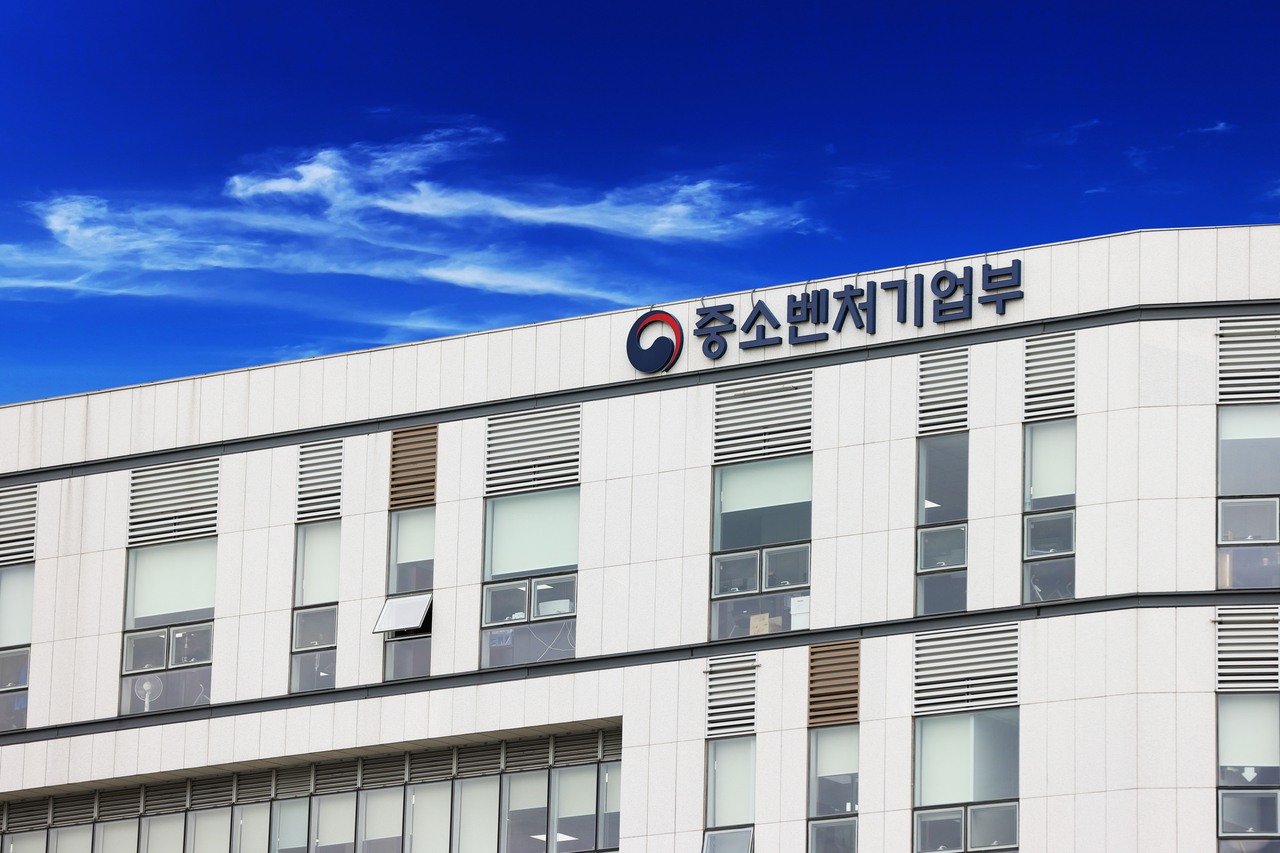
The government announced plans to cultivate AI-based defense startups modeled on Palantir, the US data-analytics firm, aiming to build five new-security companies valued at 1 trillion won ($647 million) or more and 50 innovative firms with annual sales exceeding 100 billion won by 2030.
South Korea's Ministry of SMEs and Startups, Ministry of National Defense and Korea AeroSpace Administration held a strategy meeting Friday at Cheong Wa Dae's Chungmu Hall to unveil the plan, titled "Direction for Nurturing Future New-Security Innovative Companies." The government said it intends to create a virtuous-cycle ecosystem that simultaneously strengthens national security capabilities and industrial competitiveness through advanced technologies including AI, drones, aerospace, cybersecurity and advanced materials.
The model the government cited is Palantir, which developed Gotham — a platform that integrates vast battlefield data and analyzes it using AI. The company counts the US Department of Defense and intelligence agencies among its main customers and carries a market valuation of around $300 billion.
The government will first designate strategic fields within the new-security sector and select high-growth companies as "new-security innovative companies" for intensive support. Target fields include drones, robots, defense AI and semiconductors, defense sensors and advanced materials, aerospace, and cybersecurity and quantum communications.
The procurement system will also be overhauled. Conventional weapons systems have required lengthy timelines from requirement identification to deployment, but the government plans to establish a rapid procurement framework for advanced technologies such as AI, cutting the initial deployment period to within one year.
In the defense sector, the government will expand a competitive acquisition model in which private companies propose military and industrial requirements. The plan calls for the military to adopt technologies first and then continuously improve their performance, enabling faster application of cutting-edge capabilities. Outside the defense sector, the government will introduce an "innovation-promoting contract regime" featuring milestone-based payments tied to each development stage and a liability-exemption system to ease the burden on innovative companies.
Research and development support will also expand. The government will introduce an "OTA-type R&D" framework linking research, demonstration and procurement, providing up to 10 billion won per company over five years. It also plans to strengthen support systems so companies can participate in military training and operations to gather demonstration data and develop products based on those findings.
The private investment base will be reinforced as well. The government will establish a Korean version of In-Q-Tel, the CIA's venture investment arm, as a benchmark. A 1 trillion won pool drawn from the government's Fund of Funds and a defense industry fund will supply growth capital, with plans to eventually mobilize up to 10 trillion won in investment resources to support companies at each stage of growth.
The Ministry of National Defense will also expand demonstration infrastructure so that private AI and drone companies can validate technologies alongside the military. The ministry plans to increase the number of dedicated demonstration units to nine by the end of this year and establish innovation labs within each unit to promote civil-military technology exchange. It will also broaden opportunities to demonstrate and certify drone and counter-drone technologies through events such as a national drone warfare competition and by opening military training grounds to private firms.
The ministry will build a "defense data catalog" to share military data with the private sector and expand datasets for AI training. It will also establish defense AI transformation hubs so private companies can develop AI models using military data. In addition, the government will push to enact a Defense Advanced Force Development Act to lay the groundwork for rapid acquisition of advanced weapons systems, and will pursue development of a Korea-specific AI operating system (K-Maven), a defense-specialized AI model and a defense world model. To train 500,000 drone operators, the government plans to secure 60,000 commercial training drones and build an AI- and drone-centered defense ecosystem.
The Korea AeroSpace Administration will develop the space industry as a core new-security sector. Under the K-Moonshot Project, the government aims to develop key technologies for a "space data center" and capture the next-generation infrastructure market for processing and storing satellite data. It will build a national satellite information open platform to release satellite imagery and observation data to the private sector, and use that foundation to nurture satellite-data startups. The government also plans to develop AI unmanned aerial vehicles and electric and hybrid vertical take-off and landing aircraft, while verifying the performance of domestically strong industries — including semiconductors and materials and components — in space environments to strengthen space supply chain competitiveness.
To ensure effective policy implementation, the government will establish a "New-Security Innovative Company Development Committee" chaired by the prime minister, along with an executive task force, and will pursue enactment of a special law and revision of the National Contracts Act. With the defense industry rapidly shifting from a hardware focus to one centered on AI and software, the government said it will continue pan-government support to position startups and small and medium-sized enterprises as the new engines of growth in the sector.
boo@heraldcorp.com