A global semiconductor supercycle has sent stock markets around the world to unprecedented highs, but South Korea's market stands out for the sheer intensity of its swings. Record-breaking plunges and record-breaking rallies have alternated in rapid succession, producing volatility that dwarfs even other markets with large chipmaker holdings, including those of the United States and Japan.
Analysts point to an extreme concentration in semiconductor stocks as the primary driver of the Kospi's outsized volatility. While the old investment adage warns against putting all eggs in one basket — and US and Japanese indexes are carried by a broad range of companies beyond chips — South Korea's benchmark index is, in effect, a semiconductor index. Sharp moves in chipmaker shares translate almost directly into moves in the index itself.
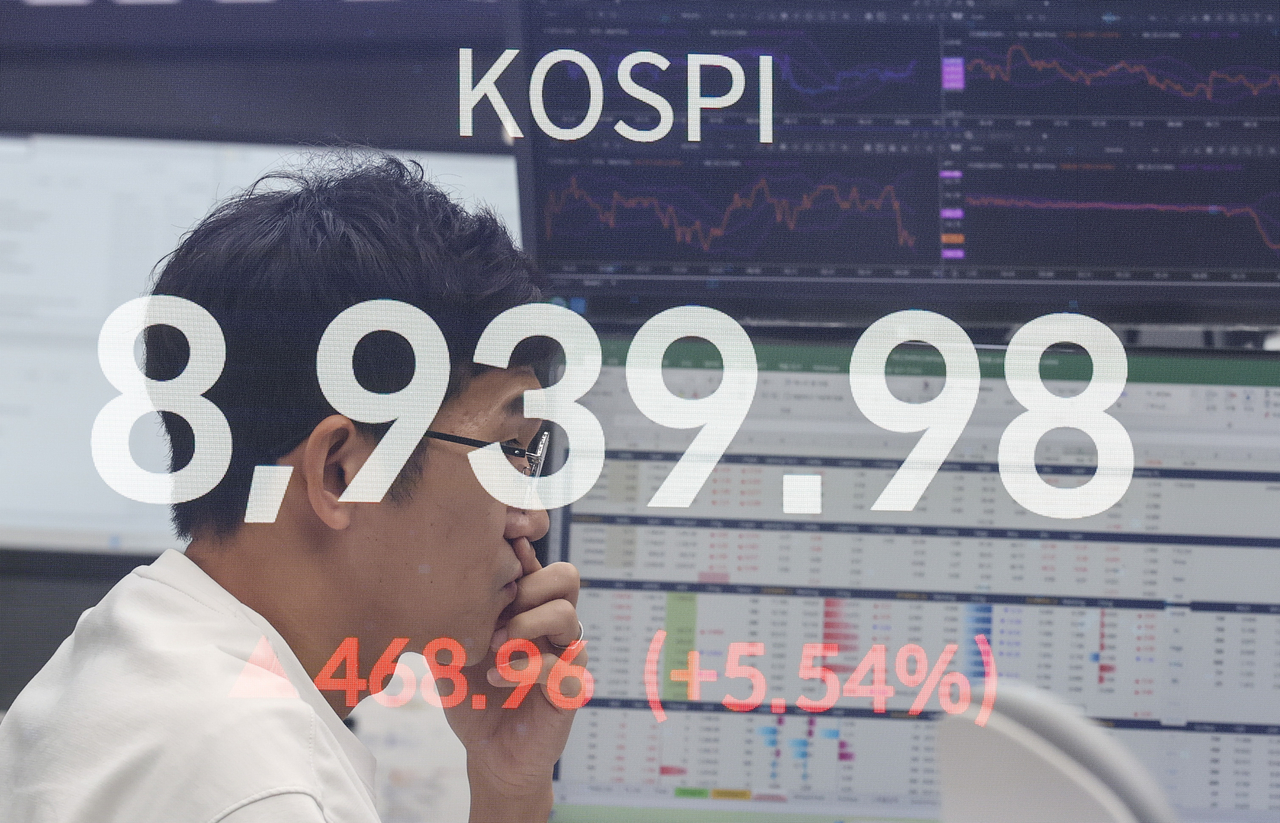
According to Korea Exchange data released Friday, the Kospi has suffered two historic crashes this year alone: a 12.1% plunge on March 4 amid fears of a US-Iran war, and a 9.99% drop on Monday over a semiconductor shock. The scale of those declines stands in stark contrast to the relatively contained moves seen in major developed markets such as the US and Japan.
The semiconductor concentration behind those swings is stark. As of Thursday, Samsung Electronics and SK hynix held combined market capitalization weights of 57.11% in the Kospi — Samsung Electronics at 28.67% and SK hynix at 28.44%. Including Samsung Electronics preferred shares, that figure climbs to 59.69%. In effect, two companies control the direction of the entire index.
At the end of last year, the combined market cap weight of Samsung Electronics and SK hynix stood at just 34.04%. The pair crossed 50% for the first time on May 27 and has continued to climb since. SK Square, the third-largest stock by market cap, accounts for just 3.43%, and the combined weights of fourth-ranked Samsung Electro-Mechanics (2.04%) and fifth-ranked Hyundai Motor (1.41%) still fall well short of Samsung Electronics alone.
Semiconductors and AI are dominant forces in the US and Japanese markets as well, but the degree of dependence differs sharply.
In the US, the S&P 500's top 10 includes several chip giants comparable in scale to Samsung Electronics and SK hynix — among them Nvidia, Broadcom and Micron Technology. Yet Nvidia, the index's largest stock by market cap as of Thursday local time, accounts for just 7.06% of the total index. Broadcom and Micron weigh in at 2.69% and 1.99%, respectively.
Beyond semiconductors, major technology companies — Apple (6.04%), Microsoft (3.93%), Amazon (3.65%) and Tesla (2.10%) — provide a broad base that absorbs and disperses market shocks.
Japan, too, is riding the semiconductor boom, with the Tokyo Stock Price Index, known as Topix, breaking the 4,000 mark for the first time. But its dependence on any single chip stock is far lower.
Kioxia Holdings, which recently overtook Toyota Motor to become Japan's largest company by market cap, accounts for only about 4.2% of the Topix prime market. That figure is based on the prime market's total capitalization of approximately 1,353 trillion yen, derived from the Japan Exchange Group's official figure of 1,332,892,100,000,000 yen ($8,240 billion) as of end-May, adjusted for subsequent index gains.
Tokyo Electron, a front-end semiconductor equipment maker ranked fifth by market cap, holds a 2.60% weight. The second through fourth spots are filled by Toyota Motor (3.15%), SoftBank Group (3.00%) and Mitsubishi UFJ Financial Group (2.83%) — representing automakers, telecoms and banks that provide broad sectoral diversification.
Japan's market is further supported by more than a dozen high-quality semiconductor equipment and materials companies, including Advantest, Renesas Electronics and Disco. Growth-industry support policies under the Takaichi cabinet have also drawn attention to leading materials firms such as Shin-Etsu Chemical, Tokuyama, Denka and Tokai Carbon, all of which have joined the rally.
"Japan has a diverse range of materials, equipment and infrastructure companies with high global market share, and automation investment to address population decline is also actively under way," said Choi Bo-won, a researcher at Korea Investment & Securities. "The likelihood that the government will maintain business-friendly policies to offset the burden of policy rate hikes is also a solid driver of earnings improvement for Japanese companies," she added.
The chronic weakness of a domestic market skewed so heavily toward semiconductors is being amplified further by the rapidly growing exchange-traded fund market. While the US ETF market channels stable passive flows through broad index-tracking products such as the S&P 500 and Nasdaq 100, the domestic market has expanded sharply around thematic and strategy-focused ETFs centered on semiconductors and covered calls.
Volatility intensified further after single-stock leveraged ETFs based on Samsung Electronics and SK hynix were listed for the first time on May 27.
"Since the listing of single-stock leveraged ETFs, intraday volatility has visibly expanded and ETF premium-discount spreads have also widened," said Ha Jae-seok, a researcher at NH Investment Securities. "There is a clear trend of retail investors selling leveraged ETFs that track the Kospi 200 or general sectors and rotating into single-stock leveraged products — and this is ultimately generating intense selling pressure on Kospi stocks other than Samsung Electronics and SK hynix," he warned.
jiyun@heraldcorp.com