Special lecture at Kim Dae-jung Political School
Remarks touch on intraparty criticism, party convention direction
'Not a question of who you're aligned with'
'Must transform into a youth-oriented party'
'Culture of using derogatory labels must change'
Calls for improvements to party member sovereignty, one-person-one-vote system
'Democratic Party will be swept away if it stays the course'
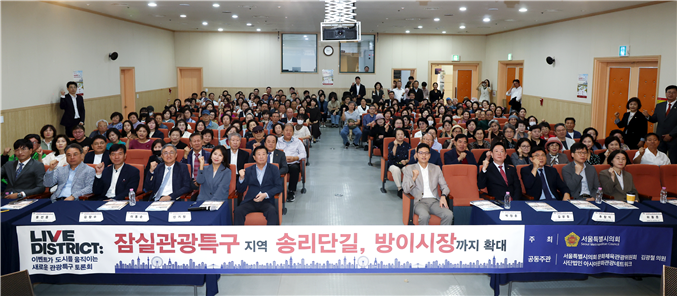
![Prime Minister Kim Min-seok delivers a special lecture on "DJ's Political Theory for Young Politicians" at the Youth Leadership School Workshop hosted by the Kim Dae-jung Political School at the Kim Dae-jung Convention Center in Gwangju on Friday. [Yonhap]](https://wimg.heraldcorp.com/news/cms/2026/06/26/rcv.YNA.20260626.PYH2026062614760001300_P1.jpg)
Prime Minister Kim Min-seok on Friday cautioned against an overheating atmosphere of intraparty competition ahead of the Democratic Party of Korea's national convention, saying criticism of the president is permissible but that the manner and tone of such criticism must not undermine his leadership.
Speaking at a special lecture held as part of the Kim Dae-jung Political School Workshop at the Kim Dae-jung Convention Center in Gwangju, Kim said that criticizing the president with excessive language or attitude — on the grounds that "I can judge better than he can" — "could, in historical terms, amount to something like a rebellion driven by overconfidence."
"We can speak frankly to the president, our supreme leader, and offer our views," he said, "but there are things we must observe when doing so: attitude, language, and mindset." He warned that actions risking "disrupting the overall ranks or undermining collective leadership" would in practice "shake the entire force and its leadership."
Political observers interpreted the remarks as targeting some of the more hardline statements that have emerged during the contest for party leadership ahead of the Democratic Party's August convention. The comments were seen as emphasizing that the convention carries implications beyond a simple leadership election, intersecting with the early governing momentum of the Lee Jae Myung administration.
Kim also called forcefully for a fundamental change in the party's character. "The Democratic Party must transform itself dramatically. If it stays the course, it will be swept away by the times," he said. "It must become a youth-oriented party and overhaul its culture wholesale — including how we conduct internal debates. Why do we use derogatory labels against one another?"
He went on to say that running on a platform of "they're the bad guys" in the next general election or presidential election would be impossible. "We need to present our achievements and appeal sincerely — not 'we'll crush those villains,' but 'we will open a great chapter in history.' Otherwise, consecutive terms in power will be out of reach," he said.
Kim identified solidarity, unity and expansion as the three tasks the Democratic Party must now pursue. "This is a time for a grand coalition built on those three pillars," he said, adding that the upcoming convention "is not a question of who you're aligned with or what faction you belong to." He defined the convention as a forum to debate how to address youth hardship, how to build an alternative to the National Election Commission, and what basic framework should govern a party leading the country.
"If the party finds itself in difficulty because of election results, the right response — as a responsible ruling party supporting the success of the Lee Jae Myung government — is to debate those results on their merits," he said.
Kim also raised the need to strengthen the party's approach to member sovereignty and its one-person-one-vote system. "A Democratic Party with a century-long history and roots should go beyond simply advocating for member sovereignty and one-person-one-vote — it must design and build a system that makes those principles genuinely meaningful," he said.
He urged the party to carry out institutional reform that would continuously guarantee "more information, more debate, more authority and more responsibility" for members — the four conditions he said were necessary for true member sovereignty. His remarks were interpreted as endorsing the direction of the current one-person-one-vote system while calling for stronger deliberative structures and accountability in intraparty decision-making.
Kim also said the party must keep pace with the spirit of the times. "What matters more than whether we as individuals are outstanding is whether we are on the right path of the age," he said. "What the times demand right now is the opening of a golden age of democracy."
He closed by saying that if the party rallies around the president to recover its approval rating, win the next general election and secure consecutive terms in power, "this era — from President Lee's tenure through your generation — will be recorded in history as a golden age."
kwater@heraldcorp.com