
All key domestic travel indicators reverse decline
Trips, nights and spending all rise year on year
Travelers average 6.5 trips and 10.2 nights per year
Regional growth outpaces Greater Seoul
Spending shift confirms broader consumer distribution
![Tourists visit the birch forest in Wondae-ri, Nam-myeon, Inje-gun, Gangwon Province. [Yonhap]](https://wimg.heraldcorp.com/news/cms/2026/06/30/news-p.v1.20260630.1934311b154f4fce8dd29f970ebc7fe2_P1.jpg)
South Korea's domestic tourism market regained momentum last year as the number of trips and total spending both rose from the previous year. Demand shifted notably away from the Greater Seoul area toward regional destinations, with more travelers choosing overnight stays over day trips — a trend that analysts say contributed to local economic vitality.
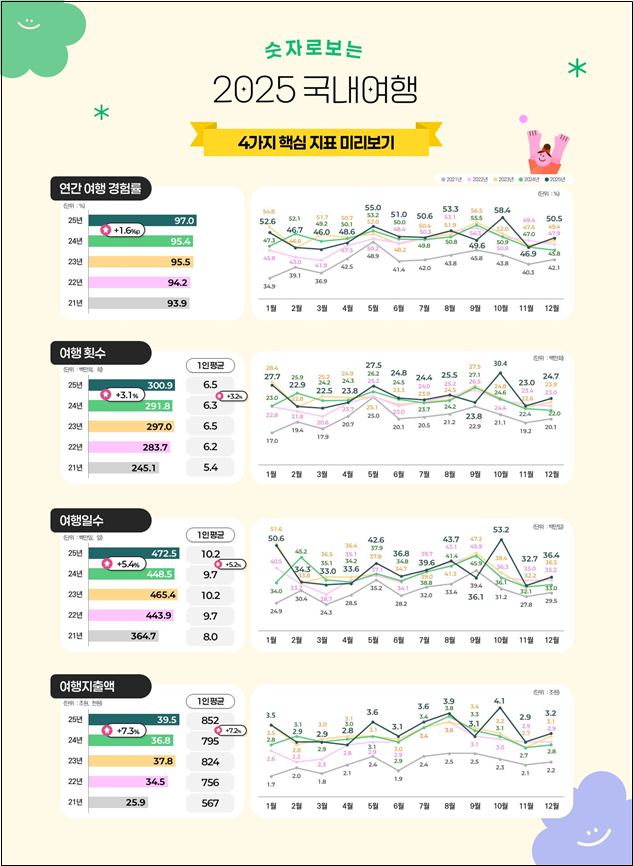
The Ministry of Culture, Sports and Tourism released the results of the 2025 National Travel Survey, conducted jointly with the Korea Culture and Tourism Institute. The government-approved statistical survey polled 4,300 people aged 15 and older each month, reaching 51,600 respondents over the course of the year.
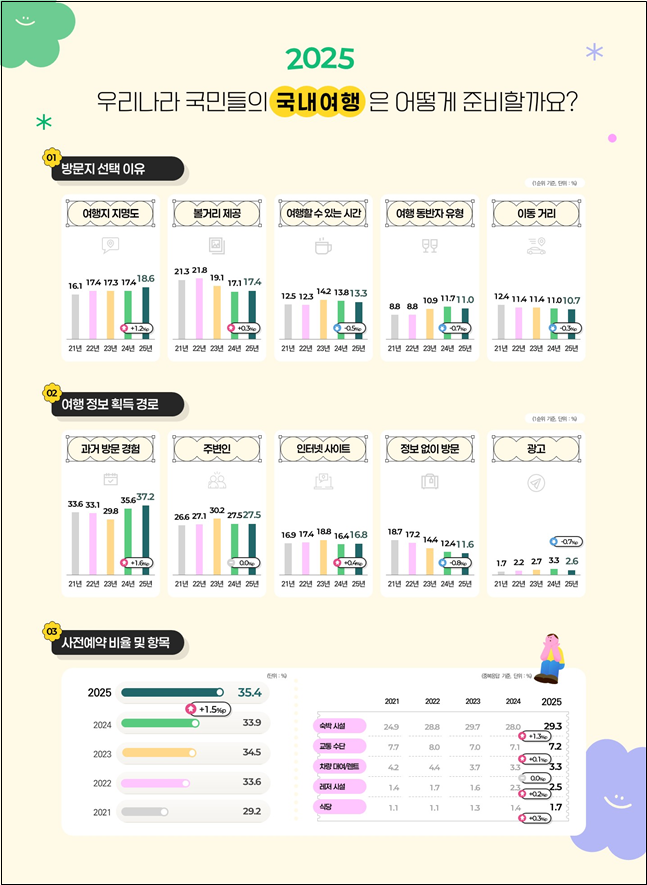
The share of people who took at least one domestic trip reached 97.0 percent, up 1.6 percentage points from the previous year, reversing a prior decline. Total domestic trips came to about 309 million, travel days reached 472.5 million and spending totaled 39.5 trillion won ($25.6 billion) — gains of 3.1 percent, 5.4 percent and 7.3 percent, respectively. All major indicators that had fallen in 2024 turned positive in 2025. On a per-capita basis, South Koreans took an average of 6.5 domestic trips last year, spent 10.2 days traveling and laid out 852,000 won in total.
Growth was particularly pronounced outside the capital region. While travel days in Seoul rose 2.9 percent and in Gyeonggi Province 5.5 percent, Daejeon posted a 20.6 percent increase, Gangwon Province 10.6 percent and North Jeolla Province 9.3 percent. Among all 17 cities and provinces, Daejeon recorded the steepest rise in domestic travel spending — about 551 billion won, up 29.7 percent from the previous year. North Gyeongsang Province (15.9 percent), Gwangju (14.7 percent) and North Chungcheong Province (13.8 percent) also posted strong spending gains, confirming that domestic travel demand is spreading to the regions.
The share of domestic trips involving at least one overnight stay rose 1.3 percentage points, from 40.0 percent in 2024 to 41.3 percent in 2025. The increase signals a growing preference for extended stays that generate more local spending over quick day trips.
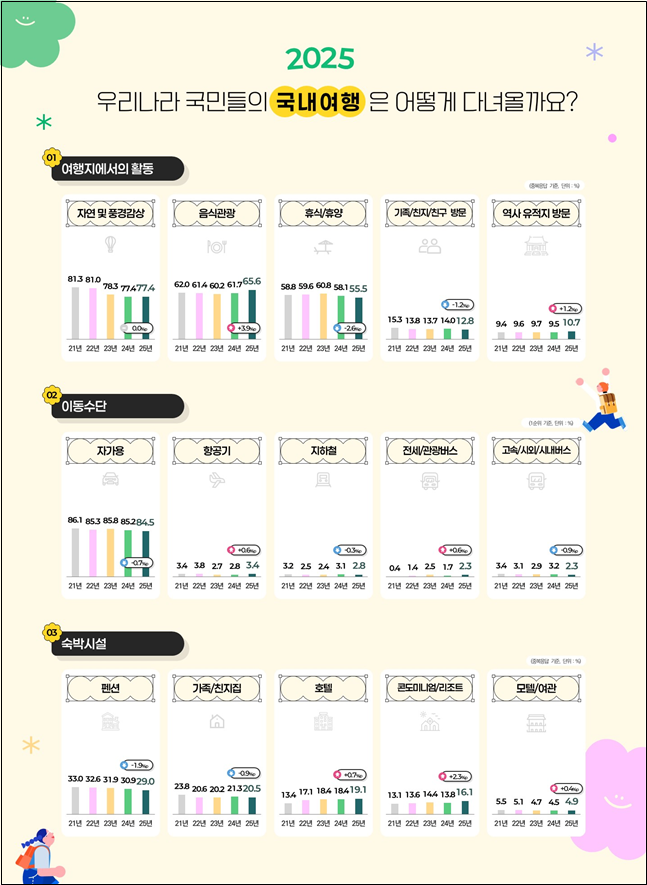
Shifts in transportation modes were also evident. Private cars remained the dominant choice at 84.5 percent of trips, but that share slipped 0.7 percentage points from the previous year. Charter and tour buses and air travel each gained 0.6 percentage points. The ministry attributed the shift in part to a rise in package tour purchases: the share of travelers buying agency products edged up from 2.7 percent in 2024 to 2.8 percent in 2025, while the proportion opting for all-inclusive packages climbed from 76.0 percent to 79.5 percent. Detailed findings are available through the Tourism Knowledge Information System and the Culture Data Center website.
Kang Dong-jin, the ministry's director general for tourism policy, said the results show domestic travel is moving beyond a simple numerical recovery toward a pattern that invigorates regional economies. "We will continue to expand region-based tourism content and infrastructure to sustain the qualitative growth of domestic travel," he said.
terry@heraldcorp.com





