
Funding disclosures obtained for Dongtan, Suji and Giheung
Gap investment funds reach 571 billion won; property-swap capital tops 2.6 trillion won
Dongtan, Giheung and Guri designated as regulated zones and land transaction permit areas
![An aerial view of Dongtan 2 New Town in Hwaseong, Gyeonggi Province. [The Herald Business DB]](https://wimg.heraldcorp.com/news/cms/2026/06/30/news-p.v1.20260629.9c60ace74ced4ee0adb1e7633ba09615_P1.jpg)
Amid the government's move to designate Dongtan, Giheung in Yongin and Guri as regulated zones and land transaction permit areas, an estimated 7.7 trillion won ($5 billion) in leveraged home-buying funds — colloquially known as "yeongkkul," or buying by scraping together every available resource — flowed into the housing markets of Dongtan and the Suji and Giheung districts of Yongin, the so-called semiconductor belt, in the first five months of this year. Funds raised through financial institution loans exceeded 2.5 trillion won, while proceeds from stock sales — buoyed by a domestic market rally — accounted for about 330 billion won. Because Dongtan and Giheung had been unregulated zones where gap investment was permitted, rental deposits on purchased properties were also tapped for as much as 570 billion won.
Dongtan's Jan.–May filings hit 3.24 trillion won — already 80% of full-year 2025 total
According to housing fund-sourcing disclosure filings for Dongtan District in Hwaseong, Suji District and Giheung District in Yongin — obtained Monday through the office of People Power Party lawmaker Kim Jong-yang of the National Assembly's Land, Infrastructure and Transport Committee — total declared amounts for January through May reached 3.24 trillion won for Dongtan, 2.88 trillion won for Suji and 1.55 trillion won for Giheung.
Under current law, fund-sourcing disclosures are mandatory in regulated zones and are also required for purchases of homes priced above 600 million won even in unregulated areas. Suji was already designated a regulated zone and land transaction permit area under the government's Oct. 15 policy package last year. Dongtan and Giheung, where apartment prices have risen sharply, will join Guri as speculative overheating districts and adjustment target areas from Tuesday, and as land transaction permit areas from Sunday.
![An aerial view of apartment complexes in Giheung District, Yongin, Gyeonggi Province. [The Herald Business DB]](https://wimg.heraldcorp.com/news/cms/2026/06/30/ams.V01.photo.HDN.P.20260630.P12026063009352543983810043_P1.jpg)
In Dongtan, where apartment buying surged over the past month or two following bonus settlement announcements at semiconductor giants Samsung Electronics and SK hynix, fund-sourcing filings for January through May have already reached roughly 80 percent of the area's full-year 2025 total of 4.12 trillion won. The concentration of home-buying demand from buyers in their 20s and 30s around Dongtan Station — which offers both shuttle and rail access — is seen as a key driver. Giheung also saw 84 percent of its full-year 2025 figure of 1.85 trillion won flow in within just five months, as the area's unregulated status combined with the semiconductor industry boom to attract buyers.
Ham Young-jin, head of the real estate research lab at Woori Bank, said Dongtan and Giheung had seen prices rise sharply in a short period due to optimism surrounding the semiconductor industry, favorable transport developments including the Greater Seoul Express Railway (GTX), and improved access to Seoul, drawing concentrated investment demand.
Property-swap funds 2.62 trillion won, loans 2.52 trillion won; gap investment reaches 571 billion won
A breakdown of fund-sourcing disclosure items filed by home buyers in the three semiconductor belt areas shows that buyers mobilized virtually every available channel — stocks and cryptocurrency, real estate proceeds, loans, deposits and cash, gifts and inheritances, and company loans and private debt.
The largest single source was proceeds from selling existing homes or land — so-called property-swap funds — at 2.62 trillion won. Dongtan alone accounted for more than 1 trillion won at 1.06 trillion won, and Suji reached 1.03 trillion won. Financial institution loans were the second-largest source at a combined 2.52 trillion won, followed by bank deposits at 1.05 trillion won.
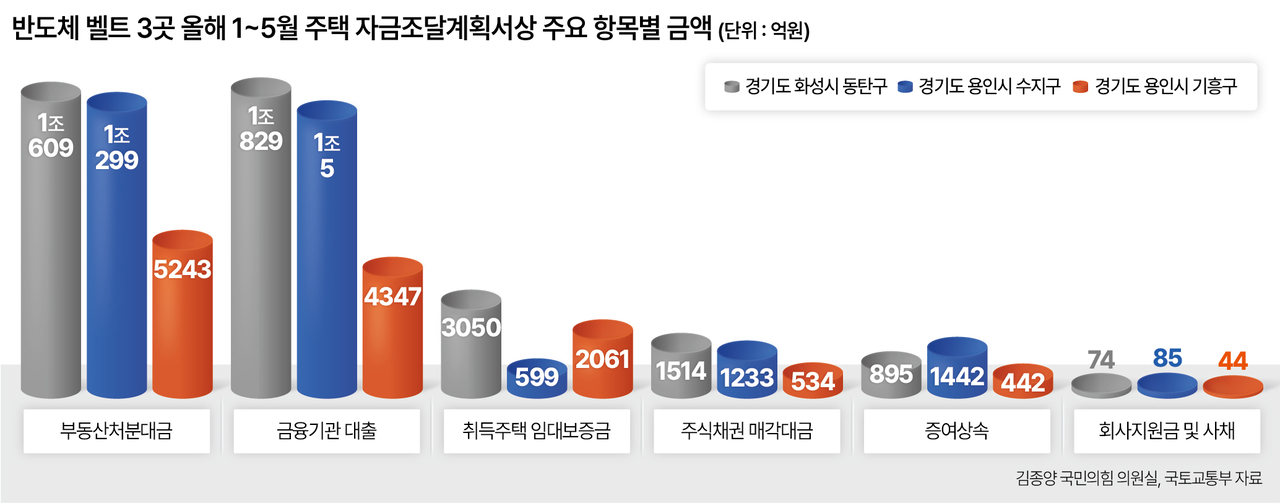
Because Dongtan and Giheung had been exempt from owner-occupancy requirements, gap investment — buying a home with the tenant's deposit covering part of the purchase price — was permitted, and 571 billion won in gap investment funds were used to buy homes in the semiconductor belt this year. Among the three areas, Dongtan recorded the highest amount of rental deposit financing at 305 billion won, followed by Giheung at 206.1 billion won. Suji, already a regulated zone, reported the lowest at 59.9 billion won. Owner-occupancy requirements will apply to Dongtan and Giheung from Tuesday, however, and the use of rental deposits for home purchases is expected to shrink going forward.
Ham said the government appeared to have designated these areas as regulated zones and land transaction permit areas to curb sharp price increases, a surge in transactions and an influx of speculative demand, noting that gap investment and short-term profit-seeking had been the main forces driving activity in these markets.
Proceeds from stock and bond sales flowing into the semiconductor belt housing market reached 328.1 billion won in the first five months of this year. As the Kospi hit new yearly highs led by semiconductor stocks, many investors are believed to have cashed out of equities and moved into real estate. In Dongtan, stock and bond sale proceeds jumped 112 percent from 26.4 billion won in January to 55.9 billion won in May, while Suji saw a 137 percent surge from 17.9 billion won to 42.4 billion won over the same period.
Cryptocurrency sale proceeds, which became mandatory to disclose from Feb. 10, totaled 3.83 billion won across the three areas. Gift and inheritance funds accounted for 277.9 billion won, while company loans and private debt amounted to about 20.2 billion won. Cash and other funds came to 61 billion won.
People Power Party lawmaker Kim Jong-yang criticized the government, saying that areas such as Dongtan — newly designated as land transaction permit zones — had shown a balloon effect ever since they were excluded from the Lee Jae Myung administration's Oct. 15 policy package, and that warnings about the effectiveness and fairness of the regulations had been raised at the time. "Ultimately, half-baked regulations that misread the market made things worse," Kim said. "How long must the public bear the costs of policy failures patched together with belated, piecemeal fixes?"
Kim also argued that the government should move away from a regulation-only approach that fails to bring down home prices while burdening ordinary people, and instead present a supply plan combining public and private sector efforts that end-users can actually feel.
The Ministry of Land, Infrastructure and Transport will designate Dongtan District in Hwaseong, Giheung District in Yongin and Guri — all in Gyeonggi Province — as regulated zones, including speculative overheating districts and adjustment target areas, from Tuesday, following a recent surge in home prices in those areas.
hwshin@heraldcorp.com





