
LTV cap of 40% takes effect Wednesday
Doubts grow over effectiveness of targeted regulations
Semiconductor boom-driven real demand seen as hard to suppress
![A view of Bojeong-dong in Giheung-gu, Yongin, Gyeonggi Province. Dongtan-gu in Hwaseong, Giheung-gu in Yongin and Guri have been newly designated as regulated zones and land transaction permit areas following sharp rises in apartment prices. [Herald DB]](https://wimg.heraldcorp.com/news/cms/2026/06/30/news-p.v1.20260630.657f59ca047849b98ee30adff38d9d79_P1.jpg)
The government has added Dongtan-gu in Hwaseong, Giheung-gu in Yongin and Guri — all in Gyeonggi Province — to its list of regulated zones and land transaction permit areas, following up on the Oct. 15 real estate measures introduced last year. The move aims to curb gap investment and highly leveraged purchases to stabilize the housing market after apartment prices in those areas surged sharply.
But the market is skeptical about whether such targeted, area-specific restrictions can actually stabilize housing prices — particularly since designating all of Seoul and 12 other areas in Gyeonggi Province as regulated zones earlier appeared to trigger a balloon effect that pushed demand into these very neighborhoods. Some analysts warn that the experience of the Moon Jae-in administration, when a series of incremental real estate regulations ultimately fueled a nationwide price surge, could repeat itself.
Dongtan, Giheung, Guri prices soar on positive catalysts — loan limits tighten Wednesday
<style ref="s1">According to the Ministry of Land, Infrastructure and Transport, Dongtan-gu in Hwaseong, Giheung-gu in Yongin and Guri will be designated as speculative overheating districts and adjustment target areas starting Wednesday, capping the loan-to-value ratio at 40 percent for homebuyers without existing properties. From Saturday, the areas will also be designated as land transaction permit zones, requiring buyers to complete the final payment within four months of receiving a land transaction permit and to occupy the property as their primary residence for two years within two months of the transaction.</style>
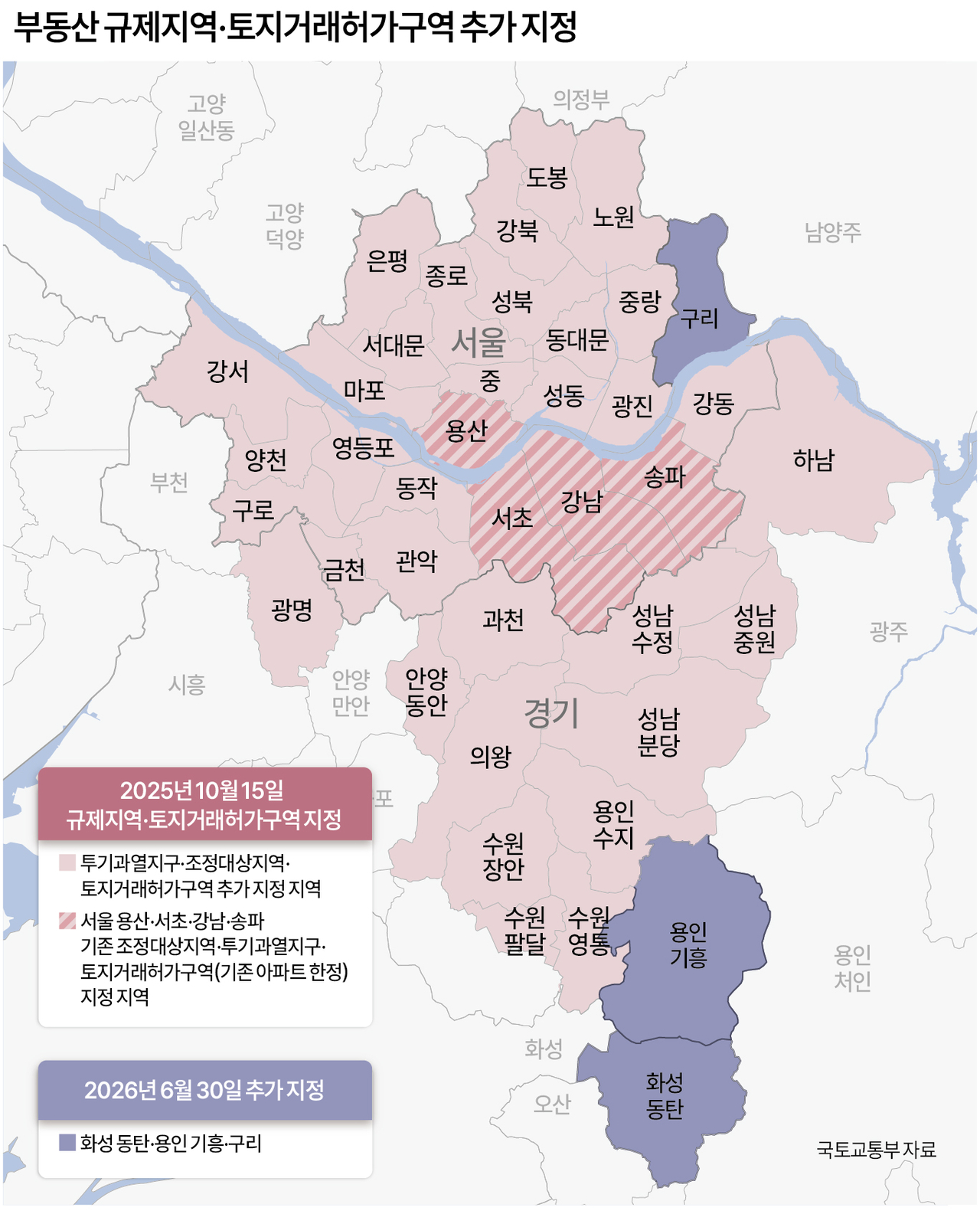
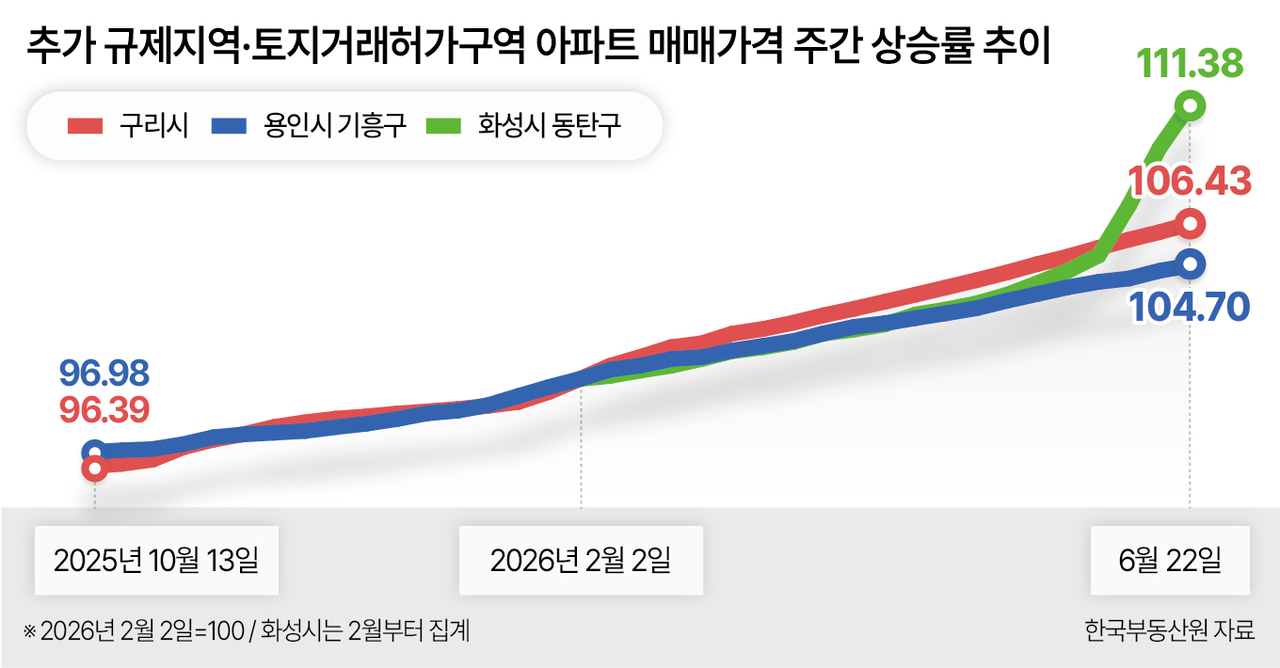
The new designations come in response to a sharp rise in apartment prices across the three areas. All three had been excluded from the Oct. 15 measures last year because prices there had been relatively stable, but they saw accelerating gains in the first half of this year. According to the Korea Real Estate Board's weekly apartment price trend data, the sale price indexes for Dongtan-gu in Hwaseong, Giheung-gu in Yongin and Guri stood at 111.38, 104.7 and 106.43, respectively, as of June 22.
<style ref="s2">Dongtan, which sits adjacent to semiconductor industrial complexes, posted the steepest gain in the country this year, rising 11.38 percent. Guri and Giheung-gu in Yongin climbed 7.87 percent and 6.21 percent, respectively, over the same period.</style>
Dongtan-gu's price surge was driven by a combination of strong tailwinds: hundreds of millions of won in performance bonuses paid out by semiconductor firms including Samsung Electronics and SK hynix, and the expansion of the Greater Seoul Express Rail network. Some speculative gap investment demand also flowed in after the area was excluded from regulated zones in October last year.
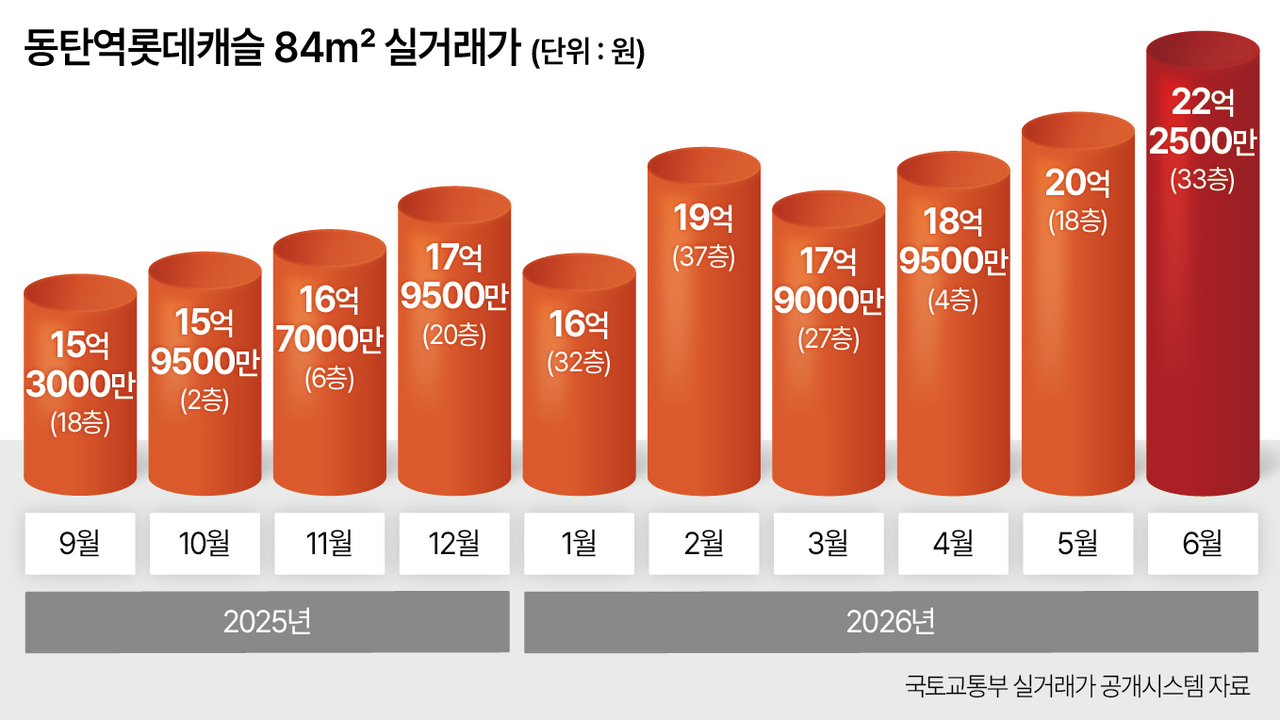
According to the Ministry of Land, Infrastructure and Transport's actual transaction price disclosure system, the 84-square-meter unit at Dongtan Station Lotte Castle — the flagship apartment complex near Dongtan Station — traded at 1.53 billion won ($993,000) as recently as September last year, before the policy announcement. Once the semiconductor boom became apparent early this year, the actual transaction price jumped to 1.9 billion won in February. It then broke through 2 billion won in May before setting a record high of 2.225 billion won in June.
Giheung-gu in Yongin and Guri have also seen consistent price gains since the October policy announcement last year. In Giheung, expectations of job growth tied to the semiconductor industry drove real-demand-led price increases — a 164-square-meter unit at Bojeong-dong Daelim 2nd Complex, which had traded at 1.4 billion won early this year, changed hands at 1.615 billion won. In Guri, flagship 84-square-meter units at complexes such as Hillstate Guri Station crossed the 1.4 billion won mark, buoyed by the area's appeal as a location just 15 minutes from Jamsil.
Will the gov't keep up its targeted regulation approach?
Experts say the triple restrictions could have a short-term stabilizing effect on prices. While stress-based debt service ratio requirements remain unchanged, the immediate reduction of the loan-to-value ratio from 70 percent to 40 percent — combined with a ban on selling properties with existing tenants — is expected to cool demand.
Yang Ji-young, a senior adviser at Shinhan Premier Pathfinder, said designating these areas as regulated zones could dampen buying sentiment and reduce transaction volumes due to tighter lending, tax and apartment subscription regulations. "Right after the restrictions take effect, both buyers and sellers are likely to adopt a wait-and-see stance, and the pace of price increases will probably slow," she said.
![A view of the transit-oriented area around Guri Station. [Herald DB]](https://wimg.heraldcorp.com/news/cms/2026/06/30/news-p.v1.20260630.32b1aeb71dc4423faf19cc40633a7469_P1.jpg)
Critics, however, warn that the government's targeted, area-by-area approach could itself stoke market anxiety. Each time prices rise and the government designates another regulated zone, it may trigger panic buying among end-users rushing to purchase before restrictions reach their preferred neighborhood.
Park Hap-su, an adjunct professor at Konkuk University's Graduate School of Real Estate, said the approach risks turning regulation into something that merely chases the market rather than stabilizing it. <style ref="s3">"Every time demand shifts to a nearby area, the government will designate that area too — and instead of calming the market, regulation could end up merely following it around,"</style> he said. "This will heighten anxiety that additional restrictions could come at any time, and buyers will feel even more rushed because they never know when the area they want to purchase in will be added to the list."
The Moon Jae-in administration's experience offers a cautionary precedent. Over five years from 2017 to 2021, it announced 26 rounds of real estate measures, beginning with the designation of all 25 districts of Seoul, Gwacheon and Sejong as speculative overheating districts, then progressively expanding to include Gwangmyeong, Hanam, Guri, Anyang's Dongan-gu, Daejeon, Cheongju and beyond — yet apartment prices ultimately surged nationwide.
Some analysts also argue that the triple restrictions are unlikely to deliver lasting results, given that the housing market has already shifted toward being driven primarily by genuine end-user demand.
Ham Young-jin, head of the real estate research lab at Woori Bank, said fundamental positive catalysts — the semiconductor boom, transportation network expansion and residential land development — remain intact and cannot be fully neutralized by regulation alone. <style ref="s4">"Prices may pause for breath in the short term, but the underlying strengths of these areas are not going away,"</style> he said.
hss@heraldcorp.com
quq@heraldcorp.com





