About 460,000 hires planned for Q2-Q3; decline narrower than last year
Q1 job openings and hires rise, unfilled vacancy rate drops to 6.5%
'No applicants with required experience' tops reasons for unfilled posts
![A job posting board at a university employment center in Seoul [Yonhap]](https://wimg.heraldcorp.com/news/cms/2026/06/30/rcv.YNA.20260513.PYH2026051308130001301_P1.jpg)
South Korean companies are showing some relief from labor shortages but remain cautious about expanding their workforces. Hiring plans for the second half of this year came in below last year's levels.
According to the Ministry of Employment and Labor's first-half 2026 business labor force survey by occupation, released Tuesday, companies plan to hire about 460,000 workers in the second and third quarters — down 9,000, or 1.8 percent, from the same period last year. The decline is far smaller than the drop of 44,000 recorded the previous year, but companies are still holding back on broader hiring. The number of unfilled positions as of April 1 stood at 467,000, unchanged from a year earlier, while the labor shortage rate edged down 0.1 percentage point to 2.4 percent.
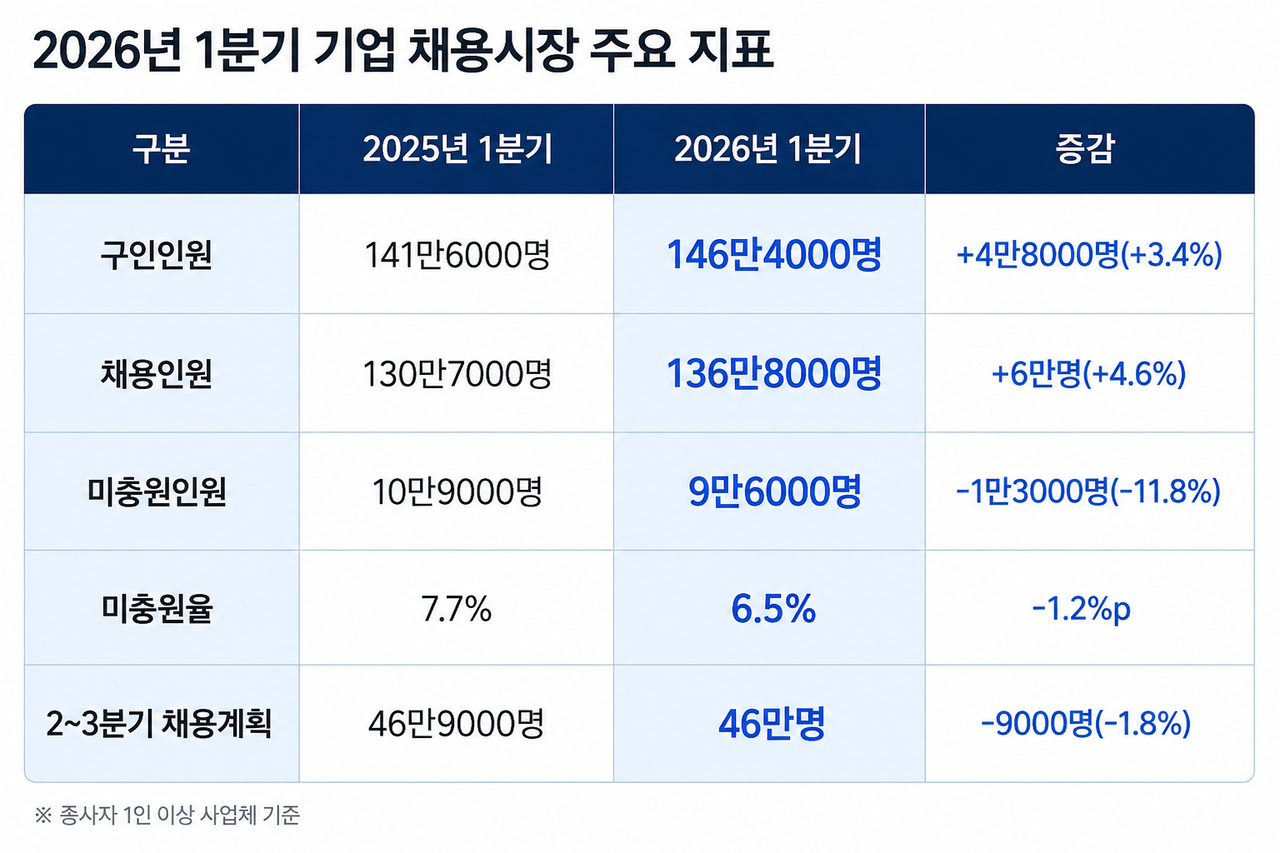
Hiring market conditions improved in the first quarter, with both job openings and hires rising while unfilled vacancies fell. Job openings at businesses with at least one employee reached about 1.464 million, up 48,000, or 3.4 percent, from a year earlier. Hires totaled about 1.368 million, an increase of 60,000, or 4.6 percent. Unfilled vacancies — positions companies actively recruited for but could not fill — fell 13,000, or 11.8 percent, to 96,000, and the unfilled vacancy rate dropped 1.2 percentage points to 6.5 percent from 7.7 percent.
By industry, healthcare and social welfare services and construction led the hiring gains. Job openings and hires in the healthcare and social welfare sector each rose by 26,000, while construction added 12,000 openings and 11,000 hires. Business facility management, business support and rental services also posted increases. By contrast, wholesale and retail trade saw openings fall by 9,000 and hires by 7,000, while accommodation and food services lost 4,000 openings and 5,000 hires. Unfilled vacancies declined most sharply in transportation and warehousing (down 8,000), wholesale and retail trade (down 3,000), and professional, scientific and technology services (down 1,000).
By occupation, care services, construction and mining, and social welfare and religious work recorded the largest hiring gains. Care service openings rose by 23,000 and hires by 21,000, while construction and mining added 15,000 openings and 14,000 hires. Sales and marketing occupations saw openings fall by 18,000 and hires by 16,000, and management, administrative and clerical roles lost 7,000 openings and 5,000 hires.
The top reason companies cited for failing to fill positions was a lack of applicants with the required work experience, accounting for 25.8 percent of responses. That was followed by a shortage of applicants meeting educational or certification requirements (18.5 percent), and a mismatch between the wages and working conditions employers offered and the expectations of job seekers (18.1 percent).
Meanwhile, to address labor shortages, companies most commonly said they would increase recruitment spending or diversify hiring methods (68.4 percent). That was followed by improving working conditions such as raising wages (28.6 percent), making greater use of workers who balance jobs with household responsibilities (17.6 percent), and extending working hours for existing staff (11.5 percent).
fact0514@heraldcorp.com