Exchange of state and public property to expand; nationwide survey of 5.9 million parcels planned over three years
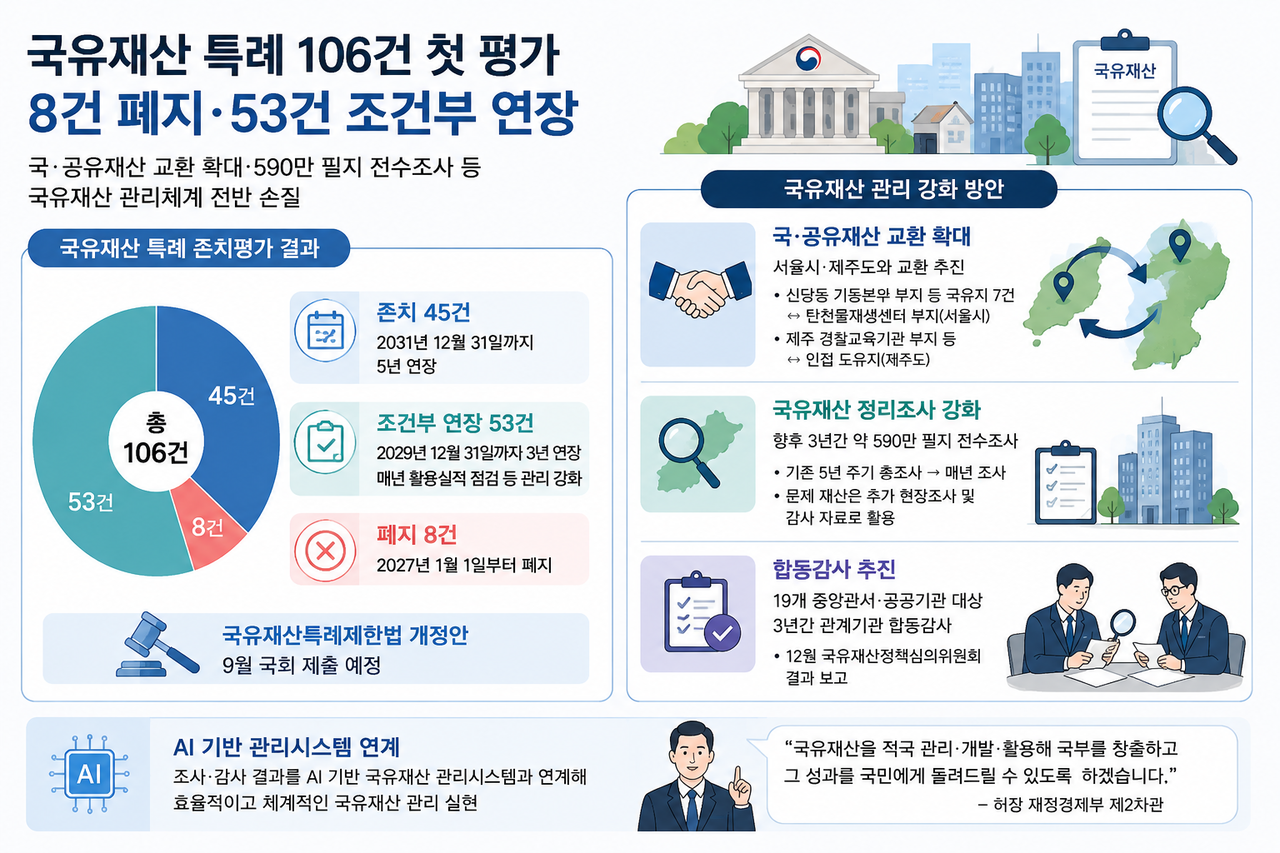
The government has completed its first review of the state property exemption regime, deciding to abolish 8 of 106 exemptions and conditionally extend 53 others. It also plans to expand exchanges of state and public property and conduct a comprehensive survey of roughly 5.9 million state-owned parcels nationwide over the next three years as part of a broader overhaul of the state property management system.
The Ministry of Finance and Economy said Tuesday it reviewed the results of the exemption retention assessment, a state-public property exchange proposal, and a plan for regular state property surveys and audits at the seventh meeting of the Real Estate Subcommittee of the 2026 State Property Policy Deliberation Committee, held at the Government Seoul Complex and chaired by Vice Minister Heo Jang.
The government conducted its first retention assessment this year for 106 state property exemptions set to expire. Of those, 45 were approved for a five-year extension through the end of 2031, while 53 were granted conditional three-year extensions through the end of 2029. Eight exemptions deemed ineffective will be abolished starting Jan. 1, 2027.
Exemptions subject to conditional extension will face tightened management requirements, including annual reviews of how each exemption is being used. The government plans to submit an amendment to the Act on Restriction of Special Cases Concerning State Property to the National Assembly in September, reflecting the committee's decisions.
The government also approved an expansion of state-public property exchanges. With the Seoul Metropolitan Government, it agreed to swap seven state-owned parcels — including the Sindang-dong mobile command base site — for the Tancheon Water Reclamation Center site, aiming to resolve long-standing occupation and use disputes. With Jeju Island, it approved a mutual exchange of provincial and state land to secure a state-owned parcel adjacent to a site earmarked for a new police training facility on the island.
Oversight of state property management will also be significantly strengthened. The government will shift from a comprehensive survey conducted every five years to an annual system, covering all roughly 5.9 million state-owned parcels over the next three years. Properties found to have problems during the survey will be flagged for additional on-site inspections and referred to a state property audit program being introduced this year.
Alongside this, the government will conduct joint audits targeting 19 central government agencies and public institutions that manage large volumes of state property. The Ministry of Finance and Economy will lead a joint audit team with the Public Procurement Service and the Korea Asset Management Corporation to inspect major management bodies, with findings to be reported to the State Property Policy Deliberation Committee in December.
The government plans to link the survey and audit results to an AI-based state property management system currently under development, aiming to improve the efficiency and utilization of state property management.
"We will actively manage, develop and utilize state property — valued at 1,403 trillion won ($910 billion) as of end-2025 — to generate national wealth and return the benefits to the public," Vice Minister Heo said. "We will continue to improve the regime and systems so that state property can be managed more efficiently and developed more proactively."
fact0514@heraldcorp.com