From welfare legislation to policy research, four years focused on residents' lives and Seocho-gu's future
The 9th Seocho-gu Council, which opened July 1, 2022, wraps up four years of legislative activity Tuesday.
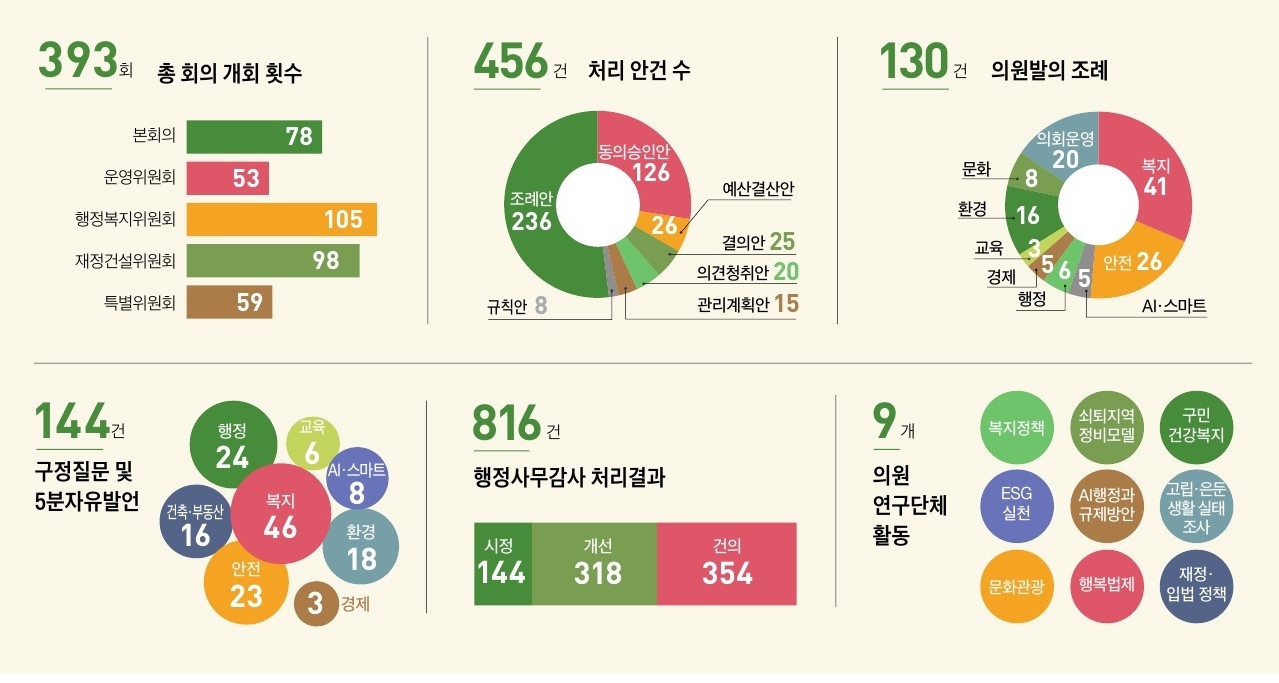
Over its term, the council held 393 meetings and processed 456 agenda items, including reviews of ordinance bills and budget proposals. Of those, 130 were ordinances initiated by council members. The council also issued 816 corrective and improvement directives through administrative audits and on-site visits, driving practical changes that residents could feel in their daily lives.
An AI analysis of the 130 member-initiated ordinances passed over the past four years found that the council's legislative priorities centered on closing gaps in the welfare safety net and building a proactive disaster-preparedness framework.
By subject area, welfare ordinances supporting vulnerable residents led at 41 bills, or 31.5 percent of the total, followed by safety ordinances protecting residents' daily lives at 26 bills, or 20 percent — together forming the council's two main pillars. Council operations accounted for 20 bills (15.4 percent) and environmental legislation for 16 bills (12.3 percent). The remaining bills covered administration (6), AI and smart-city initiatives (5), the economy (5) and education (3), completing a legislative map that spanned virtually every aspect of residents' lives.
The findings show that the 9th Seocho-gu Council's work was fundamentally people-centered — protecting lives and supporting marginalized neighbors. Rather than passively reviewing bills as submitted, the council acted as a policy-driven body that translated residents' needs directly into law.
To strengthen both expertise and practical impact, the council formed lawmaker research groups each year to explore policy alternatives for Seocho-gu's future. The groups refined their work through surveys, roundtables and field visits, and pursued actionable policy proposals by incorporating input from residents and specialists. Their work spanned welfare, the environment, AI and the overhaul of local regulations — all topics closely tied to residents' lives — and laid a solid foundation for the district's continued development.
The research groups active over the past four years were: the Seocho Welfare Policy Research Group and the Seocho-gu Declining-Area Redevelopment Model Research Group (both 2022); the Seocho ESG Practice Research Group and the Seocho Residents' Health and Welfare Research Group (both 2023); the Seocho-gu Social Isolation and Reclusive Lifestyle Survey Research Group, the Seocho AI Administration and Regulation Research Group, and the Seocho Culture and Tourism Research Group (all 2024); and the Seocho-gu Fiscal and Legislative Policy Research Group and the Seocho Happy Legal Framework Reform Research Group (both 2025).
Throughout its term, the Seocho-gu Council kept its focus on residents' daily lives and the district's future, channeling community voices into concrete legislation. From closing gaps in the welfare safety net to building proactive safeguards against climate risks and everyday hazards, and from advancing smart-city ambitions to improving the local environment, the council put an ordinance-backed framework in place wherever residents needed it most. The achievements accumulated over the past four years are expected to remain a strong foundation supporting the stable daily lives of Seocho-gu residents for years to come.
seouldream01@heraldcorp.com