
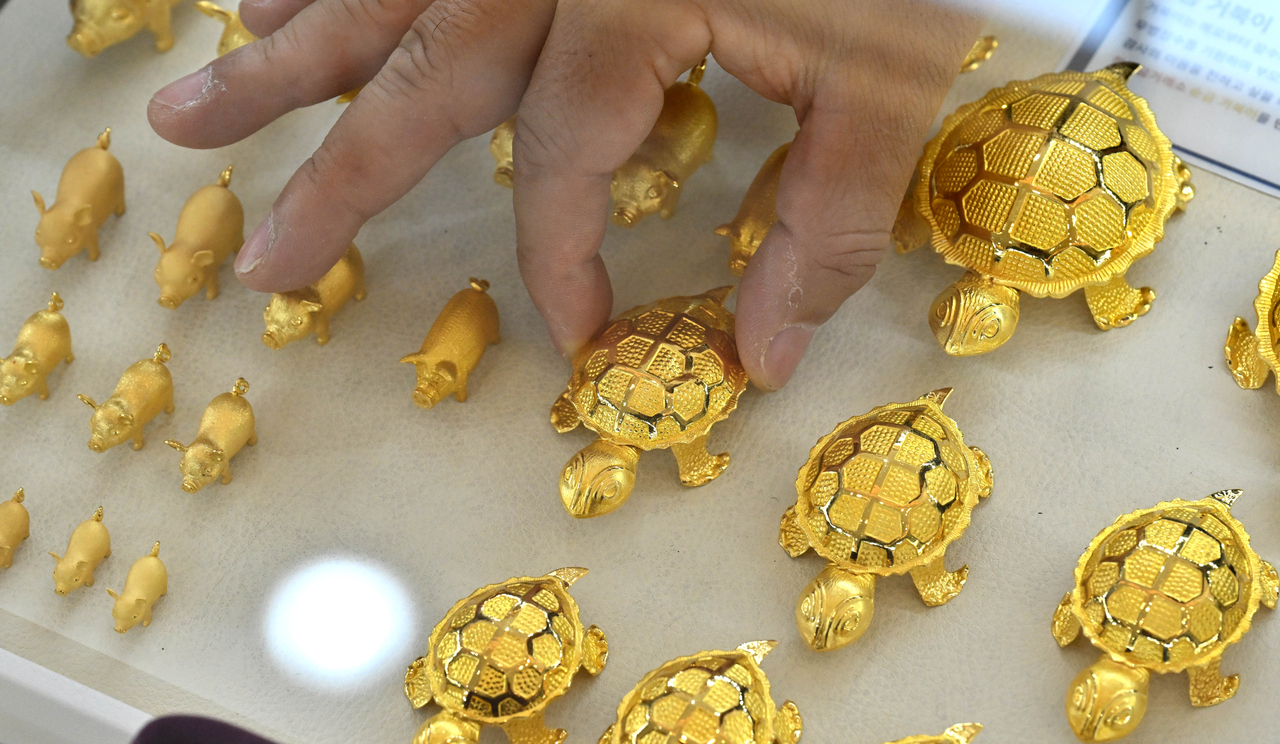
International gold prices have fallen sharply this year, deepening concerns among investors. Retail money has continued to flow out of gold exchange-traded funds amid expectations of interest rate hikes and a stronger dollar.
According to Investing.com, August gold futures on the New York Mercantile Exchange settled at $4,183.10 per ounce on Wednesday local time.
The second-quarter performance was the worst in 13 years. Gold futures fell 13.4 percent during the quarter, the largest quarterly decline since the second quarter of 2013. Spot gold also dropped to as low as $3,943 per ounce during trading on Monday, its lowest level since November last year.
The prospect of interest rate hikes has weighed on gold prices. Gold is a non-interest-bearing asset. When benchmark interest rates rise, the appeal of interest-generating assets such as deposits and bonds increases, reducing demand for gold by comparison.
With inflation concerns mounting on the back of rising oil prices driven by Middle East tensions, Federal Reserve Chair Kevin Warsh has identified price stability as his top priority, prompting markets to begin pricing in the possibility of a rate hike before year-end.
According to the CME FedWatch tool, markets are pricing in two to three rate hikes this year. The probability of a September rate hike is reflected at more than 60 percent.
A shift of investment capital toward growth assets has also been cited as a factor weighing on gold. Money has poured into growth themes such as AI semiconductors and the SpaceX initial public offering, dimming gold's relative appeal.
A stronger dollar has raised the cost of buying gold, and outflows from gold ETFs have continued. According to Korea Exchange data, retail investors net sold 78.1 billion won ($50.3 million) worth of "ACE KRX Gold Spot" from June 2 through Wednesday. They also offloaded 43.6 billion won of "Tiger KRX Gold Spot" and 14.7 billion won of "Kodex Gold Active."
However, signs of a rebound have emerged recently. On Wednesday, international gold prices broke a two-day losing streak, rising 0.9 percent during trading to around $4,066 per ounce.
Markets identify the Fed's monetary policy as the biggest variable for gold prices going forward.
The latest rebound was also partly driven by an easing of rate-hike concerns after Fed Chair Warsh delivered remarks at a European Central Bank forum in Portugal on Tuesday that were less hawkish than markets had anticipated.
Experts say factors supporting a price floor for gold also exist. Central banks around the world have been consistently expanding their gold holdings as a hedge against geopolitical risk, which could draw buyers near the $3,900-per-ounce level.
Global investment bank UBS said it "sees limited near-term probability of a Fed rate hike and expects the Fed's policy rate to ultimately move lower," adding that it "maintains a positive medium- to long-term outlook on gold prices."
moon@heraldcorp.com





