
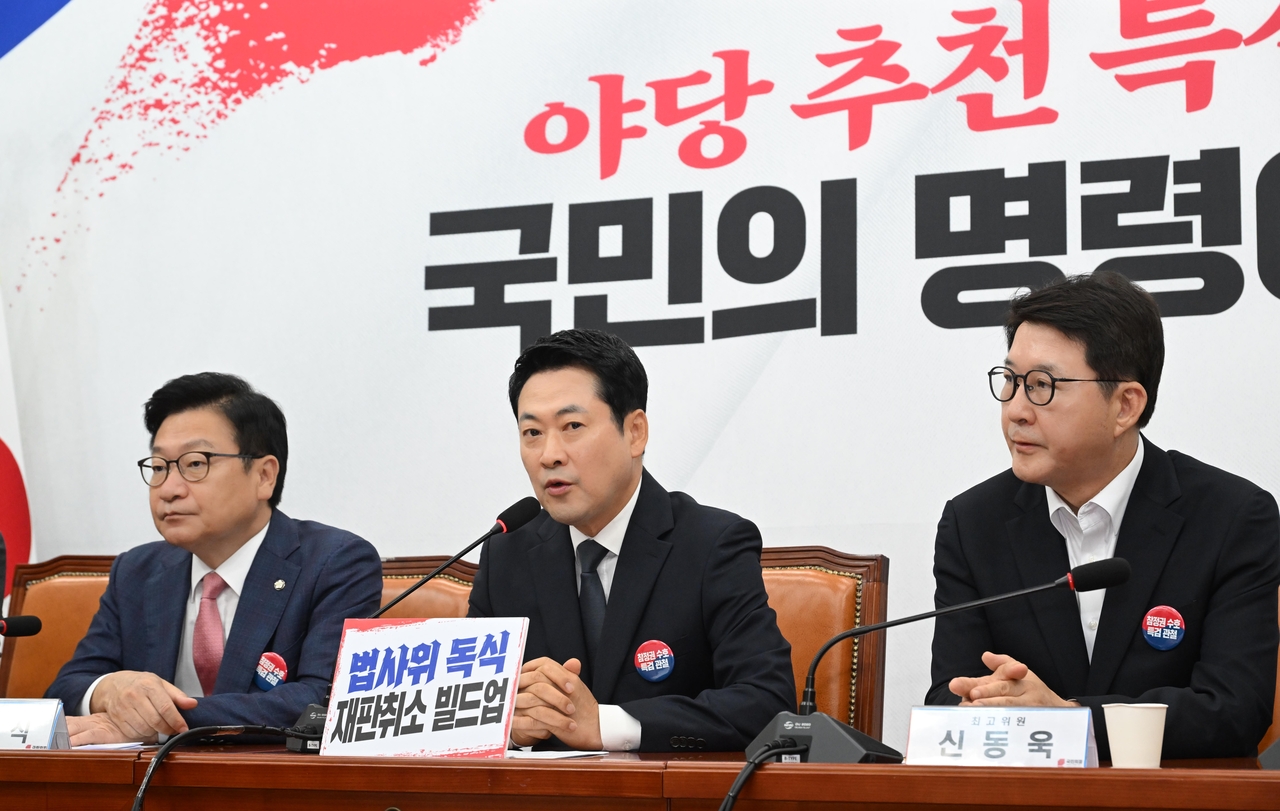
People Power Party leader Jang Dong-hyeok on Monday called the amended Network Act a tool to silence critics ahead of the withdrawal of charges against President Lee Jae-myung, saying it would amount to the "completion of Lee Jae-myung's dictatorship."
Speaking at a supreme council meeting at the National Assembly, Jang said the amended law — which he dubbed the "gag act" — takes effect Tuesday. "It will ultimately silence every citizen, and comments opposing Lee Jae-myung will disappear entirely from the internet," he said.
Jang said the law allows the government to slap a "fake news" label on content at will, triggering fines of up to 1 billion won ($649,000). "Judging by how the Lee Jae-myung administration has behaved, arbitrarily labeling things as fake news would be nothing to them," he said.
Jang and other supreme council members entered the meeting room wearing black masks, saying they did so "to raise awareness of the injustice of this law." Jang said the PPP would push to amend the Network Act again to protect citizens' freedoms and pursue what he called a proper prosecutorial reform plan.
On the Democratic Party of Korea's announcement that it plans to introduce a special prosecutor bill using a third-party nomination model, Jang said it was the Democratic Party that had brought the National Election Commission to its current state. "The special prosecutor the public wants is one nominated by the opposition, with an unlimited scope of investigation," he said. "Only then can the public trust the results. Accept a proper 'people's special prosecutor' immediately."
Jang also pushed back on Democratic Party claims that excluding it from the special prosecutor nomination process was absurd. "Have they forgotten how many times they pushed through special prosecutors that excluded the PPP?" he said, adding that if the Democratic Party persisted with what he called a "bed special prosecutor," it would only accelerate the administration's downfall.
PPP floor leader Jeong Jeom-sik also urged the Democratic Party to accept an opposition-nominated special prosecutor, saying the party's dismissal of that demand as "sophistry" was itself unreasonable.
Jeong said the scope of any special prosecutor investigation must include not only the National Election Commission but also the Ministry of Interior and Safety, which oversees election support operations. He named acting NEC chairman Wi Cheol-hwan — whom he called "the president's dining companion" — as the top investigative target, and argued that the Democratic Party must be excluded from the nomination process under the principle of barring interested parties.
mp1256@heraldcorp.com





