Defense, defense industry and AI experts warned Monday that South Korea must go beyond buying foreign platforms and secure its own battlefield operating systems and software stacks to survive in an era of AI-driven warfare.
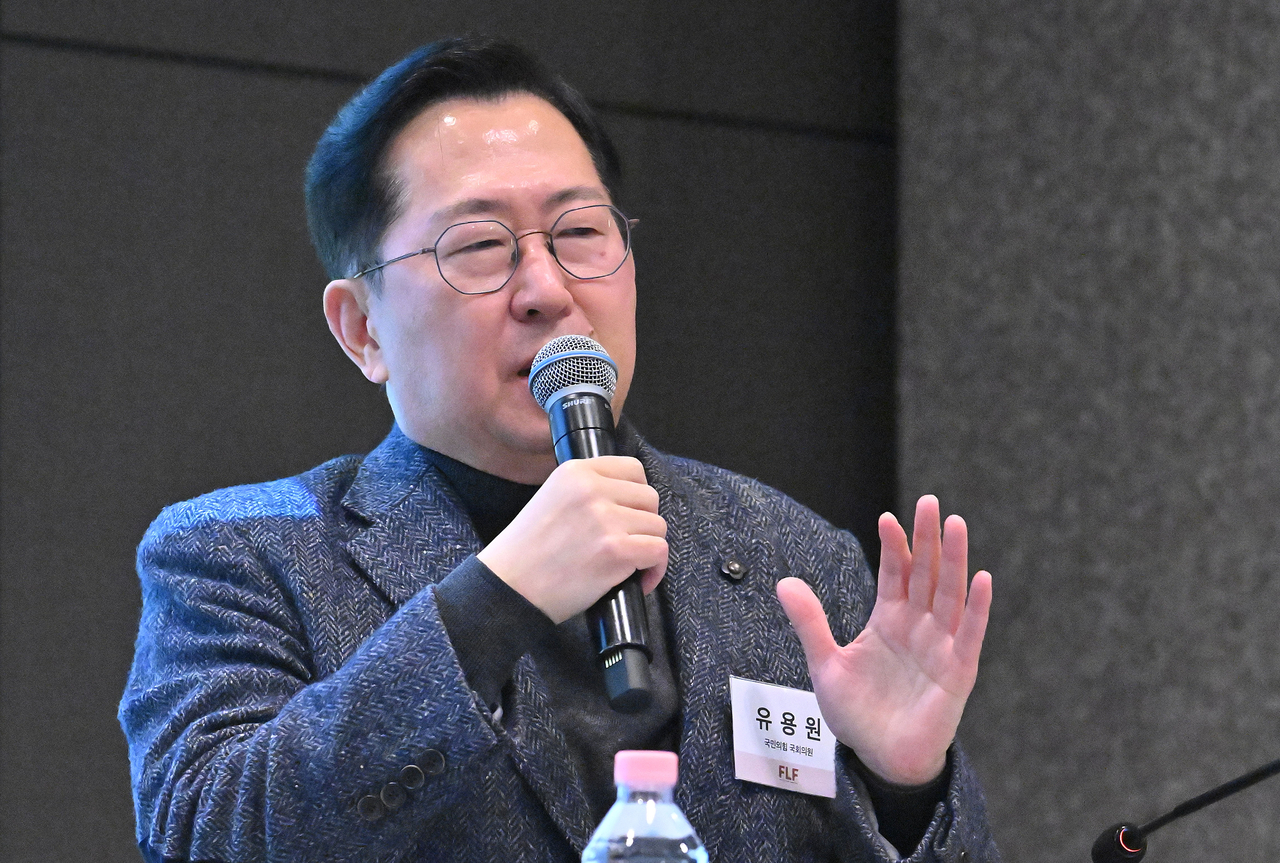
People Power Party lawmaker Yoo Yong-won hosted the defense AI conference "AWC: AI WAR 2026 — The Battlefield Has Become Reality: South Korea's Defense AI Golden Hour" at the National Assembly Members' Office Building on Monday.
The event brought together global defense AI companies including Shield AI and Anduril, along with domestic defense industry players and academic experts, to discuss how AI is reshaping future battlefields and how South Korea can strengthen its defense AI strategy and competitiveness.
Participants from Shield AI, Hanwha Aerospace, MakinaRocks and LIG D&A shared a common message: the decisive factor in AI warfare is not the weapon itself but autonomy, low-cost mass production and the battlefield operating system.
Companies at the conference said that unless South Korea moves beyond simply purchasing platforms and finished products to securing its own AI warfare operating system and software stack, strategic dependence will be difficult to avoid.
With a high-intensity conflict environment in the 2030s in mind, they argued that falling behind in AI warfare is a real risk unless defense budgets, defense industry development, data, power and semiconductor policy are integrated into a single national security strategy now.
"We must shift from a hardware-centered defense industry to an intelligent defense industry grounded in AI and software, and build a defense AI ecosystem where innovative technologies — domestic and foreign — can be rapidly applied to the defense sector," Yoo said.
Shield AI, the world's third-largest private defense technology company, presented its experience deploying an "AI pilot" across more than 30 types of unmanned systems — including drones, fighter jets and helicopters — powered by its autonomous flight software Hivemind.
The company highlighted its use of the long-range vertical takeoff and landing drone V-BAT in Ukraine to conduct intelligence, surveillance, reconnaissance and targeting missions as well as strike operations in GPS- and communications-denied environments. It also noted that Hivemind has been selected for the US Air Force's next-generation collaborative combat aircraft program.
"We are already flying fighter jets piloted by AI at an operationally ready level," said Eugene Choi, Shield AI's Korea country manager. "AI pilots will go beyond assisting human pilots to become the battlefield standard for high-risk missions." The company's concept for the VTOL-based AI combat aircraft X-BAT envisions delivering strike capability equivalent to that of the F-35A — which relies heavily on runways — at far lower cost and from dispersed forward positions.
Hanwha Aerospace argued for a structural shift away from a high-cost, precision-asset-heavy air power model toward a layered combination of expendable, reusable and small platforms.
"We need to move away from the era of holding the line with a handful of premium weapons and start thinking about how to design forces we can afford to lose alongside those we must protect," said Kang Dong-gwan, head of Hanwha Aerospace's unmanned aerial vehicle project team. He called for South Korea to formally pursue the introduction of Korean-style air-launched effects within the Army's aviation forces and joint command, control, communications, computers and intelligence systems, adding that there is significant room to design a homegrown K-CCA — a Korean collaborative combat aircraft — while cooperating with US programs at the same time.
AI infrastructure company MakinaRocks framed defense AI not as a model or chatbot problem but as an infrastructure problem.
The company presented AI as a "five-layer cake" structure — energy (L1), chips (L2), platform (L3), model (L4) and application (L5) — and said South Korea must develop not only applications and models but also a domestic AI operating system and on-premises operational capabilities to achieve strategic autonomy.
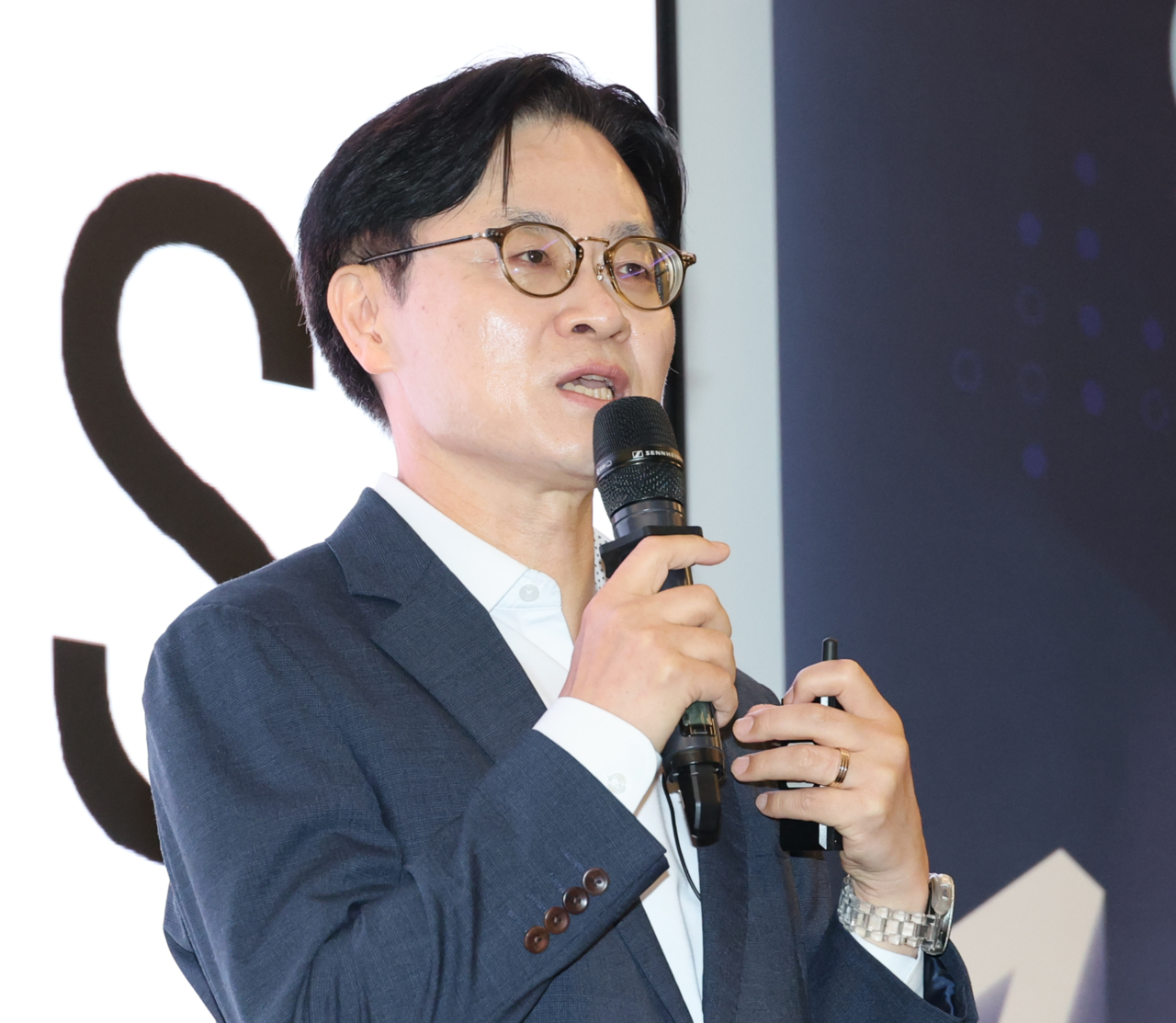
"South Korea's L5 applications and L4 models are growing fast, but strategic investment and policy vision for L2 chips, L3 platforms and L1 energy infrastructure remain weak," said Kim Min-seong, head of MakinaRocks' defense business division.
Kim said AI is "not just a matter of models and apps but an operational OS-level challenge that requires integrated management of data, security, operating systems and power."
LIG D&A unveiled its "UxV AI Kit" — a unified system linking unmanned surface vessels, drones and unmanned vehicles — along with an AI-based unmanned command and control roadmap. The company plans to connect sensors, command and control, C4I systems and weapons into a single stack, with AI assisting a decision-making and combat execution framework loop to enable multi-layered surveillance and response in complex battlefield environments such as those near the Northern Limit Line.
"We are applying an agile defense development model that rapidly cycles through prototyping, optimization, early fielding and export in four-month sprints within a hybrid live-virtual environment," said Cho Gyu-tae, head of LIG D&A's AI Lab. "The software and AI development culture in defense must shift from slow specification-driven projects to fast experimentation and iteration."
rimsclub@heraldcorp.com