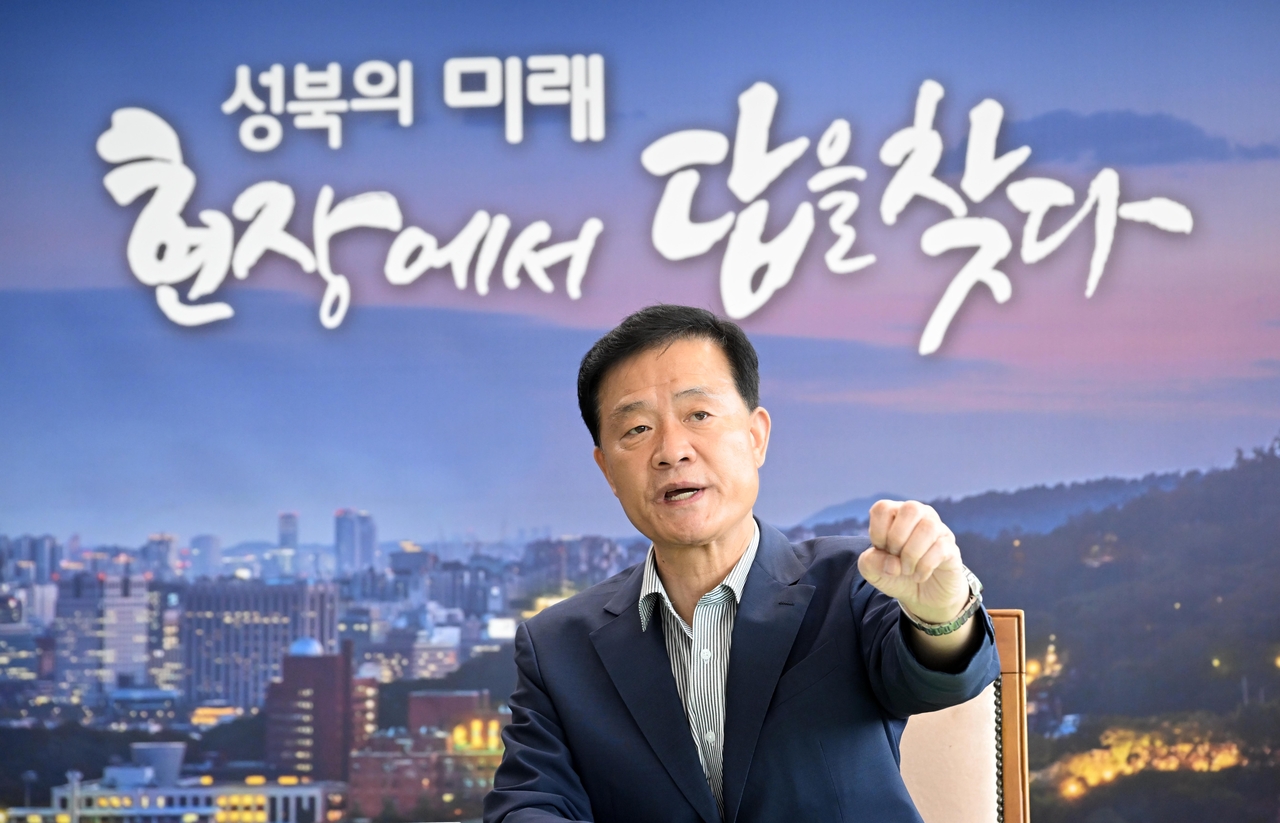
"I was genuinely worried that seeking a third term might come across as overly ambitious — it weighed on me heavily. I intend to repay the residents who chose me again with real results."
Lee Seung-ro, who became the first three-term district mayor in Seongbuk-gu's history following the June 3 local elections, said he feels the weight of that title far more than any pride in it. He acknowledged that residents' expectations of a three-term mayor would be correspondingly high, and that the only way to meet them was through tangible achievements — as if he had taken on an enormous assignment.
The Herald Business sat down with Lee at his office in the Seongbuk-gu district hall on May 24 to hear his plans for the ninth term of elected local government. Lee said he would push to accelerate all 138 ongoing redevelopment and reconstruction projects in the district while working to secure essential infrastructure for residents. He also pledged to break ground on the Gangbuk Crosstown Line before his term ends. He promised to change residents' daily lives by expanding the authority of basic local governments, which is currently limited in areas such as urban renewal projects and community bus route adjustments. The following is an edited transcript of the interview.
— What are your thoughts on winning a third term?
"Becoming the first three-term district mayor in Seongbuk-gu's history is a great personal honor, but I see it as residents telling me to see through the projects now under way for Seongbuk's future and deliver results. Looking back, the past eight years were not easy. Throughout that time, the answers were always found on the ground. Through the on-site district mayor's office, more than 20,000 resident suggestions and complaints were turned into policy. I believe this outcome reflects residents' recognition of our communication with the community, our field-centered administration, and the value they found in eight years of results. A third term is not a glory — it is the beginning of a greater responsibility. For the next four years, I will be a district mayor who goes to the scene first, listens to residents' voices first, and takes responsibility for Seongbuk's future to the very end, so that the changes we bring enrich residents' everyday lives."
— How does the ninth term differ from the seventh and eighth?
"If the seventh and eighth terms were about laying the groundwork and completing the roadmap, the ninth term must be the period when that change bears concrete fruit in residents' lives. During the eighth term, Seongbuk put redevelopment and reconstruction projects on a full track, laid the foundation for reviving the Dongbuk Line and the Gangbuk Crosstown Line, improved Seongbuk Stream, expanded everyday social infrastructure, built a foundation for a cultural city, and established a tight care network — all of which transformed the character of the district. The ninth term will be the stage where Seongbuk residents feel the results of that change. Redevelopment and reconstruction must translate not just into completed projects but into better residential and living environments; transportation policy must translate into shorter commutes. A cultural city must go beyond festivals and events to energize the local economy and neighborhood commerce, and welfare must go beyond expanded support to deliver stability and happiness in people's lives. Ultimately, the defining word for the ninth term is 'completion.' If the past eight years grew Seongbuk's potential, the next four years will be the time to turn that potential into reality."
— What is your top priority after taking office?
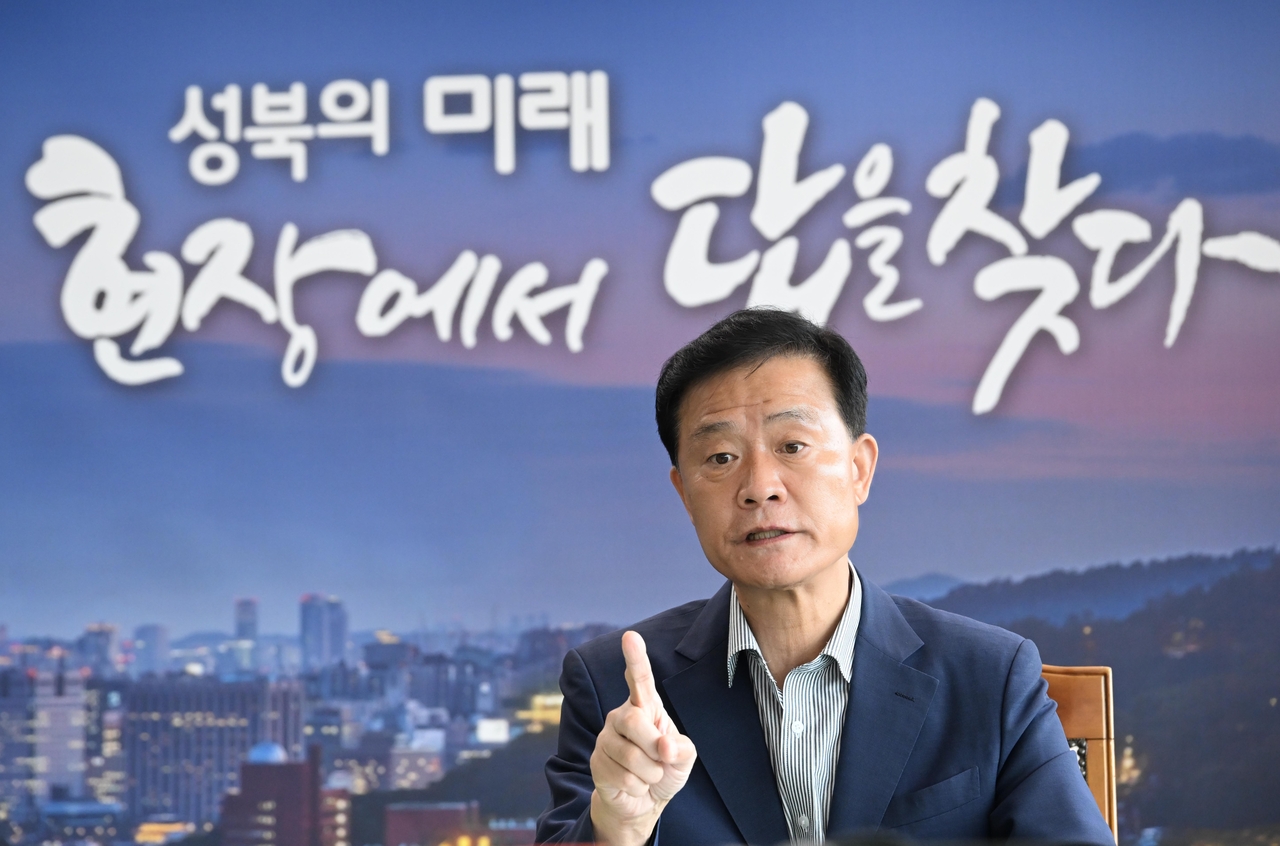
"First, successfully completing Seongbuk's urban transition. Seongbuk is currently carrying out more redevelopment and reconstruction projects than any other district in the country as it shapes the city's future. But the authority of basic local governments over urban renewal projects and bus routes is far too restricted. In the ninth term, I will work with the Seoul Metropolitan Government to expand the authority of basic local governments, cut unnecessary procedures, and speed up projects. At the same time, I will not neglect using public land secured through development contributions to expand the everyday infrastructure residents need — libraries, playgrounds, child-care centers, welfare centers and the like."
Lee was elected the new chair of the Seoul Special Metropolitan City District Mayors' Council at its first general assembly of the ninth term's inaugural year, held at PJ Hotel in Jung-gu, Seoul, on June 7. He is expected to press the Seoul Metropolitan Government — where Mayor Oh Se-hoon won a fifth term — strongly for an expansion of autonomous district authority. The council, established in 1995, is the consultative body of Seoul's 25 autonomous district mayors, and its chair serves as the representative channel for negotiations with the city government and the central government.
— The Gangbuk Crosstown Line project fell through last year. What is your plan?
"The Gangbuk Crosstown Line is a long-cherished project for residents of Seoul's northeastern districts and a core initiative that must be pursued for balanced development across the city. We can no longer leave unaddressed a reality in which travel times differ by nearly an hour depending on whether the line exists or not. I will concentrate every administrative and political resource at my disposal to ensure this results in the visible achievement of breaking ground before my term ends. I will also conduct a comprehensive review of the transportation network within Seongbuk-gu. In particular, because most of the authority over community bus routes and stop adjustments rests with the Seoul Metropolitan Government, basic local governments — which are closest to residents and best positioned to identify their inconveniences on the ground — face real limitations in responding quickly."
— What other priorities are you planning to focus on?
"I will invest in people and transform quality of life. I want to ensure that residents anywhere in Seongbuk can enjoy a comparable level of culture, education, welfare and leisure. Through a public postpartum care center and a tight care network, I will create an environment where parents can raise children with peace of mind. I will expand startup and employment support linked to universities, as well as a foundation for youth activities, to build a city where young people want to stay and put down roots. For senior residents, I will realize an age-friendly city where housing, health, care and leisure are all within reach, through a 'Seongbuk-style age-friendly living environment improvement plan.'"
ikson@heraldcorp.com