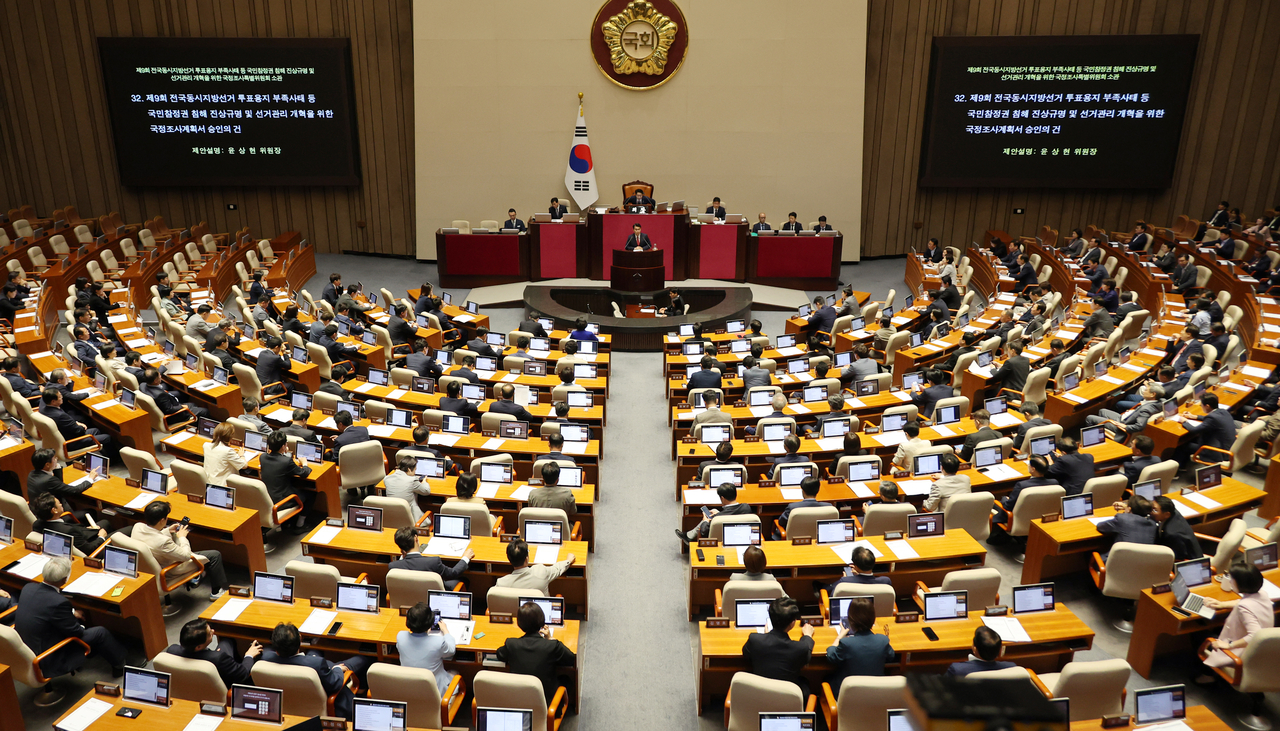
The ruling and opposition parties have failed to agree on committee assignments for the second half of the 22nd National Assembly for more than a month, prolonging a legislative vacuum. With key standing committees operating at half capacity, discussions on livelihood and economic bills have ground to a halt, raising fears in political circles that the Assembly may be on track to surpass the record set by the 14th National Assembly — the longest delayed session formation in South Korean history.
As of Wednesday, 34 days have passed since the second-half session opened June 5, yet the Democratic Party of Korea and the People Power Party have still not reached a final agreement on committee assignments. Negotiations have stalled over the politically charged question of who chairs the National Assembly's Legislation and Judiciary Committee, with the two sides at an impasse.
The Democratic Party earlier unilaterally appointed chairs for 11 standing committees, including the judiciary panel, while the People Power Party has refused to fill the remaining chairmanships and is boycotting all standing committee activities. The PPP argues that because the Assembly Speaker — who holds the authority to convene plenary sessions — is a Democratic Party member, the main opposition party should chair the judiciary committee to check the ruling party.
The PPP has yet to put forward a clear response, whether in the form of a negotiating deadline or a concrete counteroffer. PPP floor leader Jeong Jeom-sik said Wednesday, in an appearance on the Maeil Sinmun YouTube channel, that he was considering "convening a senior lawmakers' meeting to hear the views of senior members" on next steps. He drew a line against calls from some within the party for a mass resignation of Assembly seats, citing "questions of practical feasibility."
The longest delay in session formation on record was during the first half of the 14th National Assembly, which took 125 days after opening before committees were constituted. If the current deadlock continues, the 22nd Assembly could earn the same ignominious distinction.
The prolonged standoff is also disrupting standing committee operations. On Tuesday, the Finance and Economy Planning Committee held its first departmental briefings with Democratic Party members only. Five committees chaired by the Democratic Party — including the judiciary, political affairs, science and technology and broadcasting, and national defense panels, along with the finance committee — have already held their inaugural meetings. The Democratic Party plans to convene the first meetings of the remaining six standing committees on its own in the near future and push through pending agenda items.
With the main opposition PPP absent, the Assembly's half-functioning status is drawing criticism. Livelihood and economic bills that require joint deliberation by both parties are not being properly discussed. Even bills that have already cleared committee review and are awaiting only a plenary vote remain blocked.
According to the National Assembly's bill information system, 69 items are currently pending before the plenary. Of those, 59 were referred to the floor with bipartisan agreement. Bills pending before the plenary are typically those that have completed standing committee review and require only a full Assembly vote to pass.
Han Byung-do, acting Democratic Party leader and floor leader, said at a Supreme Council meeting Wednesday that "a significant number of the 59 bills now before the plenary have already cleared standing committee and judiciary committee review without major disputes" and that "all of them are bills that must be passed for the safety, livelihoods and economy of the people."
He then criticized the PPP, saying, "Can the People Power Party explain to the public exactly why it is blocking even these bills?" and adding, "No matter how much the PPP obstructs, it cannot stop the clock of the National Assembly. The clock of people's livelihoods will not wait."
thanks@heraldcorp.com