![Aluminum awaits loading at the Port of Rotterdam in the Netherlands. [Getty Images]](https://wimg.heraldcorp.com/news/cms/2026/07/09/news-p.v1.20260709.a6dad135b4c64829beb8c6851b4a1742_P1.jpg)
Aluminum prices, which surged after the outbreak of the Iran war, have tumbled back to pre-war levels. The MOU signed by the United States and Iran to end the war proved the decisive trigger for the drop, and a drive to boost production in Asia has helped the market shed its supply chain risks tied to the Middle East. Although tensions in the region remain elevated amid recent exchanges of airstrikes between the two sides, expectations that neither wants a prolonged conflict have kept downward pressure on prices intact.
The Nikkei reported that the three-month aluminum futures contract on the London Metal Exchange — the global benchmark — briefly fell to $3,040 per metric ton on Thursday, retreating to levels seen before the Iran war broke out at $3,150. Prices have remained weak since, standing at $3,149 as of Wednesday local time, down 17 percent from their peak of $3,787.50.
The swift return to pre-war levels is notable given how sharply prices had risen during the conflict. Aluminum is one of the non-ferrous metals most sensitive to Middle East conditions, as the region accounts for a significant share of global production — roughly 10 percent of the world's total output last year.
The war deepened the aluminum supply crunch and drove prices sharply higher. The closure of the Strait of Hormuz from March onward cut off exports of Middle Eastern aluminum, while Iranian strikes on smelters in the United Arab Emirates and Bahrain reduced production capacity, tightening supply further. According to the International Aluminium Institute, aluminum output from Gulf Cooperation Council countries — including the UAE and Qatar — fell 35 percent in May compared with the same month last year.
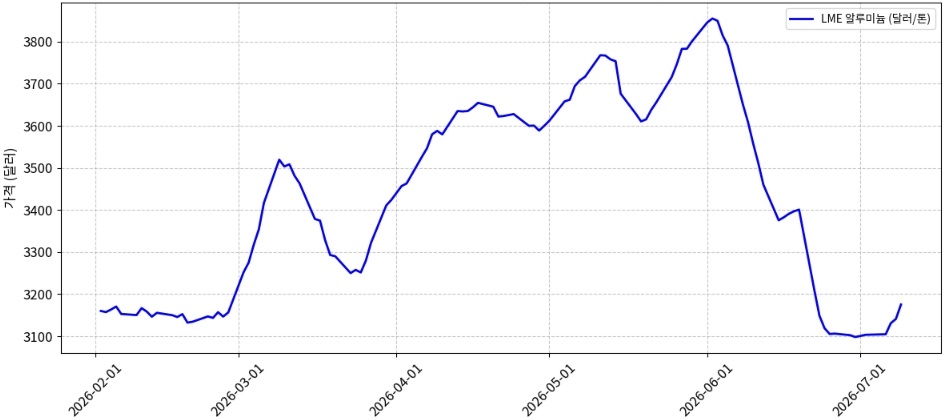
The turning point came when the United States and Iran signed an MOU to end the war. Nomura Kazutomo, a director at Mizuho Bank, told the Nikkei that the MOU — which included an agreement to reopen the Strait of Hormuz — led to a visible increase in oil tanker transits through the strait and fueled expectations that Middle Eastern aluminum supply would normalize. He said sentiment alone was enough to stabilize prices quickly, regardless of whether smelters had actually resumed operations.
Although recent exchanges of airstrikes between the two countries have stalled peace negotiations, the market expects aluminum prices to keep falling. Nomura said neither country appears to want a prolonged fight, and that expectations of further progress in talks remain intact.
A growing sense of urgency about over-reliance on the Middle East has also spurred production increases outside the region, particularly in Asia, lending further support to the outlook for sustained price stability. The Nikkei highlighted Indonesia as playing a central role in driving the expansion of aluminum production across Asia.
Indonesia is accelerating its strategy of processing its abundant mineral resources domestically to capture more added value, and is pushing to expand smelter output. The country plans to bring a large smelter online this year, lifting production to around 1.64 million metric tons. British research firm CRU projects that Indonesia's aluminum output target would represent about 2 percent of global production this year, with capacity continuing to grow and potentially reaching around 4.7 million metric tons by 2030.
Debriefing: The Herald Business international desk breaks down the untold stories behind the hottest global issues. Leave your questions in the comments — we want to hear from you.
kate01@heraldcorp.com