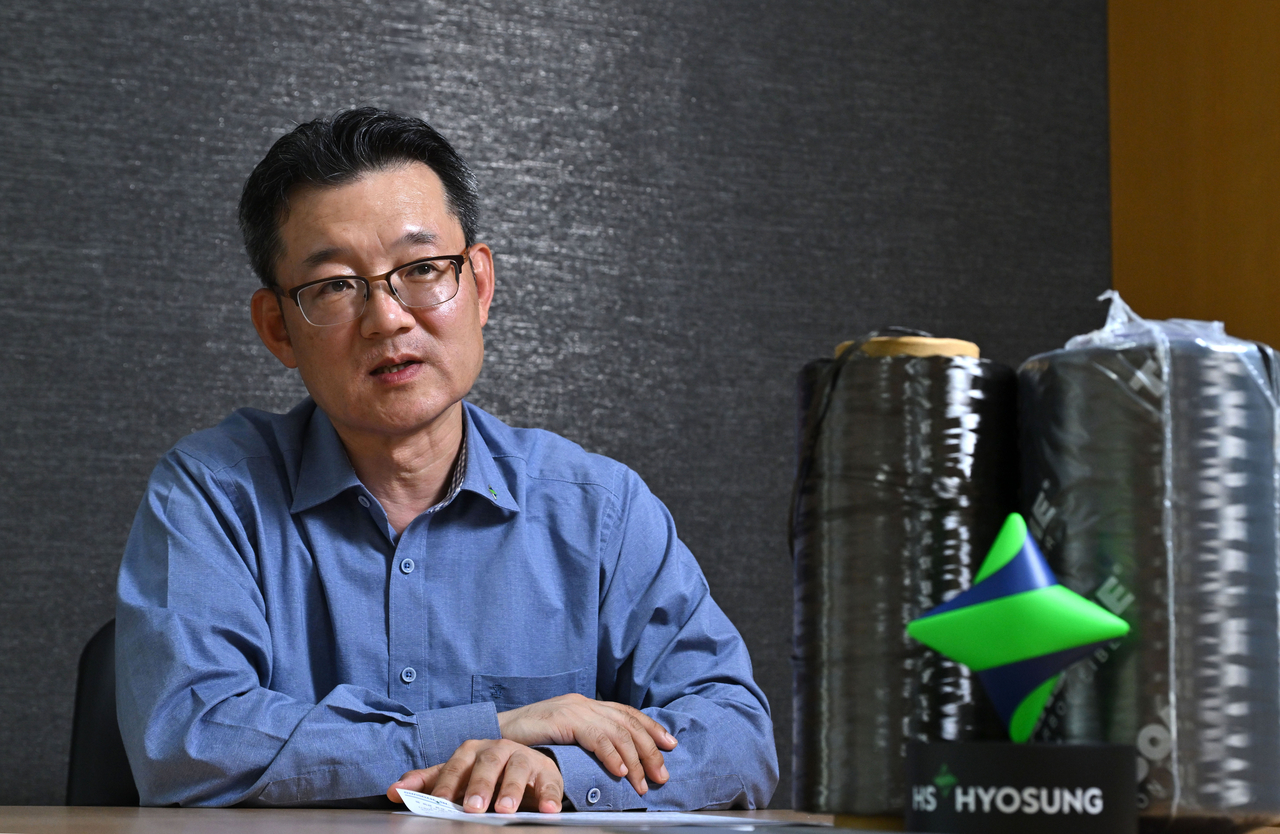
"Carbon fiber used in aerospace and defense is a critical strategic material, yet foreign products account for 80 percent of supply. Because certification in those fields requires years of effort and enormous cost, progress on switching to domestic alternatives has stalled."
Lee Min-su, marketing team leader at HS Hyosung Advanced Materials' carbon materials unit, made the remarks Wednesday at Hyosung's headquarters in Mapo-gu, Seoul, calling carbon fiber "a core element underpinning supply chain stability and the independent design, development and mass-production capabilities of the aerospace and defense sectors." He said institutional support for domestic production is urgently needed. While South Korean defense exports have posted a string of successes in recent years, the high-performance materials that form the structural backbone of weapons systems remain overwhelmingly dependent on foreign suppliers. Domestically developed high-performance carbon fiber — used to reduce the weight of fighter jets, missiles and military drones — has reached world-class standards, yet its application in the defense sector remains limited.
World's third to develop T-1000-grade technology — but domestic supply lags
The global carbon fiber market is currently led by Japan and the United States, the traditional technology powerhouses, while China — a relative latecomer — is mounting an aggressive price offensive focused on commodity products, backed by massive government subsidies. Against that backdrop, HS Hyosung Advanced Materials has become only the third company in the world, after Japanese and American rivals, to independently develop ultra-high-strength T-1000-grade technology, establishing itself as a global top-tier player.
T-1000-grade carbon fiber is a cutting-edge, high-end material used in space-launch vehicle fuel tanks that must withstand extreme pressure, missile systems, components for domestically developed fighter jets, and unmanned aerial vehicle airframes. Despite achieving that level of technological independence, the barriers to entering the domestic defense market remain high. "Domestic technology has already reached world-class standards, but actual supply of domestic materials to the defense sector is still very limited," Lee said.
Industry sources say that because even minor defects in defense components can cause catastrophic failures across an entire weapons system, the military and finished-product manufacturers tend to stick with foreign competitors' products that were specified at the design stage and have been validated over decades. Switching to domestic materials requires redesigning systems and undergoing lengthy test evaluations — a process that carries both risk and cost. Critics say the military and systems integrators are reluctant to adopt domestic materials on the grounds that they have no track record in actual weapons, leaving domestic suppliers with few opportunities to build one.
"From a defense company's perspective, the test-evaluation and certification costs that can run into the billions of won to qualify a domestic material for a weapons system are an enormous burden," Lee said. "The most urgent need is a system that links the certification, evaluation and procurement processes so that domestic materials can actually be applied to weapons systems."
Specifically, he said what is needed is a fast track to make test-evaluation and certification procedures faster and clearer, meaningful incentives for using domestic materials, and demand creation tied to initial production volumes or demonstration projects. "Support is needed so that domestic materials can build real-world references through government-led demonstration projects, defense industry clusters and pilot-application programs for weapons systems," he added.
Institutional overhaul seen as key — offset trade emerges as option
To overcome these constraints, HS Hyosung Advanced Materials reorganized its carbon-aramid unit into two separate divisions — a carbon materials unit and an aramid unit — at the end of last year, accelerating decision-making and tailoring its sales approach. On the production side, the company is preparing to bring its Vietnam factory (annual capacity: 5,000 tons) online, following its existing plants in Jeonju (9,000 tons per year) and China (5,000 tons per year). It has also been actively pursuing new demand, including carbon fiber for power cable cores, driven by the global surge in AI data center construction.
Even so, observers say that unlocking domestic procurement in the defense sector ultimately requires institutional reform. The political sphere has taken note: at a Democratic Party defense industry committee meeting held in North Jeolla Province in April, participants discussed measures to encourage the adoption of domestic materials.
HS Hyosung Advanced Materials has also recently been in talks with relevant industry associations on ways to expand its supply chain in the aerospace and defense sector and to promote the domestic use of carbon materials. At those meetings, "offset trade" — a mechanism that turns global trade rules to domestic advantage — was raised as a concrete alternative to overcome the limitations of the home market. Under South Korea's offset trade system, when the government procures large foreign weapons systems or aircraft, it requires the overseas contractor to transfer technology or to incorporate domestically made components and materials, effectively creating reverse-export opportunities. The arrangement could offer domestic companies a path to building a global supply chain track record.
"Even though domestic carbon fiber technology has reached global standards, the lack of a track record within the domestic defense supply chain structure means we face a double burden in marketing — having to simultaneously argue for the legitimacy and the credibility of going domestic," Lee said. "We will work to persuade customers in a credible way that our materials can guarantee stable supply and performance over the long term."
keg@heraldcorp.com