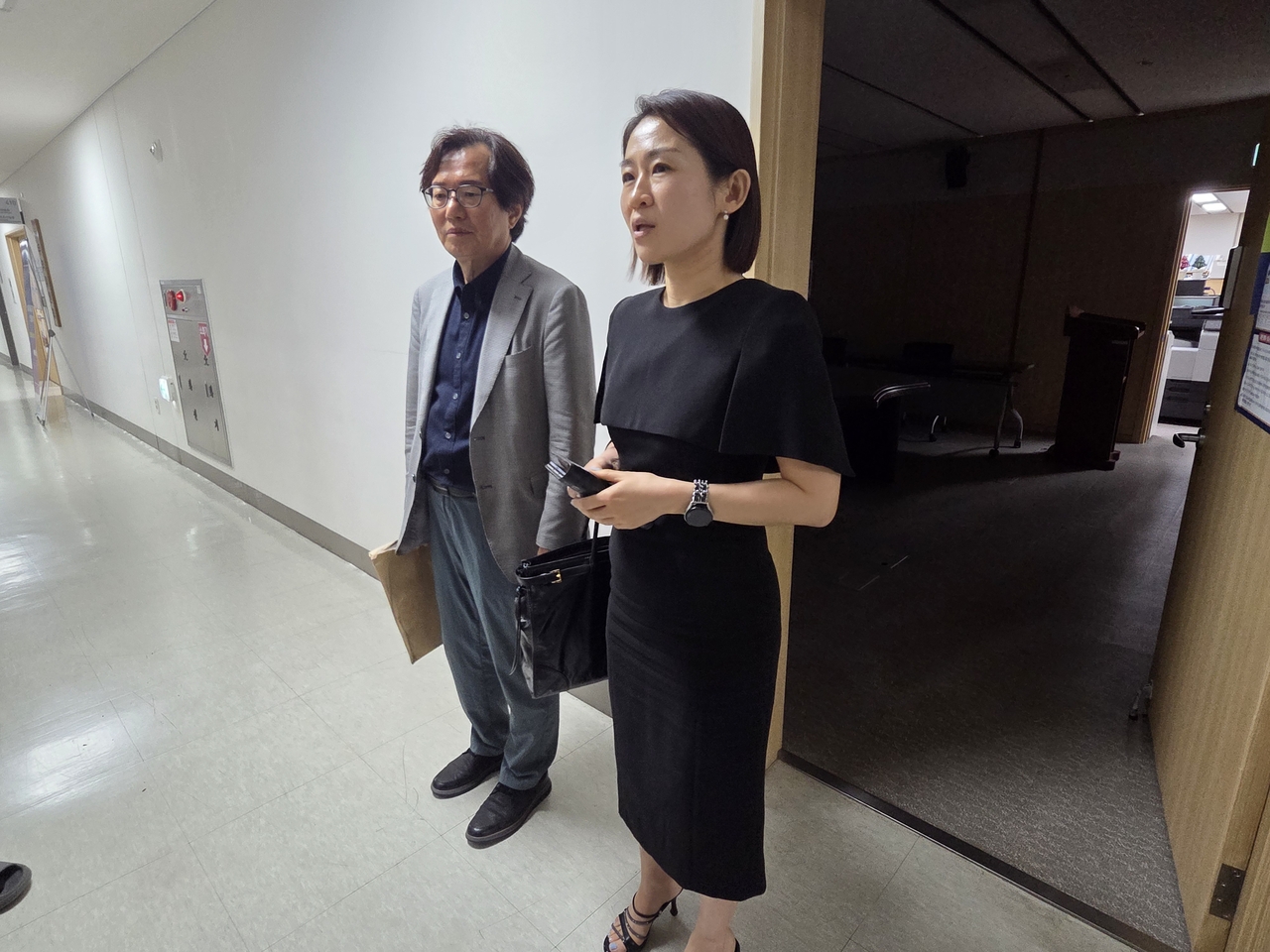
An unusual scene unfolded at the 13th plenary session of the Minimum Wage Commission on Thursday. When public interest members called for additional revised proposals, employer representatives for small business owners walked out, declaring they could not accept even a 10-won increase in the hourly wage.
As of Friday, both sides have submitted nine rounds of revised proposals, leaving a gap of 690 won per hour. Labor is seeking 11,220 won ($10.80) per hour — an 8.7 percent increase — while management has proposed 10,530 won, a 2.0 percent rise. Management raised its offer by 10 won from its previous proposal, but employer representatives for small business owners pushed back hard, saying they could not accept any further increase.
A 10-won difference amounts to just 0.1 percentage point in the rate of increase. But for self-employed business owners, the minimum wage is not simply a matter of a few won more per hour. It is the starting point that triggers a cascade of rising costs — weekly holiday pay, severance, overtime and night-shift premiums, and the employer's share of the four major social insurance contributions.
![Ryu Gi-jeong, executive vice president of the Korea Employers Federation, and Ryu Gi-seop, secretary-general of the Federation of Korean Trade Unions (right), listen with serious expressions to remarks by Lee Mi-seon, vice chairwoman of the Korean Confederation of Trade Unions, at the 13th plenary session of the Minimum Wage Commission at the Government Sejong Building on Thursday. [Yonhap]](https://wimg.heraldcorp.com/news/cms/2026/07/10/rcv.YNA.20260709.PYH2026070915910001300_P1.jpg)
Based on labor's ninth revised proposal of 11,220 won per hour, next year's minimum wage would rise by 900 won per hour from this year's level. On a monthly basis — calculated at 209 working hours — that translates to an increase of about 188,100 won per worker, or roughly 2.26 million won annually. For a business employing four minimum-wage workers, the wage bill alone would grow by about 9.03 million won a year. Add in severance provisions, the employer's share of social insurance, and higher overtime, night-shift and holiday pay, and the actual labor cost burden could climb far higher. That is why labor and management have been talking past each other in minimum wage negotiations year after year.
Statistics lay bare the reality facing small-scale self-employed operators. A Ministry of SMEs and Startups survey found that last year's average monthly business income for small business owners was 1.91 million won — less than this year's monthly minimum wage equivalent of about 2.15 million won. Research by the Korea Labor Institute also found that nearly half of micro-businesses earn less than 830,000 won a month.
On the ground, a practice of splitting shifts to reduce labor costs has been spreading.
A Korea Federation of Micro Enterprise survey found that 65.1 percent of respondents employ workers for fewer than 15 hours a week — below the threshold that triggers mandatory weekly holiday pay. Job postings have recently appeared asking part-time workers to clock out just one minute early on a single day each week to keep total hours at 14.9 per week. The paradox is plain: the heavier the labor cost burden, the more stable jobs give way to ultra-short-hour employment.
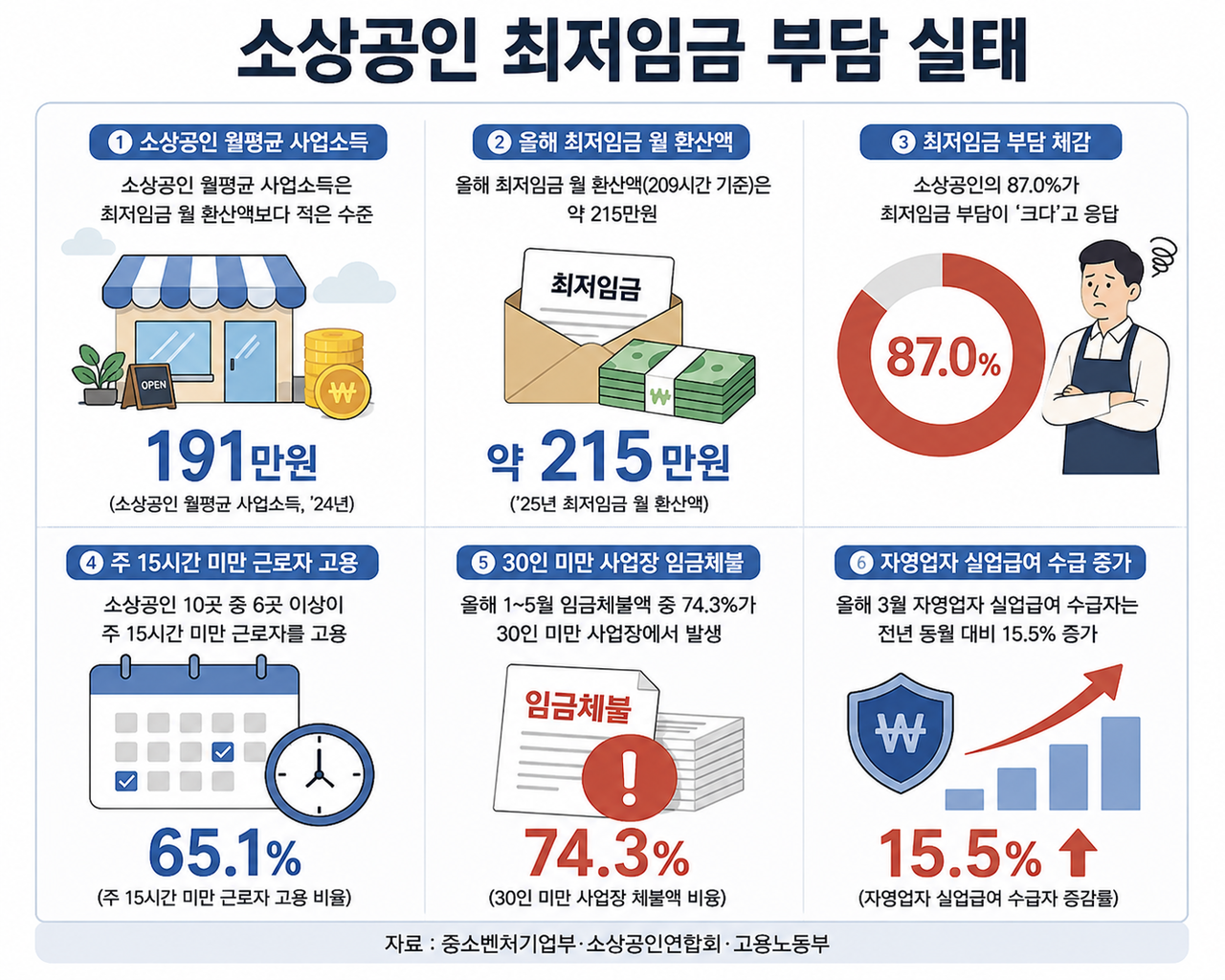
The financial strain shows up across a range of indicators. According to the Ministry of Employment and Labor, unpaid wages from January through May this year totaled 772.7 billion won, of which 574.4 billion won — 74.3 percent — came from businesses with fewer than 30 employees. The number of self-employed workers receiving unemployment benefits stood at 1,794 in March, up 15.5 percent from a year earlier, while the number of self-employed workers enrolled in employment insurance rose 18.4 percent. Analysts say more self-employed people are signing up for coverage as a hedge against economic uncertainty and the risk of closure.
Adding to the pressure, this year's minimum wage becomes the baseline for next year's negotiations. A 10-won increase now sets a new floor for the next round. That is why small business representatives say they cannot give ground even on 10 won — or 0.1 percentage point.
Labor, however, is equally unwilling to back down. Persistently high inflation has squeezed the livelihoods of low-wage workers. South Korea's food and non-alcoholic beverage price index last year stood at 146 on a purchasing power parity basis — 46 percent above the OECD average, the second highest among member countries after Switzerland.
Labor groups argue that three consecutive years of low minimum wage increases contributed to sluggish domestic consumption, and that raising the minimum wage is the bare minimum needed to protect the real incomes of low-wage workers.
The Minimum Wage Commission will hold its 14th plenary session on Tuesday. Public interest members are widely expected to propose a recommended range to prompt either a negotiated agreement or a vote between the two sides. With the statutory deliberation deadline already passed, next year's minimum wage is in effect expected to be decided at that session.
"Na Yu-jeong" is a series that explains useful policy information in plain language, covering the background behind policy proposals, what the changes mean, and who can use them, when and how.
fact0514@heraldcorp.com