
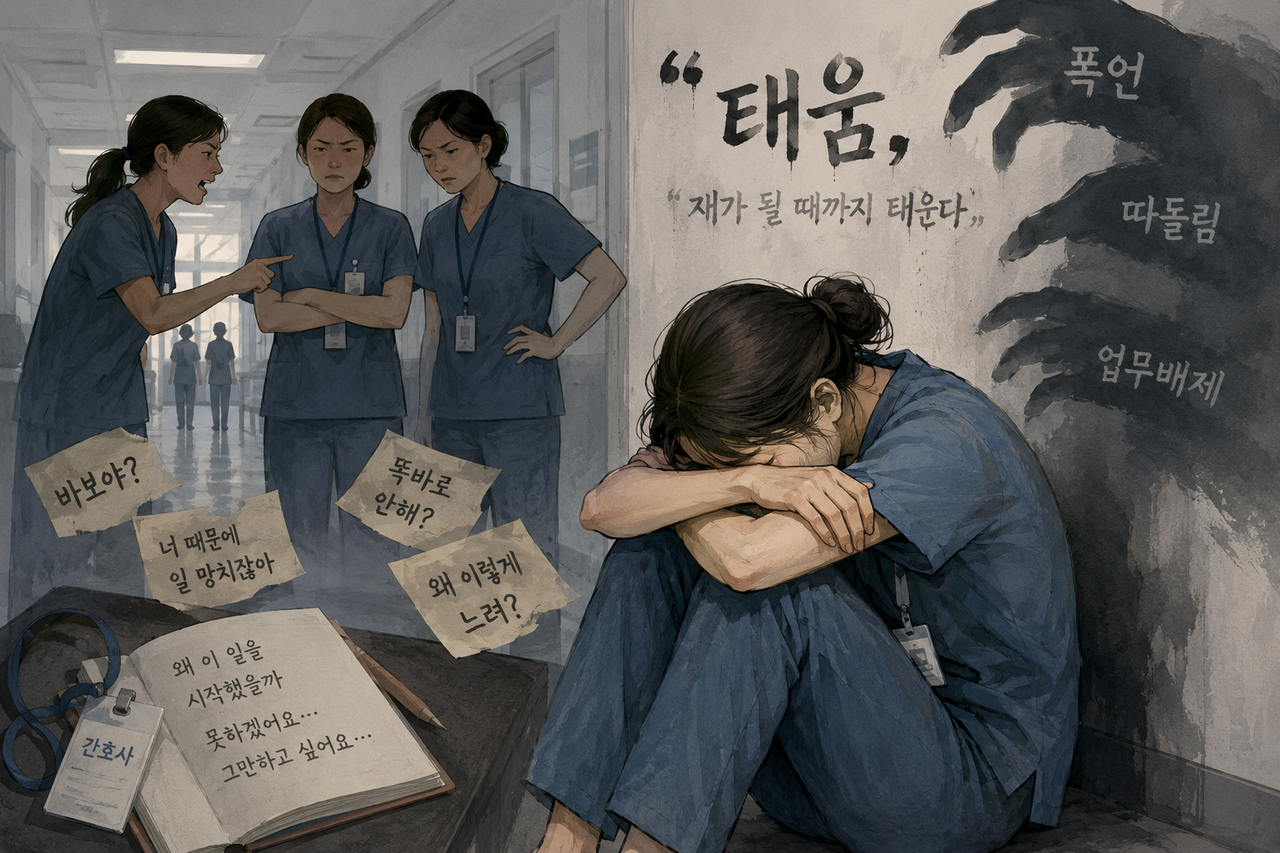
The death of a nurse in her 20s who took her own life after enduring "taeoom" — a form of workplace bullying endemic to the nursing profession — has drawn fresh fire over an entrenched culture that critics say has gone unreformed for years. The tragedy is the latest in a string of similar cases since 2018, with calls growing for structural change to end verbal abuse and harassment in hospitals.
Kang Su-bin, a nurse in her 20s who had worked at a hospital in Gwangju, Gyeonggi Province, was found dead at her home on June 2 after enduring repeated verbal abuse and mistreatment from senior nurses, according to government and medical community sources. The practice, known as taeoom, had driven her to take her own life, the sources said.
Kang left the hospital in March last year and filed a workplace harassment complaint with the Ministry of Employment and Labor. Labor authorities acknowledged some of the harassment, but the hospital reportedly disciplined the perpetrators with only a reprimand.
Taeoom is nursing-industry slang derived from the expression "to burn until nothing but ash remains," describing a culture in which senior nurses subject new recruits to verbal abuse, humiliation, public reprimands and ostracism under the guise of on-the-job training. It is widely regarded as one of the most prevalent forms of workplace bullying in healthcare settings.
After news of Kang's death spread, President Lee Jae-myung wrote on his X account on June 2 that "taeoom is horrific violence that can never be justified," and extended his "deepest condolences to the bereaved family." He directed the relevant authorities to conduct a thorough investigation, take strict action for any legal violations and draw up measures to prevent a recurrence.
The Gyeonggi Southern Police Agency has since launched an investigation into workplace harassment based on the contents of Kang's diary and other written records. The Ministry of Employment and Labor has also begun a special labor inspection of the hospital to examine whether workplace harassment and labor law violations occurred.
The Ministry of Health and Welfare said it would review existing measures to prevent taeoom among nurses.
Health and Welfare Minister Jeong Eun-kyeong said the ministry would "review the progress of measures to prevent nurse taeoom and address any shortcomings." She added that it would operate a workplace harassment reporting center within the nursing workforce support center and work with regional labor offices under the Ministry of Employment and Labor to carry out labor inspections and organizational culture consulting.
The case underscores that the taeoom problem, which has recurred throughout the nursing industry, remains unresolved.
The late Park Seon-uk, a nurse at Asan Medical Center, died in 2018, followed by the late Seo Ji-yun, a nurse at Seoul Medical Center, in 2019. In 2021, a new nurse at Uijeongbu Eulji University Hospital took her own life after suffering verbal abuse and harassment from a senior colleague.
The nurse responsible in the 2021 case was sentenced to six months in prison on charges of insult and assault, and the hospital pledged to reform its organizational culture — yet similar incidents have continued.
Surveys of the industry confirm that human rights violations in nursing workplaces persist.
A 2026 survey of healthcare workers released in May by the Korean Health and Medical Workers' Union found that 58.2 percent of respondents had experienced at least one instance of verbal abuse, physical assault or sexual violence in the past year. Among nurses specifically, 62.3 percent reported experiencing verbal abuse from patients, guardians, doctors or supervisors.
A separate survey on human rights violations among nurses, released last year by the Korean Nurses Association, found that 50.8 percent of nurses had experienced verbal abuse, workplace harassment or other rights violations in the past year. Senior nurses were identified as the most common perpetrators at 53.3 percent, followed by doctors at 52.8 percent and patients or their guardians at 43.0 percent.
The nursing community argues that taeoom stems not from individual conflicts but from structural failures.
A chronic shortage of nursing staff has created excessive workloads, and that pressure, combined with a closed organizational culture and a hierarchical approach to training, perpetuates the abuse, advocates say.
"Without meaningful improvements to working conditions and adequate staffing, the same tragedies will keep repeating," a Korean Nurses Association official said. "The organizational culture that tolerates violence in the name of education must change."
If you or someone you know is struggling with thoughts of self-harm or suicide, contact the Ministry of Health and Welfare's helpline at 1393, available 24/7. Please request a translator for English-language services.
fact0514@heraldcorp.com





