
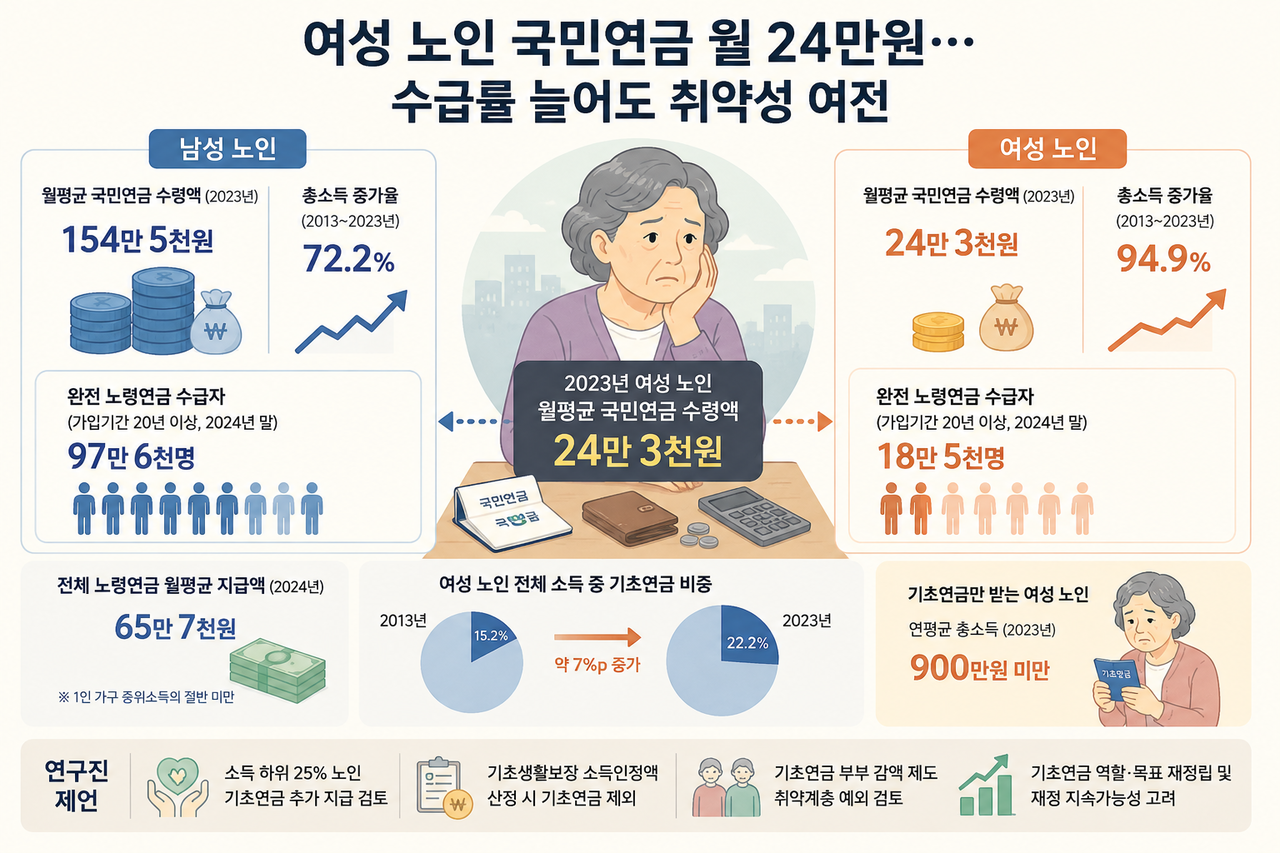
Elderly women's enrollment in public pension schemes has consistently grown and their income has risen faster than men's over the past decade — yet their actual pension amounts and living standards still lag far behind, a new study shows.
Researchers particularly noted that the basic pension, on which many elderly women depend, has had limited effect on improving their livelihoods, and called for systemic reforms to better protect the most vulnerable.
According to a study released Saturday by the National Pension Research Institute — titled "Analysis of Changes in Income Composition and Consumption Levels of Elderly Women by Public Pension Receipt" — total income among women aged 66 and older rose 94.9% between 2013 and 2023, outpacing the 72.2% increase recorded for elderly men over the same period.
The faster growth rate, however, does not mean elderly women's economic situation has meaningfully improved. Researchers said the high rate largely reflects a base effect, given how low the starting point was. As of 2023, elderly women received an average of 243,000 won ($162) per month in national pension benefits — roughly one-sixth of the 1.54 million won received by men. The gender gap in retirement income persists despite broader pension coverage.
The gap in contribution periods also remains wide. As of the end of last year, 976,000 men were receiving full old-age pension benefits, meaning they had contributed for 20 years or more, compared with just 185,000 women — a roughly fivefold difference.
The overall monthly average payout for old-age national pension benefits stood at 657,000 won, less than half the median income for a single-person household, suggesting that pension income alone is insufficient to sustain a stable retirement.
Researchers found that economic vulnerability among elderly women varies sharply depending on which type of public pension they receive.
Women receiving only the national pension showed positive outcomes — higher pension amounts were associated with increased overall consumption and essential spending. By contrast, women receiving only the basic pension had the lowest total incomes, and increases in basic pension payments did not produce statistically significant gains in essential spending such as food and housing costs.
The income structure of elderly women has also shifted toward greater reliance on the basic pension. In 2023, the basic pension accounted for 22.2% of elderly women's total income — the largest single share — up about 7 percentage points from a decade earlier. Among elderly men, the basic pension made up just 3.6% of total income.
Women receiving only the basic pension were the most economically vulnerable group overall, with annual total income falling short of 9 million won.
Among single-person households, economic vulnerability proved a stronger predictor than gender. Both women and men living alone had low income levels, but single women showed particularly high dependence on the basic pension and private transfers such as support from children. The smaller a person's assets, the more heavily they tended to rely on the basic pension.
To strengthen retirement income security for vulnerable elderly women, the researchers proposed paying an additional basic pension to those in the bottom 25% of the income distribution, and excluding basic pension income from the income calculation used to determine eligibility for the national basic livelihood security program. They also recommended reviewing whether the current rule — which reduces basic pension payments by 20% each for couples receiving benefits together — should allow exceptions for the most vulnerable households.
fact0514@heraldcorp.com





