People Power Party lawmaker Yoo Yong-won, a member of the National Assembly's National Defense Committee, on Monday criticized the government's plan to use Gwangju Air Base as the site for a Honam-region semiconductor cluster, calling Cheong Wa Dae's idea that dispersing air force assets to other bases would free up the land quickly "armchair theorizing that completely ignores the reality of our air force."
According to Yoo and political circles, Cheong Wa Dae policy chief Kim Yong-beom said in a media interview that dispersing the training requirements of the Gwangju base to other air force installations would eliminate the need to wait for a new airport to be built at Muan, and that the land could be made available simply by relocating the aircraft — without acquiring additional land.
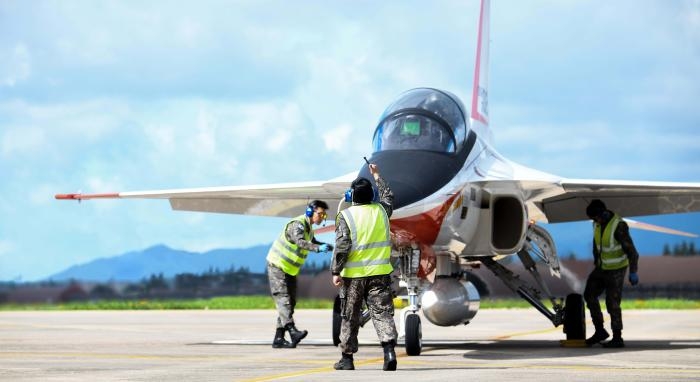
In response, Yoo said he was concerned the government had "rushed to make an announcement without first carefully verifying whether early dispersal is actually feasible." He cited three specific challenges tied to the base's unique characteristics: Gwangju is an advanced flight training base responsible for producing pilots; it houses academic education facilities dedicated to advanced flight training; and finding another military installation capable of accommodating the dozens of trainer aircraft currently stationed at Gwangju would be extremely difficult in practice.
The base is home to multiple T-50 simulators used for pilot training, along with temperature- and humidity-controlled facilities needed to keep those simulators running with precision — infrastructure built up over more than a decade at a cost of hundreds of billions of won.
The academic education facilities are unique to Gwangju and exist at no other wing. Yoo said relocating this pilot-training infrastructure to another base "would take at minimum a year and a half and cost hundreds of billions of won," adding that "this is not a matter of moving a few aircraft — it means relocating the entire pilot-training system."
Finding a base capable of absorbing the dozens of trainer aircraft currently at Gwangju is also a practical problem. The air force is already carrying out facility construction at multiple bases ahead of the KF-21's entry into service, and flight squadrons at those bases under construction have already been relocated to other installations.
Yoo said many of the air force's flight bases "are already in a state of effective saturation, having absorbed assets from other bases while simultaneously conducting combat training and ongoing operations. That is why there are voices pointing out that there is in effect no wing with the capacity to take on the dispersed assets from Gwangju."
There is also the issue of the roughly 10,000 military personnel and their families permanently stationed at Gwangju Air Base, who would have to move temporarily to dispersal bases and then relocate again to Muan. Yoo said it was doubtful the government had considered the impact on military families' daily lives and the educational conditions for service members' children, given that the timeline for beginning and completing the transfer of the air base to Muan Airport remains impossible to predict.
As concerns mounted over the feasibility of dispersal, an alternative is reportedly under consideration: breaking ground on one or two semiconductor fabrication plants at a site within the base already prepared for the relocation of an ammunition depot. Yoo said even that option was "physically impossible in practice."
He elaborated, saying the idea of beginning construction on even part of the ammunition depot relocation site "assumes that dispersal of air force assets is restricted — in other words, that the Gwangju airfield would still be in normal operation while a couple of factories are built alongside it. That is physically impossible from a flight safety standpoint."
The ammunition depot relocation site — the land most readily available, having already been leveled at a cost of about 300 billion won ($199 million) — sits just a few hundred meters from the runway. It falls within Flight Safety Zone 4, where structures must gain one meter of permitted height for every seven meters of distance from the edge of Zone 1, the 600-meter-wide zone that includes the runway itself. On land only 300 to 500 meters from Zone 1, erecting the tower cranes dozens of meters tall that are essential for semiconductor fabrication plant construction would itself be impossible under flight safety rules.
Even if a semiconductor factory were completed, operating it would pose further problems. Semiconductor manufacturing requires extreme vibration suppression to achieve nanometer-level precision, and experts say the ground vibrations generated by T-50 advanced trainer aircraft during takeoff and landing far exceed the tolerance limits of semiconductor processes. In short, building or operating a semiconductor factory next to an active airfield is physically impossible.
On top of all this, Gwangju Air Base is a jointly operated Korea-US air force installation where US air power would be deployed in the event of a contingency. Any relocation of facilities within the base or adjustments to fuel pipelines must go through consultation procedures under the Status of Forces Agreement, or SOFA.
The US Seventh Air Force has previously stated that it "already has significant military interests at Gwangju Air Base." Cheong Wa Dae hastily announced on July 10 that Korea-US consultations would begin soon, but such consultations typically take years. A similar process involving Daegu Air Base has been ongoing for years and has yet to be concluded.
Yoo said that "relocating the pilot-training facilities alone will take at least 18 months, and securing bases to receive the fighter aircraft cannot happen until the KF-21 facility construction is finished — and on top of that come the issues of military families' lives and Korea-US consultations. The government announced its position that dispersal would allow quick use of the land without properly examining any of this."
He added that he was "by no means opposed to the semiconductor cluster project itself, as it is essential for regional development and the advancement of the nation's high-tech industries," but said he was concerned that the Lee Jae Myung administration had "hastily chosen an air force base directly tied to national security out of a political fixation on delivering results within its term in office." He warned that "reckless and rushed pursuit of this project must not be allowed to create security gaps — such as disruptions to air force pilot training — or friction between Korea and the United States."
bigroot@heraldcorp.com