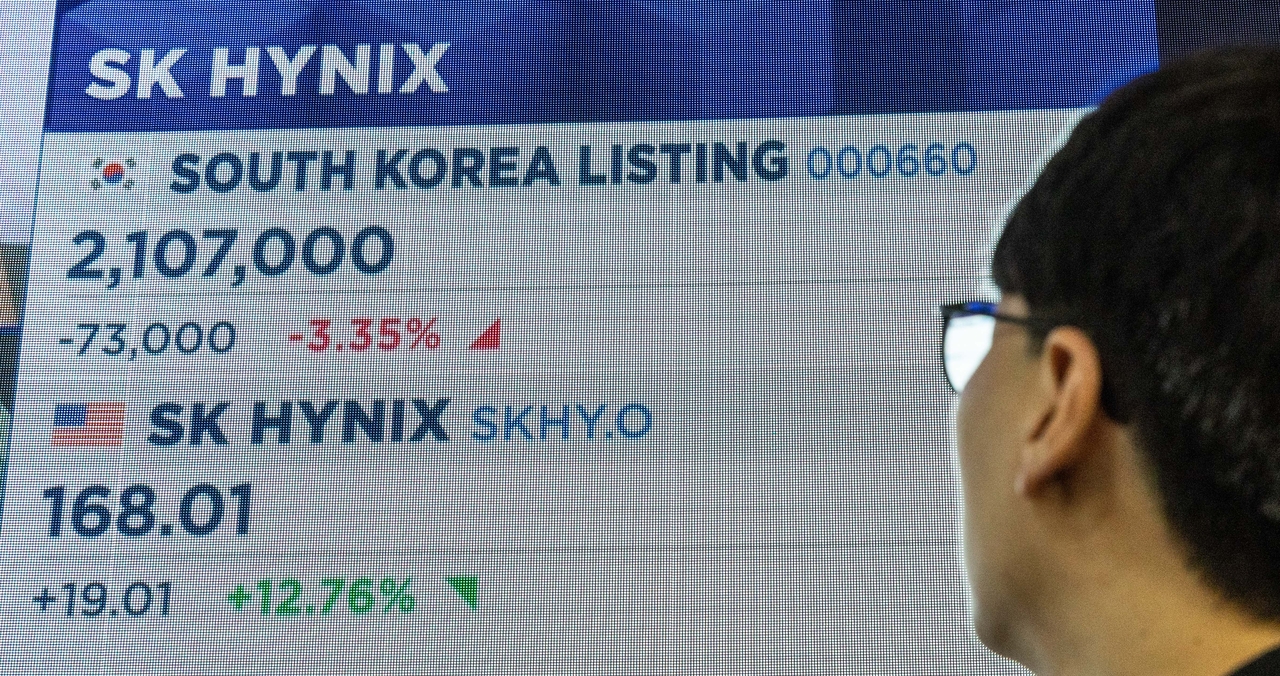
Shares of Samsung Electronics and SK hynix tumbled during Monday's session, with SK hynix breaking below the psychologically significant 2 million won ($1,330) threshold.
SK hynix was trading at 1.954 million won as of 11 a.m. Monday, down 10.37 percent from the previous close, according to the Korea Exchange.
The stock opened down 3.07 percent at 2.113 million won before sliding as low as 1.942 million won. The last time SK hynix closed below 2 million won was June 8.
The sharp decline came despite a strong debut for SK hynix's American depositary receipts on NASDAQ.
Analysts attributed the selloff to short-term profit-taking as the ADR listing catalyst faded, compounded by concerns over shareholder dilution — the ADR was structured as a new share issuance to raise fresh capital rather than a sale of existing shares.
Some market watchers also raised the possibility of arbitrage trades by certain foreign institutional investors — buying the ADR while short-selling the domestic shares — as a factor weighing on sentiment in the local market.
SK Square, which held a 20.5 percent stake in SK hynix as of the end of the first quarter, also plunged 12.91 percent.
Still, brokerages leaned toward the view that the ADR listing could provide further upside for the domestic shares.
Daishin Securities raised its target price for SK Square by 12 percent to 2.1 million won on Monday, citing SK hynix's share price gains and the ADR premium, while maintaining a buy recommendation.
"SK hynix accounts for 98 percent of SK Square's net asset value," analyst Kim Hoe-jae said. "We raised the target price to reflect the increase in SK hynix's market capitalization and the ADR premium."
The target price was derived by applying a 30 percent discount to SK Square's per-share NAV. Since SK Square's spinoff listing in November 2021, its NAV discount has ranged from 36 to 77 percent, with an average of around 65 percent.
Kim noted that SK hynix's ADR rose 13 percent on its first day of trading after listing on the US market on Friday, and that the ADR was trading at a 15.5 percent premium to the domestic shares. Including after-market gains, the ADR premium expanded to around 18.3 percent, he added.
Samsung Electronics fell 6.67 percent to 266,000 won in the same period, touching an intraday low of 265,000 won. The broader decline in chip stocks reflected market concerns over a potential peak-out in the semiconductor cycle.
KB Securities maintained its target price for Samsung Electronics at 600,000 won and kept a buy rating.
"2027 is expected to see the tightest supply in the 70-year history of the semiconductor industry," said Kim Dong-won, head of research at KB Securities. "With virtually no new commodity memory production capacity coming online next year, big tech companies will begin long-term supply agreements in earnest, and new memory output will be allocated first to those big tech firms that have signed such deals."
"The recent correction in Samsung Electronics shares appears to reflect concerns over the sustainability of AI investment — sparked by Meta's data center leasing plans — alongside debate over whether the second quarter marked a peak in earnings," Kim said. "However, Samsung Electronics' operating profit is forecast to reach 110 trillion won in the third quarter and 124 trillion won in the fourth quarter, representing a wider improvement than in the second quarter."
"The strength of SK hynix's ADR is expected to lift both SK hynix's domestic shares and Samsung Electronics, creating a chain reaction that could drive a virtuous cycle of semiconductor re-rating."

jiyun@heraldcorp.com