
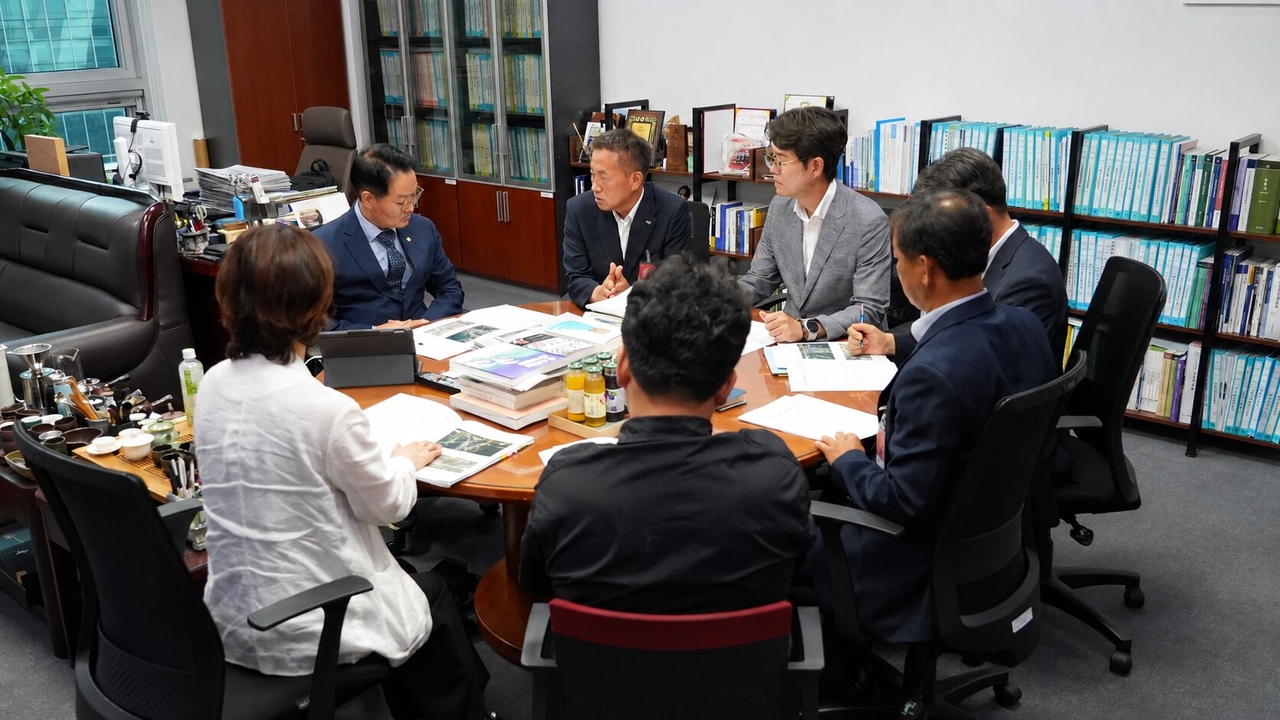
Yanggu-gun chief Kim Wang-gyu visited the National Assembly on Monday morning to urge support for two long-standing local priorities: bridging the Yongha-Yachon-ri section of the Chuncheon-Sokcho railway's fourth construction zone, and expanding National Route 46.
Kim, along with Gangwon Province SOC policy director Lee Hye-gyo, railway division chief Lee Won-dae and other provincial and county officials, met with Assembly member Heo Yeong and submitted three joint requests — chief among them national funding for the bridge construction on the Yongha-Yachon-ri section and key improvements to National Route 46 — calling for active support.
Yanggu-gun and Gangwon Province also requested improvements to bottleneck sections along National Route 46.
The meeting also addressed the bridging of the Yongha-ri to Yachon-ri embankment section, a proposal that has drawn strong opposition from local residents, including the village council of Gukto Jungangmyeon, who issued a statement of protest.
According to Yanggu-gun, the parties reached a formal agreement at an on-site mediation session convened by the Anti-Corruption and Civil Rights Commission on Aug. 7, 2025, at which government agencies and residents jointly pledged to bridge the entire 355-meter section.
The mediation agreement explicitly stated that the financial burden on Yanggu-gun should be minimized in consideration of the county's fiscal constraints.
The Ministry of Planning and Budget and Korea National Railway recently reversed course, however, citing insufficient justification for the bridge design and concerns about setting a precedent for other local governments. They now insist that Yanggu-gun bear the full 8.2 billion won ($5.44 million) cost increase under the "originator pays" principle.
Kim said requiring a county at high risk of population extinction — with a fiscal self-sufficiency rate of just 8.6 percent — to shoulder billions of won in costs amounts in effect to pressuring the county to abandon the bridge plan, and constitutes "a direct betrayal of residents who trusted the government and waited patiently." He called on the government and relevant agencies to honor the 2025 agreement, immediately approve the revised total project cost, and guarantee that the national government cover at least 70 percent of the additional expenses.
Assembly member Heo expressed solidarity with Yanggu-gun, saying the embankment approach "would split the village in two, which runs counter to the very purpose of building the east-west high-speed railway and undermines balanced regional development — which is why we agreed with residents to build a bridge instead." He added that demanding a fiscally struggling county pay the entire cost of a design error made at the outset of a national project "is an abdication of the state's responsibility."
Heo pledged that the Assembly would exhaust every administrative and political avenue to ensure the government and relevant agencies faithfully implement the Anti-Corruption and Civil Rights Commission's legally binding mediation ruling and secure the necessary level of national funding.
The roughly 9-kilometer stretch of National Route 46 between Chuncheon and Yanggu — heavily concentrated with tunnels and bridges — chronically bottlenecks traffic, generating persistent complaints from residents and travelers about severe congestion and safety risks on weekends and during peak seasons.
On Tuesday, Yanggu-gun plans to visit the government complex in Sejong for back-to-back meetings with working-level officials at the Ministry of Planning and Budget's investment project management division and the Ministry of Land, Infrastructure and Transport's railway construction and road facility safety divisions, followed by an afternoon meeting with the vice minister of land, infrastructure and transport to press for a government-level decision on resolving the outstanding issues.
abc@heraldcorp.com





