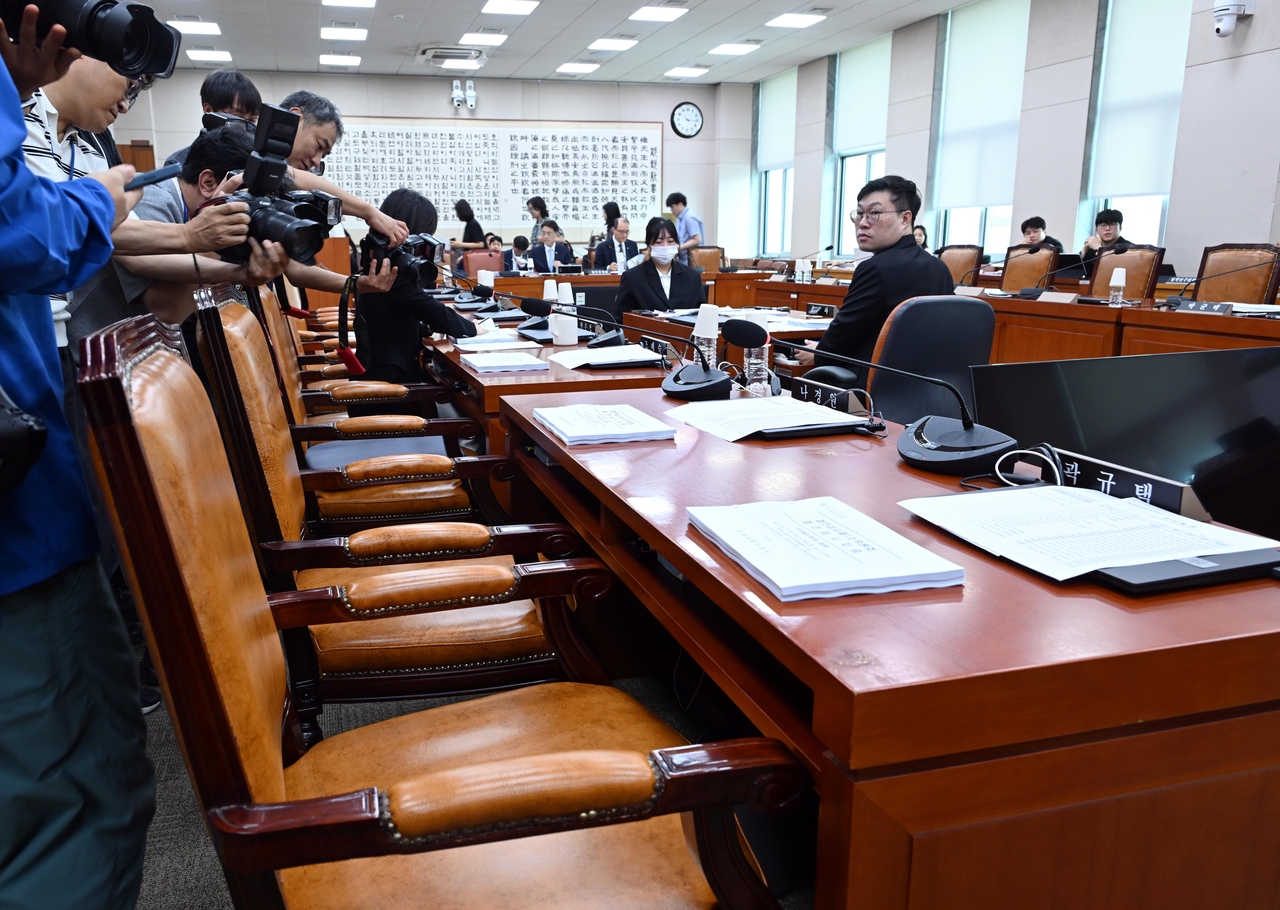
The National Assembly's Legislation and Judiciary Committee convened its first bill-review subcommittee Monday under ruling-bloc leadership to examine proposed amendments to the Criminal Procedure Code centered on abolishing prosecutors' supplementary investigation powers. With dissent persisting — including moves within the Democratic Party to introduce a version preserving limited exceptions to the abolition — the committee plans to continue its review Wednesday.
Kim Seung-won, the Democratic Party's floor representative on the Legislation and Judiciary Committee, told reporters after the subcommittee session that members had held "in-depth discussions focused on the National Assembly review report on the Criminal Procedure Code amendment."
The subcommittee reviewed bills introduced by the Democratic Party's Criminal Procedure Code amendment TF, Democratic Party lawmaker Kim Yong-min, Rebuilding Korea Party lawmaker Park Eun-jeong, and Rebuilding Korea Party lawmaker Cha Gyu-geun, examining opinions from the committee's expert staff and relevant government agencies. Topics included supplementary investigation powers, the right to demand corrective action, the right to request reinvestigation, warrant execution procedures, command authority over special judicial police, and adjustments to detention periods. The review is set to continue Wednesday.
Kim said, "This week, including today, we plan to hold the review subcommittee two or three times," adding that the next session would aim to wrap up deliberations on topics ranging from complainants' and accusers' rights to file objections to pretrial warrant examination procedures and other systems to prevent investigative abuse.
Discussions also covered digitizing evidence, sentencing factors and other elements during investigations to create electronic records, allowing parties involved in a case to meet with prosecutors, a post-case verification system, and a "named investigator" system identifying the investigators and prosecutors responsible for each case. Kim plans to introduce an additional Criminal Procedure Code amendment bill focused on digitizing investigative records.
Although the ruling bloc is driving the Criminal Procedure Code review in the Legislation and Judiciary Committee, the People Power Party boycotted the session. The party has been refusing to participate in the legislative schedule the Democratic Party set after unilaterally organizing the Assembly's committee structure. The People Power Party opposes abolishing supplementary investigation powers, arguing it would remove a check on the police.
Voices within the ruling camp calling for limited exceptions to the abolition have also persisted. Democratic Party lawmaker Hong Gi-won plans to introduce Tuesday a Criminal Procedure Code bill that would grant supplementary investigation powers only for crimes targeting vulnerable groups — including sexual violence, stalking, abuse of people with disabilities and the elderly, and voice phishing scams.
Hong said Monday that "the reason President Lee Jae-myung — who was the biggest victim of prosecutorial abuse of power — has spoken of the need for exceptional supplementary investigation is clear. The goal is to create exceptions for the people, not for prosecutors," in remarks directed at fellow Democratic Party lawmakers.
Democratic Party lawmakers Kim Nam-hee and Kim Dong-a, along with progressive party lawmaker Son Sol, held a press conference Monday at the National Assembly's media center alongside six women's organizations — including the Democratic Lawyers Association's Women's Rights Committee, Korea Women's Hotline and Korea Women's Association United. They warned that "since the 2021 adjustment of investigative authority between prosecutors and police, victims of criminal cases involving people with disabilities, women and children have suffered greatly from investigation delays and repeated questioning. There are growing calls that the Criminal Procedure Code revision must not make that situation worse." The group said it is also considering introducing additional amendment bills.
On consolidating additional Criminal Procedure Code amendment bills into the current review, Kim said the matter "is for Legislation and Judiciary Committee Chair Seo Yeong-gyo to decide," adding that "once decided, they will be referred directly to the subcommittee to be reviewed alongside the three bills currently under discussion." Under the National Assembly Act, bills directly related to matters already under subcommittee review may be referred straight to the subcommittee — without a separate plenary session of the standing committee — at the discretion of the standing committee chair and the floor representative.
The Legislation and Judiciary Committee plans to hold both a subcommittee session and a full committee meeting Wednesday, summoning officials from the Korean National Police Agency and the Corruption Investigation Office for Public Officials to hear their views on the Criminal Procedure Code amendments. The Democratic Party will also hold a general assembly of its lawmakers Tuesday to gather opinions.
addressh@heraldcorp.com