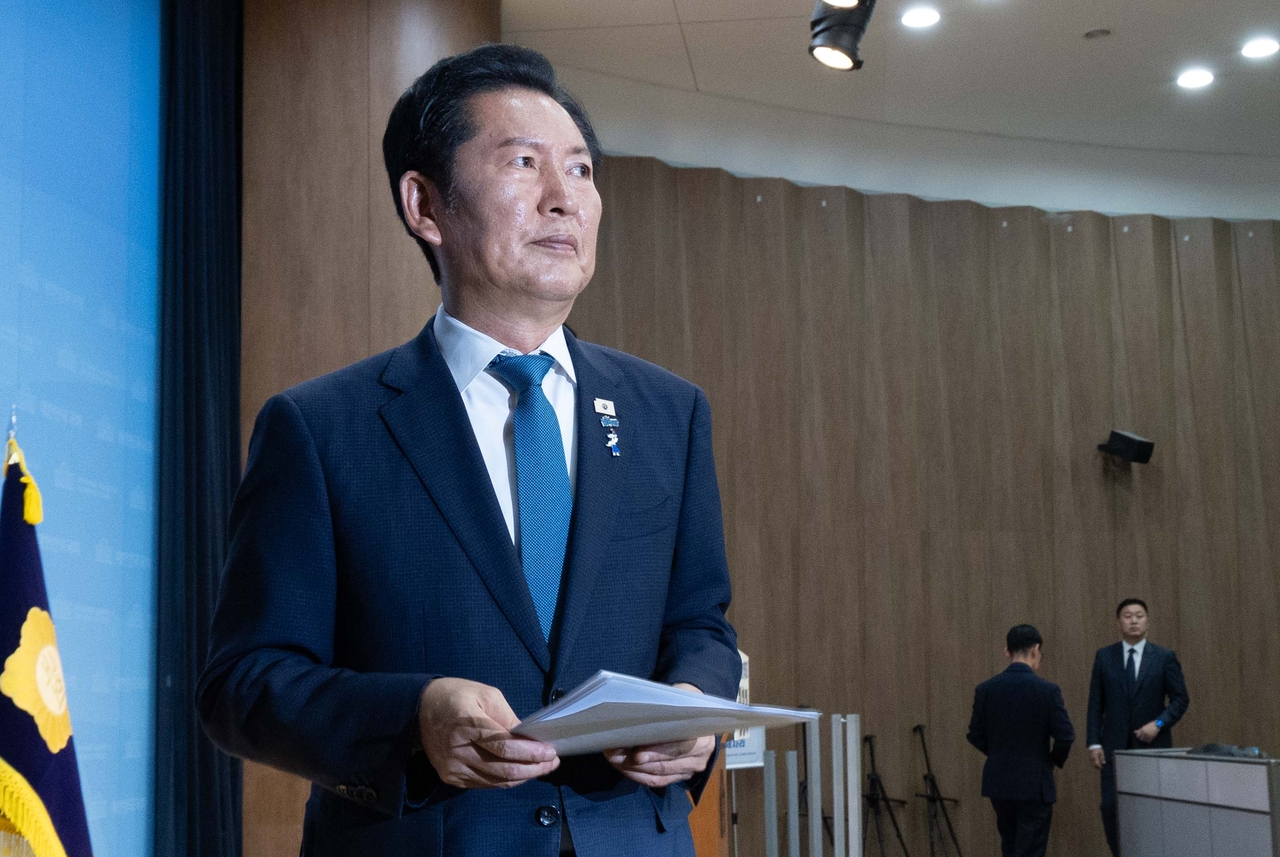
Jung Chung-rae, a contender for the leadership of the Democratic Party of Korea, appeared on broadcaster Kim Ou-joon's YouTube channel on Tuesday — the day after formally announcing his candidacy for party leader at the Aug. 17 national convention — to make his pitch on party unity and reform.
Speaking on the YouTube program "Humility Is Hard: News Factory," Jung said the party must not allow divisions among its traditional base to become mainstream. "The Democratic Party is a single-root community running from Presidents Kim Dae-jung, Roh Moo-hyun, Moon Jae-in and Lee Jae Myung," he said. "But at some point, suspicions began to arise that someone was trying to cut that root." He added that someone needed to play the role of rallying the core base under that shared spirit — and that the right person was himself.
On the June 3 Pyeongtaek-eul by-election, which the People Power Party won after candidates from the broader pro-government camp split the vote, Jung said he had come to believe in hindsight that the Democratic Party should not have fielded a candidate. He acknowledged, however, that withholding a nomination at the time would have drawn fierce criticism — accusations of boosting the Rebuilding Korea Party and reviving the pro-Moon Jae-in faction — and would have caused serious confusion and division within the party.
On the failed merger proposal with the Rebuilding Korea Party earlier this year, which collapsed amid internal opposition and has drawn criticism from rival candidates, Jung said he acknowledged the process had been rough but maintained that the merger should have been pushed through regardless.
He was sharper toward rival Kim Min-seok, the former prime minister, who had suggested the party absorb the Rebuilding Korea Party rather than merge with it as equals. "It's like saying, 'Let's shake hands' — but telling the other side to kneel first," Jung said. "It's best to avoid hurting the other party's feelings as much as possible."
Jung declined to elaborate on allegations that President Lee Jae Myung had backed a plan to hold a unified convention in August, only for Kim to block it. The allegations surfaced after Supreme Council member Kang Deuk-gu, an ally of Kim, posted and then deleted a social media message saying he had met with presidential political affairs secretary Hong Ik-pyo. Jung confirmed he had also been present at that meeting and said he knew what was discussed, but stopped short of disclosing details. "There are things that must go to the grave with me," he said. "Even if speaking out might benefit me, it does not seem appropriate for a former party leader to say such things."
Jung also elaborated on his pledge, made at Monday's announcement, not to run for president during his term as party leader. He said he anticipated that any action he took over a two-year term would be attacked as presidential positioning or groundwork, and wanted to preempt that. "I thought about the advice from those around me — that if I have no intention of running for president, it would be better to declare that upfront — and concluded they were right," he said.
On calls within the party for caution over abolishing the police's supplementary investigative powers, Jung made clear he would not back down from the reform. "We must press forward boldly, like a lion undisturbed by the sound of the wind," he said, adding that while some lawmakers may be wavering, they do not represent the prevailing view.
sunpine@heraldcorp.com