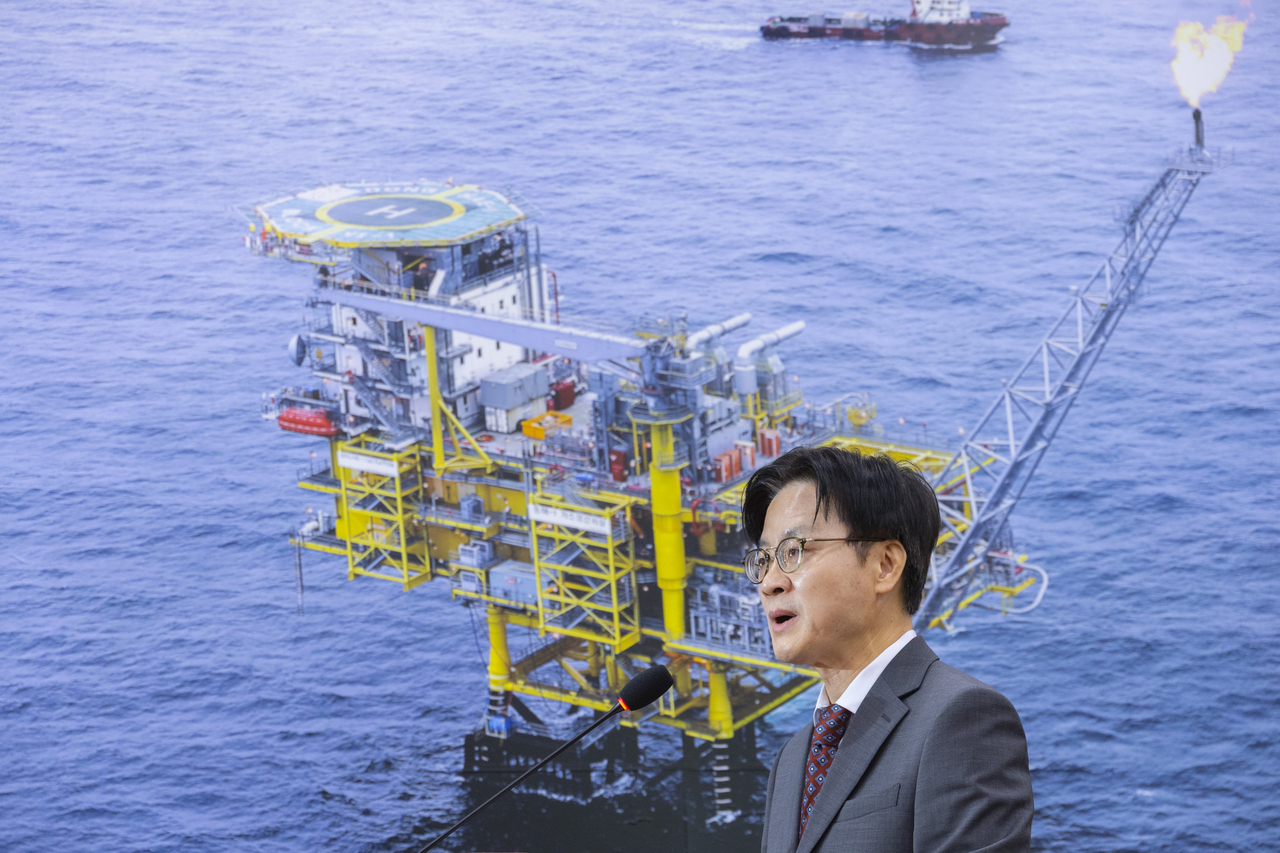
![Minister of Employment and Labor Kim Young-hoon delivers opening remarks at the forum. [Yonhap]](https://wimg.heraldcorp.com/news/cms/2026/07/14/rcv.YNA.20260713.PYH2026071305020001300_P1.jpg)
The controversy over performance bonuses pegged to a fixed percentage of operating profit at Samsung Electronics and SK Hynix has sparked a broader push to redesign how companies share gains in the AI era.
Proposals now on the table include shifting the bonus benchmark from operating profit to net profit for the period, and introducing a special-purpose tax — modeled on the levy that claws back windfall gains from apartment reconstruction projects — to redirect a portion of AI-driven excess profits into research and development, youth hiring and other reinvestment.
The Ministry of Employment and Labor held a forum Tuesday at Peace&Park in Yongsan-gu, Seoul, under the theme "New Paths for Social Innovation in Step with AI Technological Change." The event marked the first public forum to extend Labor Minister Kim Young-hoon's earlier proposal for a "Korean-style social solidarity wage" into a broader social contract for the AI age. Seoul National University of Science and Technology professor Jeong Heung-jun and Konkuk University professor Yun Dong-yeol presented the main papers, while representatives from the Federation of Korean Trade Unions, the Korean Confederation of Trade Unions (KCTU), the Korea Enterprises Federation, the Korea Federation of Enterprises and academic experts took part in designated discussions.
The forum had originally been planned around the "Korean-style social solidarity wage" theme but was postponed once amid controversy over whether the government was overstepping into decisions about how companies use their profits. The Ministry of Employment and Labor subsequently broadened the agenda into a public deliberation on corporate innovation, the labor market and social safety nets in the AI age before rescheduling the event.
Net profit over operating profit: experts propose special-purpose tax, national wage council
The central question at the forum was the practice of setting performance bonuses as a fixed percentage of operating profit.
Jeong Heung-jun, a professor in the business administration department at Seoul National University of Science and Technology, said distributing excess profits through company-by-company bonus negotiations alone has its limits in the AI era, and proposed a new set of principles for profit sharing.
He said the government should consider introducing a special-purpose tax that would capture a portion of corporate excess profits in the AI age for industrial competitiveness — similar in design to the levy that recovers windfall gains from apartment reconstruction. Revenue raised through such a tax, he argued, should bypass the general budget and flow instead into semiconductor R&D, youth hiring, industrial complex modernization and support for subcontractors, strengthening the competitiveness of the entire industrial ecosystem.
"Samsung Electronics' operating profit this year is forecast to reach 320 trillion won ($213 billion) on the back of the AI semiconductor boom, while SK Hynix is projected to reach 220 trillion won," Jeong said. "The combined operating profit of just those two companies exceeds the total operating profit of all Japanese companies." He said the concentration of AI technology dominance in a handful of firms is generating wealth on a scale with no historical precedent, making it difficult to close the gap between companies and industries through existing firm-level bonus arrangements alone.
He also called for changing the way bonuses are calculated. The "N percent of operating profit" formula that unions demand takes workers' share off the top before taxes and interest costs are accounted for, he said, which creates fairness problems for other stakeholders including the government and shareholders. "It is more rational to negotiate bonuses based on net profit for the period — which reflects taxes and all other costs — rather than operating profit," Jeong said.
He further proposed establishing a national wage council to oversee the minimum wage, a minimum pay regime for platform workers and performance bonus policy, arguing that wage gaps and profit-sharing disputes in the AI era cannot be resolved through firm-level bargaining alone. The idea is to use a national-level wage coordinating body to set new principles for profit distribution.
Capping big-company wages has limits; experts call for 'social solidarity investment' to build AI competitiveness
Konkuk University business administration professor Yun Dong-yeol agreed that excess profits should be put to social use but drew a line at simple wage redistribution.
AI and digital transformation are sharply raising productivity at large companies and among highly skilled workers, he said, while small and medium-sized enterprises and lower-skilled workers are being left behind by technological change. "How the money is used matters more than how much is shared," he said. Suppressing wages at large companies does not automatically transfer those resources to workers at smaller firms, he added, and excess profits should instead be channeled in ways that sustain corporate innovation while raising national competitiveness.
He proposed evolving the existing "social solidarity wage" concept into "social solidarity investment," directing AI-generated excess profits into joint innovation between prime contractors and subcontractors, AI transformation support for suppliers, future talent development, vocational training, job-transition assistance and social safety net expansion. He also said labor policy should shift its focus away from protecting specific jobs — "job security" — toward supporting workers' mobility and re-employment, or "employment security," in the AI age.
The designated discussion session laid bare a sharp divide between labor and management on how AI-era profits should be shared.
Ryu Je-gang, head of policy bureau 2 at the Federation of Korean Trade Unions, said society needs a broader conversation about returning AI-generated excess profits to youth employment, vocational training and social safety net reinforcement, but urged caution about legally standardizing bonus payment criteria. Lee Gyeo-re, chair of the KCTU's youth special committee, called for institutionalizing employment impact assessments for AI adoption and worker participation, and for building a social dialogue body that includes young people and unorganized workers.
On the management side, Hwang Yong-yeon, a director at the Korea Enterprises Federation, said performance bonuses linked to operating profit are a matter of distributing business results, not a working condition, and therefore fall within management's discretion rather than the scope of collective bargaining. Lee Sang-ho, head of the economic and industrial bureau at the Korea Federation of Enterprises, said directly clawing back excess profits could weaken companies' capacity for R&D and capital investment, and argued that using government surplus tax revenue to fund AI talent development and vocational training is a more realistic alternative.
Labor calls for social returns, business warns of investment chill — AI profit-sharing debate turns contentious
Experts also outlined the broader conditions a social contract for the AI age should meet, going beyond the immediate bonus debate.
Yun Hong-sik, a professor at Inha University, said social safety nets must be reformed alongside technological innovation and called for an overhaul of the employment insurance and welfare systems. Ryu Seong-min, a professor at Kyonggi University, proposed building a lifelong vocational training system covering both current employees and career changers, while Cho Yong-man, a professor at Konkuk University, called for a social dialogue framework broad enough to encompass new forms of work such as platform labor.
Jeong Seung-il, a doctor of political economy, said institutional design that connects AI productivity gains to growth across the entire national economy is critical. Hong Ki-bin, a visiting associate research fellow at the Korea Institute for Advanced Study, said a new social contract must be built through long-term public deliberation and broad social consensus.
The Ministry of Employment and Labor said it plans to use the forum as the starting point for a full-scale discussion on an "AI-era social innovation green paper."
The ministry said it will form a deliberative body bringing together labor and management organizations, experts, young people and platform workers to gather public opinion, publish the green paper by year-end and continue social dialogue on that basis. The government's public deliberation process is set to continue with a forum on "Corporate Investment and the Future of Labor in the AI Age," to be held Wednesday by the Ministry of Trade, Industry and Energy.
"The astronomical AI gains companies are posting were not created by corporate innovation alone — they are a social achievement built together with government infrastructure support and the contributions of workers across the supply chain," Minister Kim said. "We need a new social contract suited to the AI age, one that moves beyond the binary of investment versus distribution." He added that the government intends to serve as "a facilitator helping diverse stakeholders find answers together, not a referee who decides the conclusion in advance."
fact0514@heraldcorp.com