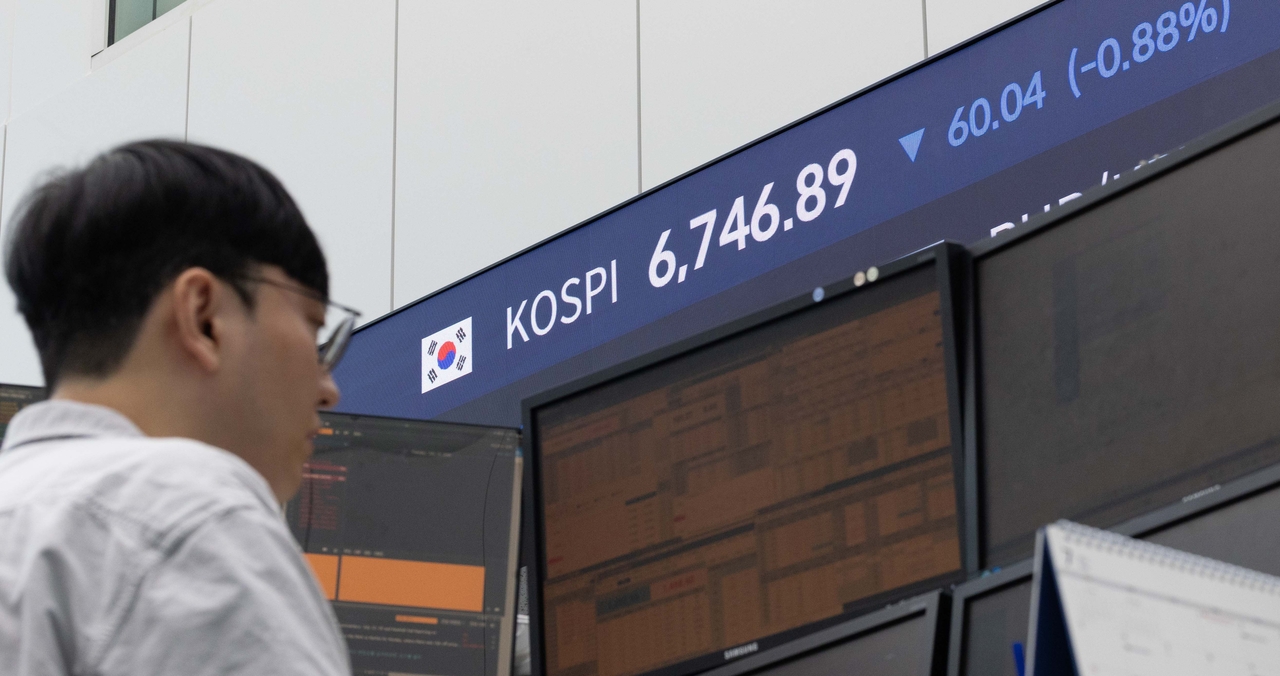
Foreign investors pulled a record $32.37 billion from South Korea's stock market in June, the largest monthly equity outflow ever recorded, as caution over frothy global AI investment and portfolio rebalancing following domestic share-price gains drove the exodus.
The Bank of Korea said Tuesday that net outflows of foreign securities investment — covering both equities and bonds — totaled $30.72 billion in June, according to its international finance and foreign-exchange market report. A net outflow means more foreign capital left the domestic stock and bond markets than entered.
Foreign securities funds have posted net outflows for five consecutive months since February. June's outflow was the second-largest on record, trailing only March's $36.55 billion. Measured in won at the end-of-June exchange rate of 1,548.7 won per dollar, the figure amounts to roughly 47.58 trillion won.
On a cumulative basis for the first half of this year, net outflows reached $100.93 billion. That compares with a net inflow of $42.06 billion for all of last year.
Breaking down by asset class, equity outflows in June hit a record $32.37 billion.
Foreign equity funds have recorded net outflows for six consecutive months since January. The cumulative first-half net outflow stands at $110.21 billion — more than 15 times the full-year net outflow of $7.07 billion last year.
Bond funds, however, recorded a net inflow of $1.65 billion in June, extending their run of net inflows to three consecutive months since April. The inflow was smaller than the previous month's $5.68 billion. For the first half as a whole, bond funds posted a net inflow of $9.28 billion.
The Bank of Korea said equity outflows expanded due to dampened investor sentiment tied to caution over global AI investment and rebalancing triggered by the run-up in domestic share prices. Bond funds continued to attract inflows, supported by growing inclusion in the World Government Bond Index (WGBI), even as some government bonds reached maturity.
The credit default swap premium on South Korean government bonds — based on the five-year foreign exchange stabilization bond — averaged 0.23 percentage points in June, down 0.02 percentage points from 0.25 percentage points the previous month.
The average daily fluctuation range and rate of change in the won-dollar exchange rate in June were 7.6 won and 0.5 percent, respectively, both wider than the previous month's 6.6 won and 0.45 percent.
Meanwhile, the average daily trading volume of non-deliverable forwards (NDFs) by foreign investors in the second quarter rose to $22.77 billion, up $3.87 billion, or 20.5 percent, from $18.9 billion in the first quarter — the highest quarterly figure since records began in 2018. On a monthly basis, June NDF trading volume also set an all-time high at $27.6 billion.
NDFs are contracts in which foreign currency is bought or sold at a pre-agreed exchange rate at a specified future date, settled offshore. Unlike conventional foreign-exchange transactions involving the actual exchange of currencies, NDFs are settled in dollars based only on the difference between the contracted rate and the rate at maturity. They have increasingly been used by hedge funds and others as a vehicle for currency speculation, and are widely cited as a key factor behind the won's depreciation.
kimstar@heraldcorp.com