The Kospi closed slightly higher Tuesday after an extraordinarily volatile session, as bargain hunting by institutions and foreign investors helped the index partially recover from Monday's steep selloff.
A rebound in large-cap semiconductor stocks helped restore investor confidence, while the broader market remained cautious ahead of the release of US June consumer price index data and Federal Reserve Chair Kevin Warsh's first congressional testimony since taking office.
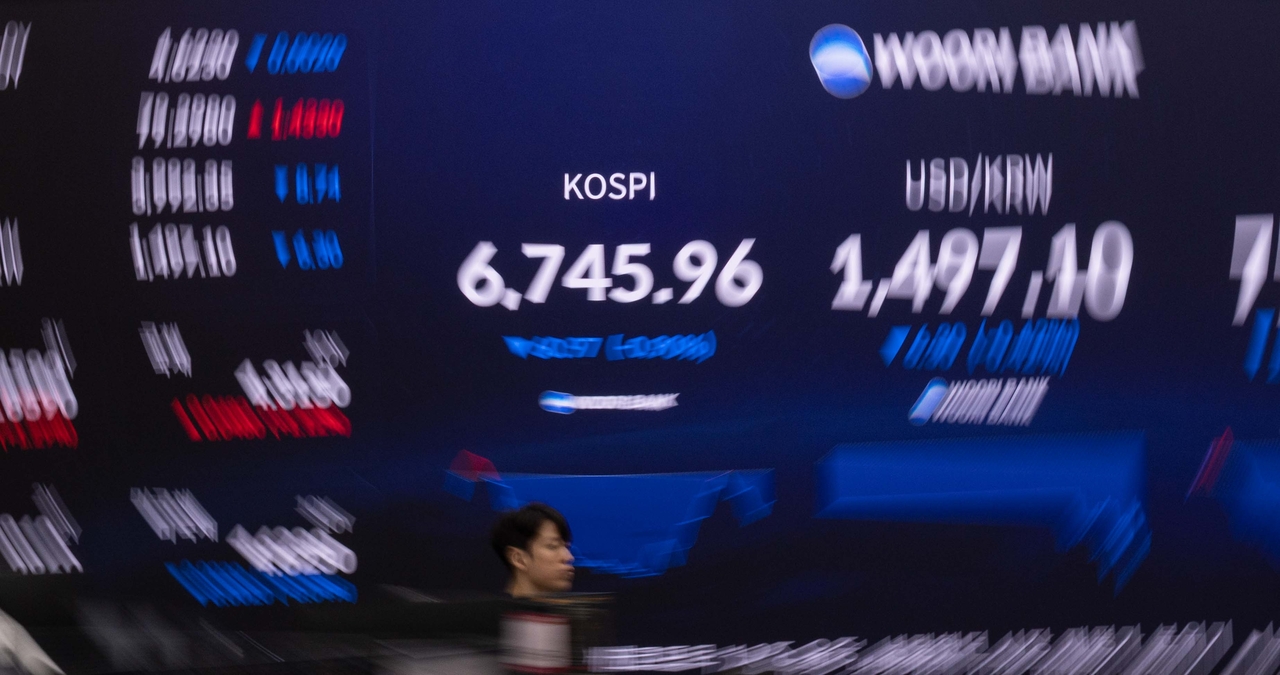
According to Korea Exchange, the Kospi finished up 49.90 points, or 0.73 percent, at 6,856.83. The index opened down 37.87 points, or 0.56 percent, at 6,769.06 and struggled to find direction through the morning and into early afternoon. After briefly charging toward the 7,000 level in early trade, it reversed sharply and fell as low as 6,448.86, a decline of 5.26 percent at the session's trough. The intraday swing reached 531 points.
Institutions and foreign investors, reversing course from Monday, stepped up their net purchases and drove the recovery. Institutions net bought 3.22 trillion won ($2.14 billion) and foreigners net bought 969.4 billion won, with foreign investors returning to net buying for the first time in three sessions. Retail investors were net sellers of 4.14 trillion won — the fifth time this year that individual investors have offloaded more than 4 trillion won in a single session.
With all three major Wall Street indexes closing lower overnight, retail investors shed risk assets and flooded the market with sell orders, while institutions moved in to buy at lower prices. Semiconductor stocks, weak early in the session, turned higher in the afternoon after analysts flagged oversold conditions, helping the index claw back its losses. Samsung Electronics and SK hynix both closed up more than 3 percent.
Markets are now focused on events expected between Tuesday evening and early Wednesday morning. In the United States, June CPI figures are due for release Tuesday (local time), alongside Fed Chair Warsh's first appearance before Congress since his confirmation. Investors widely believe the outcome of the Federal Open Market Committee meeting scheduled for later this month will hinge on both the inflation data and Warsh's remarks.
Among the top market-capitalization stocks, all declined except SK Square, which rose 2.50 percent. Samsung Electro-Mechanics fell for a second straight session after Monday's more than 18 percent collapse, though Tuesday's drop narrowed to around 2 percent. Oil-related and shipping stocks surged on rising crude prices driven by escalating Middle East tensions — Heungku Oil gained 8.93 percent and STX Green Logis jumped 29.92 percent.
The Kosdaq could not escape the selling pressure. The index opened down 2.20 points, or 0.28 percent, at 797.16 and closed down 15.38 points, or 1.92 percent, at 783.98. At its intraday low, the Kosdaq fell as much as 6.20 percent to 749.76 — its lowest level not only this year but since June 4 last year, when it touched 747.35, marking the weakest reading in roughly 13 months.
Foreign investors led the decline on the Kosdaq, net selling approximately 250 billion won, while retail investors net sold 72.9 billion won. Institutions were net buyers of 158.6 billion won.
A sell-side sidecar was triggered on the Kosdaq at 12:06 p.m. It was the 20th sidecar activation on the Kosdaq this year — comprising 12 buy-side and eight sell-side triggers — surpassing the 19 recorded during the 2008 global financial crisis to set an all-time annual record.
A Kosdaq sell-side sidecar is triggered when the Kosdaq 150 futures price falls 6 percent or more from its reference price and the Kosdaq 150 index simultaneously drops at least 3 percent from the previous session's closing level, with both conditions persisting for one minute.
The won strengthened against the dollar, supported by foreign buying. The won-dollar rate at the 3:30 p.m. close in the Seoul foreign exchange market fell 10.4 won from the previous session to 1,493.0 won per dollar.
th5@heraldcorp.com