![Kwon Sun-won, chairman of the Minimum Wage Commission, speaks at a press conference after the commission's 14th plenary session at Government Complex Sejong on Tuesday, where next year's minimum wage was set at 10,700 won ($7) per hour — a 3.7 percent increase from this year. [Yonhap]](https://wimg.heraldcorp.com/news/cms/2026/07/15/rcv.YNA.20260714.PYH2026071420520001300_P1.jpg)
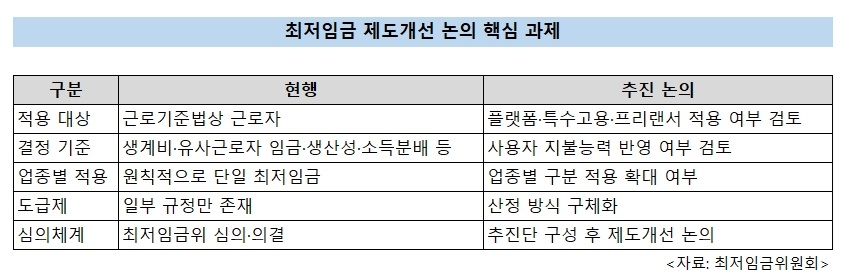
South Korea's minimum wage system, whose basic framework has remained largely unchanged for nearly four decades, is set to undergo a sweeping overhaul. The public-interest members of the Minimum Wage Commission have formally recommended that the Ministry of Employment and Labor establish a "minimum wage system reform task force," signaling the start of a broad review covering whether platform, special-employment and piece-rate workers should be covered, as well as the criteria used to set the wage and the overall deliberation structure.
According to the government Wednesday, the commission's public-interest members issued the recommendation at a plenary session held Tuesday, calling on the ministry to comprehensively review the current system's scope of coverage and the criteria for setting the minimum wage, develop improvement measures, and prepare findings in time to inform next year's minimum wage deliberations.
The public-interest members' formal call for reform reflects a growing frustration that minimum wage deliberations have stalled year after year over the same disputes, even as the labor market undergoes rapid change driven by the spread of AI, the rise of platform work and a broader restructuring of industry.
The push has also been shaped by international developments: the International Labour Organization has begun work on global employment standards for platform workers in ride-hailing and food delivery. A Seoul High Court ruling recognizing delivery riders as workers under the Labor Standards Act — the first appellate decision of its kind — has further expanded the legal debate over how labor law applies to platform work.
This year's deliberations touched on the scope of coverage under Article 3 of the Minimum Wage Act, the criteria for setting the wage under Article 4, and the application of the minimum wage to piece-rate workers under Article 5, Paragraph 3 — but proposals on all of these points failed to reach agreement and were voted down. Labor representatives pushed to extend minimum wage coverage to workers in special employment, platform and freelance arrangements, while management argued for sector-specific differentiated rates and for factoring in employers' ability to pay. Neither side could find a solution within the existing legal framework, and all related proposals were rejected.
Commission Chairman Kwon Sun-won told reporters that "applying the minimum wage to piece-rate and platform workers is difficult to resolve under the current system alone," adding that the intent of the recommendation was for the Ministry of Employment and Labor to form a task force, conduct field surveys and gather on-site opinions before developing reform proposals.
The task force is expected to take up a wide range of issues: whether platform workers should be covered, whether employers' ability to pay should factor into the wage-setting criteria, whether sector-specific differentiation should be expanded, how to calculate the minimum wage for piece-rate workers, and how to improve the overall deliberation and decision-making process.
The system's broader structural limitations also drew fire. Labor and management narrowed the gap between their final proposals to 30 won through 13 rounds of revisions, but still could not reach agreement, and the minimum wage was decided by a vote. Chairman Kwon said the vote with a 30-won gap was "in effect equivalent to a consensus," but added that "similar disputes have repeated over the past three years, and the current system makes it difficult to accommodate the demands of both sides — reform is necessary."
Controversy over the deliberation-facilitation range resurfaced this year as well. The public-interest members calculated the upper bound of the range using economic growth and inflation forecasts from the Bank of Korea and the Korea Development Institute, but did not incorporate the government's own economic outlook released the same day. The employment growth rate, which had been included last year, was also left out this year. Chairman Kwon said the deliberation-facilitation range "is not a target but a tool to encourage labor-management agreement," and that "the criteria can change each year as economic conditions and the parties' revised proposals are weighed together."
Critics, however, note that the methodology shifts from year to year even when the same economic indicators are used, and that without objective criteria, predictability and acceptance of the outcome suffer — a concern raised repeatedly each year. The Minimum Wage Act contains no separate provision specifying how public-interest members must calculate the deliberation-facilitation range, and the resulting opacity has repeatedly prompted one side to walk out of sessions in protest.
Reforming the minimum wage system is also part of the Lee Jae Myung government's policy agenda. The government has included "improvements to the operation of the Minimum Wage Commission and the criteria for setting the minimum wage" among its national policy tasks. With the public-interest members' recommendation for a task force now added to the mix, a broader overhaul of the wage-setting framework — in place since the system was introduced in 1988 — is expected to gain momentum.
fact0514@heraldcorp.com