

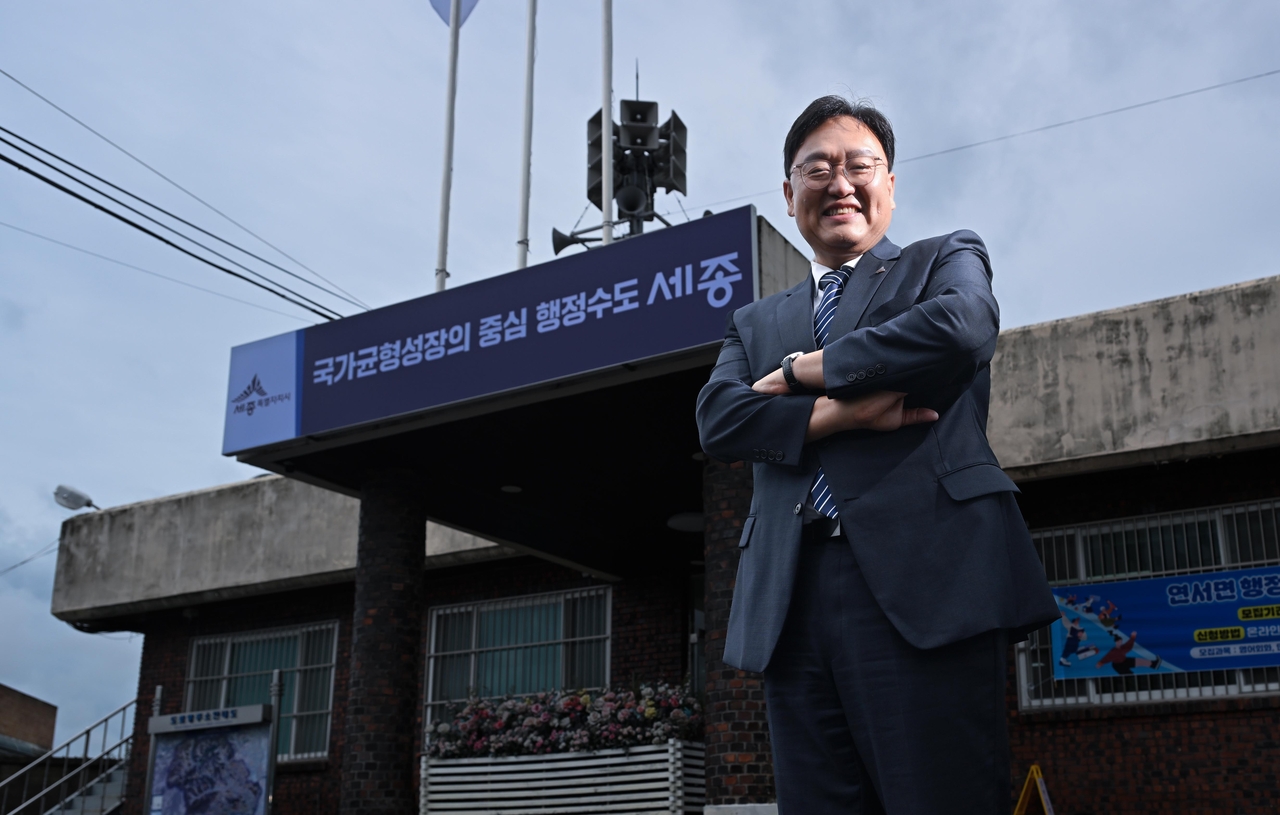
Sejong Mayor Jo Sang-ho sat down for an interview not at City Hall but at the Bongam branch office — a small administrative outpost in Yeonseo-myeon — on Thursday, just days after taking office Monday. Jo has converted part of the branch, originally set up to handle routine civil paperwork, into a personal field office, splitting his time between it and the main City Hall building. The modest space may seem an unlikely choice for the chief executive of a metropolitan city of 400,000 people, but Jo chose it for its proximity to the Sejong Smart National Industrial Complex. "My judgment is that completing the smart national industrial complex is the key to building a self-sufficient city," he said. "I chose this as my field office so I could resolve residents' concerns quickly and provide the necessary support from as close to the site as possible." The Korea Herald met Jo at the Bongam branch office to hear his plans for Sejong's long-stalled development and his approach to the overarching challenge of enacting the special administrative capital law.
— The interview venue is unusual. It's a small branch office near the industrial complex, not City Hall. I also heard you use the former deputy mayor's night office at City Hall rather than the main mayoral suite.
Sejong originally grew out of South Chungcheong Province's Yeongi County, so it has very little industrial base. Back in 2017, I proposed that Sejong should have a national industrial complex as part of then-President Moon Jae-in's campaign pledges. After difficult negotiations, it was included as a presidential pledge. Ten years on, land compensation is only now nearing completion. During the campaign I promised residents I would run a field office near the site — even out of a shipping container if necessary — until there was a clear picture of which major companies would move in. I was elected, so I have to keep that promise. When I looked into using the industrial complex site itself, there were legal issues, and while I was exploring a private office rental, staff suggested this space was sitting empty and offered it to me. That's how I ended up at the Bongam branch office.
— Sejong's fiscal difficulties are one of the problems that must be solved. I understand the city expects a shortfall of more than 100 billion won ($66.5 million) in the second half of this year alone.
Sejong is a little more than ten years old as a city, and this year and next are shaping up to be the most financially difficult yet. The city has run a deficit of around 100 billion won for three consecutive years. That figure alone is not catastrophic, but consecutive deficits force deep cuts to services residents depend on and make it impossible to carry out essential work. That breeds a kind of helplessness among staff — when there is no money to act on ideas, confidence erodes. At the current trajectory, there is a real risk that next year Sejong could become the first of the country's 16 metropolitan governments to be designated a fiscally at-risk local authority.
Under the Local Finance Act, a local government whose debt-to-budget ratio exceeds 25 percent is designated a "Caution" authority and must draw up and report a fiscal stabilization plan. A ratio above 40 percent triggers a "Serious" designation.
Jo devoted much of the interview to the fiscal problem. "The root cause of the shortfall is that when the city was established, no one designed a fiscal structure suited to its legal status as a special autonomous city," he said. "The single-tier structure — where Sejong City Hall handles all administrative functions directly without any subordinate district offices — and the city's heavy reliance on acquisition tax revenue have compounded the problem."
He added that normalizing the fiscal structure was the only path to stable finances. "On the revenue side, we need to simultaneously pursue a fixed-rate system for the general local allocation tax, make use of Korea Land and Housing Corporation development levies, and broaden the tax base," he said. "On the spending side, the fiscal stabilization task force we have been running since the transition team will be formally launched at the city level, and we plan to conduct a comprehensive review of projects and spending patterns that have continued simply out of habit."
— The allocation tax issue persists. Sejong receives only 6.5 percent of what Jeju Island gets in general local allocation tax. I understand you are pushing for a fixed-rate system.
When Jeju merged its metropolitan and basic local governments, it received a special provision entitling it to a fixed 3 percent of the total general local allocation tax pool — about 1.8 trillion won a year. With a population of 670,000, that works out to roughly 2.71 million won per resident. Sejong, by contrast, operates under a fiscal special provision rather than a fixed-rate system. The support it receives is unstable and has been kept alive only through repeated sunset extensions. Last year Sejong received 115.9 billion won in general local allocation tax — about 300,000 won per resident for a population of 390,000. The fundamental solution is to increase the total allocation tax pool and introduce a fixed-rate system for Sejong like the one Jeju enjoys. The general local allocation tax is currently set by law at 19.24 percent of total domestic tax revenue, so the overall pool is finite. The 2025 total was 60.4 trillion won. The key is to grow the overall pie by raising the statutory rate. Alongside efforts to expand the total pool, the Sejong City Act must be amended to introduce a fixed-rate allocation for Sejong. The current system effectively passes the cost of completing the administrative capital on to Sejong's own residents. We continue to press the Ministry of Interior and Safety for reform of the general local allocation tax system.
— Once the planned presidential office and National Assembly building are established in Sejong, the city is expected to take its place as the administrative capital. I understand you are also pushing for a separate special administrative capital law.
The relocation of the National Assembly's Sejong chamber and the president's second executive office has been confirmed, but Sejong's status as the administrative capital has yet to be codified in law or institutional frameworks. That has made it difficult to build the fiscal infrastructure the administrative capital needs. The slogan I chose for the fifth term of city government — "Sejong, Administrative Capital at the Heart of Balanced National Growth" — reflects my determination to complete the administrative capital within my term. "National spatial transformation" is a concept I introduced when I served as deputy head of the policy bureau during last year's presidential election campaign; the idea is to expand the space in which the country is governed and its territory managed, using the administrative capital as the vehicle. Frankly, Sejong is currently called an "administrative and multipurpose city," but the reality is somewhat ambiguous — it feels like we are only halfway there. Staying at half-measures will place a considerable burden on how the country is actually run. When I helped draft the presidential campaign pledges and national policy agenda, one of the items I wrote was "completing Sejong as the administrative capital," and it included a presidential commitment to pursue the enactment of a special administrative capital law. The president has already made that promise. The Democratic Party of Korea also made a firm commitment — then-party leader Jung Chung-rae pledged during the local elections to push the special administrative capital law through without fail. The People Power Party has also indicated its support, so the conditions are not unfavorable. I regard this year as the golden window for the special administrative capital law, and I am working to make it happen before the year is out.
— If the special administrative capital law passes, what changes for ordinary citizens?
The framework for governing the country changes. The central axis of politics and administration in Korea shifts. Seoul has played that role since 1392, but in politics and administration, Sejong now becomes the center. When you look at the world through Seoul's eyes, everything seems fine — Seoul is a magnificent city on its way to standing among the world's great metropolises. But when you look at Korea through Sejong's eyes, you see how everything is crammed into Seoul. The overload is immense and the costs are soaring. If even 10 percent of that concentration were redistributed, Seoul would become leaner and far more competitive.
Jo then brought up two figures, now deceased, whose lives were bound up with the administrative capital project: former President Roh Moo-hyun and former Prime Minister Lee Hae-chan. "When the administrative capital takes shape, I expect it to bring the greatest change in how this country is run," he said. "That is what the late President Roh and Prime Minister Lee worked toward. Making it real is my dream."
Throughout the interview, Jo wore on his left wrist a watch associated with President Lee Jae Myung. According to a post Jo published on his SNS account on Feb. 23, the watch originally belonged to the late former Prime Minister Lee Hae-chan. After Lee Hae-chan's death, his wife, Kim Jeong-ok, gave it to Jo as a keepsake. Jo served as an aide to Lee Hae-chan when Lee represented Sejong in the National Assembly, and was sometimes called Lee's "political son."
Jo also has ties to President Lee Jae Myung. He served as a member of the political and administrative subcommittee of the National Policy Planning Committee, which functioned as the transition team for the Lee Jae Myung administration. During the campaign, Jo was known for frequently saying he would "fight like Lee Hae-chan and work like Lee Jae Myung."
— What is your thinking on research and development?
Many business leaders came to Sejong with high hopes, drawn by the administrative capital title, but the city's population is still only around 399,000. The city's capacity has not yet matched expectations. Despite housing the central government, Sejong has struggled to generate synergies from that presence. I think the largest enterprise in Sejong is the state itself — an organization with annual revenue of around 760 trillion won and a workforce of more than 30,000, doing business across the entire country and performing strongly in overseas markets as well. From Sejong's perspective, the priority is to get that enterprise to conduct as much of its business as possible within the city. Connecting other companies and their suppliers to that central-government enterprise so they do business here in Sejong — that is one of the most important tasks I have.
— Sejong takes its very name from King Sejong the Great, so the city has long paid close attention to hangul and Korean cultural heritage. The Hangeul Run event has also been drawing attention.
The Hangeul Run is a wonderful event and I want to see it grow. It is one of the running events young people love most right now, so there is strong interest. Sejong is also naturally flat, which makes it an ideal city for marathon events.
— Is there a campaign pledge or policy you are absolutely determined to deliver during your four-year term?
I will make sure to deliver on both "completing the self-sufficient city" — my first directive — and "the administrative capital" — my second directive — and return tangible, felt results to residents. I will not forget the commitment I made before taking office to be a "useful public servant" for the people of Sejong, and I will lead the fifth term of city government with that spirit. The keyword running through this term is "citizen communication." The guiding principle I have adopted — "시민여상," a classical phrase meaning "look after residents' lives as you would tend your own wounds" — captures what I believe local government is fundamentally about: putting residents' lives first. Four years from now, in 2030, Sejong enters its completion phase: the relocation of national institutions will become visible and the multipurpose self-sufficient city will take shape. If residents look back on these four years as Sejong's golden era, I will consider my duty fulfilled.
Mayor Jo Sang-ho — career highlights
Born in Seoul, 1970
Graduated from Dankook University High School, 1989
Graduated with a degree in public administration from Konkuk University's Glocal Campus, 1996
Master's degree in political science and diplomacy, Korea University, 1999
Doctoral coursework in political science and diplomacy, Korea University, 2004
Chief of political coordination, Democratic Party of Korea leadership office, 2018
Political deputy mayor of Sejong, 2019
Economic deputy mayor of Sejong, 2020
Vice president, Democratic Research Institute; member, National Policy Planning Committee of the Lee Jae Myung administration, 2025
Fifth mayor of Sejong Special Autonomous City
ikson@heraldcorp.com





