![Deputy Prime Minister and Minister of Economy and Finance Koo Yun-cheol [Herald Business DB]](https://wimg.heraldcorp.com/news/cms/2026/07/15/news-p.v1.20260703.f9b4ac1db400461086d0661586df9d43_P1.jpg)
The government plans to fundamentally shift how it manages more than 1,400 trillion won ($938 billion) in state assets — moving away from a preservation-and-disposal approach in place for 76 years toward a value-creation model. At the same time, it will push ahead with internationalizing the won so that foreigners can freely trade the currency overseas, and will establish a "K-development finance" framework to support private-sector projects in developing countries through equity investment and guarantees.
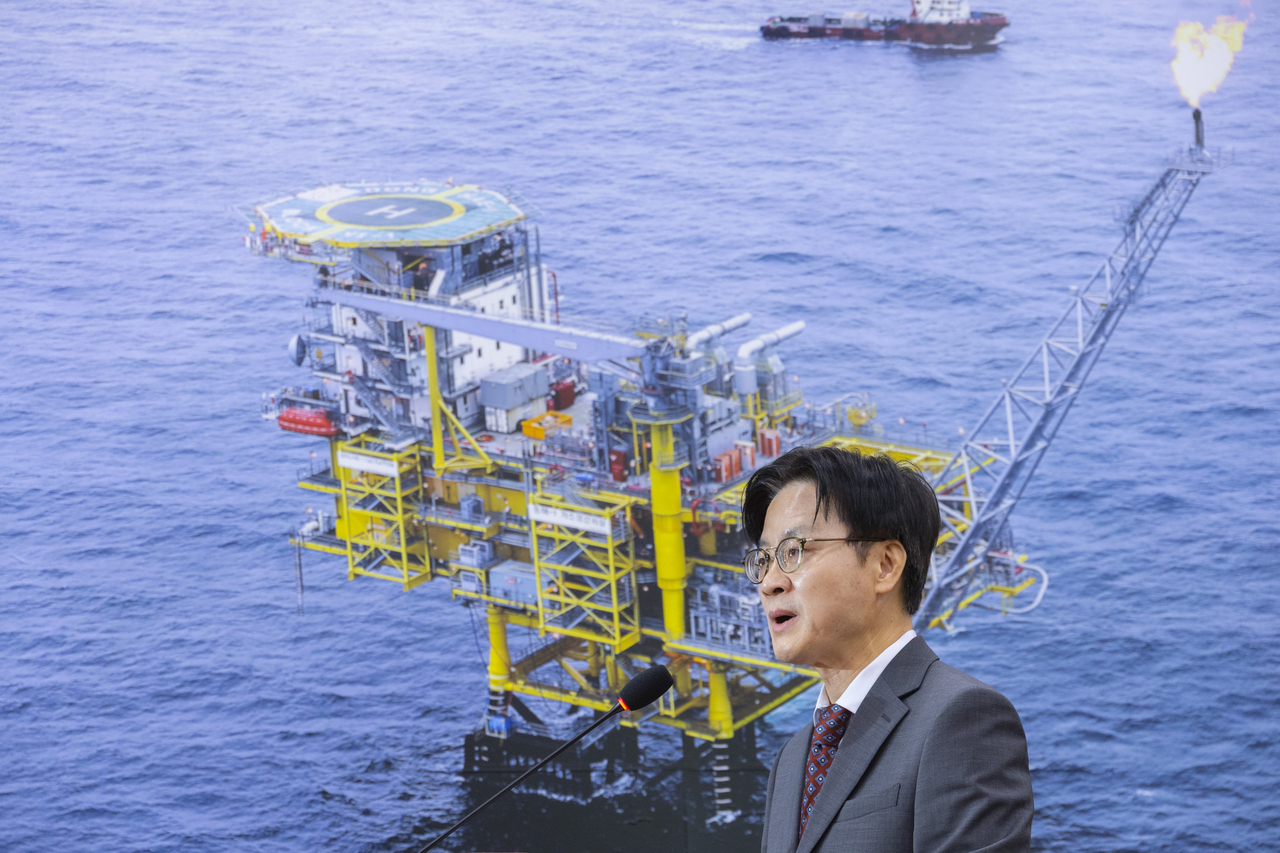
Deputy Prime Minister and Minister of Economy and Finance Koo Yun-cheol presented these key second-half priorities at a ministerial briefing held Wednesday at Cheong Wa Dae's state guesthouse.
As a first step, the government will pursue legislation of a Basic Law on State Assets that would fundamentally restructure how public property is managed. The current State Property Act, enacted in 1950, was designed around a real estate-centric asset structure and has struggled to accommodate new asset types such as intellectual property and virtual assets.
According to the Ministry of Economy and Finance, the total value of state property surged from 188.3 trillion won in 2001 to 1,402.7 trillion won last year.
In response, the government plans to make the comprehensive state property survey — currently conducted every five years — an annual exercise, and to incorporate new asset types such as virtual assets into the national asset registry. It also aims to expand the ministry's coordinating role and make greater use of specialized agencies such as Kamco to strengthen development oversight and expertise. Returns from the securitization of state-owned real estate through security token offerings will be shared with the public.
The government will also pursue won internationalization, starting with the introduction of an offshore won settlement system in January next year. It plans to expand incentives for current-account transactions denominated in won and build a nighttime won liquidity supply framework to boost both demand and supply simultaneously. A detailed roadmap will be released this month.
Tax and fiscal reform is another priority. All tax expenditures will be reviewed from scratch, with unnecessary programs to be abolished. The family business inheritance deduction system will be completely redesigned to prevent inheritance tax avoidance, and a rational improvement plan for real estate taxation will be drawn up after gathering public input.
Tapered brackets will be introduced for the special tax reduction for small and medium-sized enterprises and for tax credits on production costs for video and webtoon content, creating a buffer so that tax support does not drop sharply as companies grow into mid-sized firms.
A new "productive finance ISA" will also be created to support long-term investment in domestic shares. Details will be disclosed in a tax reform package to be announced as early as this month.
To address "K-shaped polarization," the government will prepare measures targeting youth, small and medium-sized enterprises, and small business owners. The Ministry of Economy and Finance will take the lead in coordinating polarization-reduction policy through a structural reform ministers' meeting.
On development finance, the government will establish a K-development finance framework under which public financial institutions mobilize private capital to support private-sector projects in developing countries through equity investment and guarantees.
The Economic Development Cooperation Fund will have its interest rate structure revamped, and a "K-AI package" bundling AI solutions, data centers and renewable energy will be developed to shift the fund's support focus toward AI. To prevent fraudulent disbursements of public funds, the government will introduce a blockchain-based model — a world first — in which payments are made using deposit tokens.
AI will also be integrated into public institutions. An AI utilization competition called "Innovation Challenge," open to all public enterprises and quasi-governmental agencies, will be held, with the top 20 selected for recognition.
Legal grounds for dismissing the heads of public institutions where serious workplace accidents occur will be established in the third quarter. The government will also make an all-out push to pass 13 priority bills — including the Strategic Export Finance Support Act and the Basic Act on Service Industry Development — within the year.
Nine national normalization tasks in the economic sphere will also be completed this year. To cut the economic incentives for hoarding and cornering markets, new penalty surcharges and whistleblower rewards will be introduced, while unauthorized occupation of state property will be eradicated through higher compensation rates and administrative enforcement.
The Ministry of Economy and Finance on Tuesday reiterated the "3-4-5 economic leap" targets — a potential growth rate of 3 percent, ranking among the world's top four exporters, and per capita national income of $50,000 — set out in its second-half economic growth strategy.
In particular, the government plans to provide full support — including allowing discretionary contracts for state-owned land and reducing usage and lease fees on state property — to advance three mega-projects aimed at raising the potential growth rate.
oskymoon@heraldcorp.com