![Hwang Seong-yeop (far right), chairman of the Korea Financial Investment Association, speaks at an emergency meeting of securities firm executives held Tuesday at the association's office in Yeouido, Seoul. The association and CEOs of 10 major brokerages discussed market conditions surrounding single-stock leveraged ETFs and investor protection measures. [Yonhap]](https://wimg.heraldcorp.com/news/cms/2026/07/15/rcv.YNA.20260714.PYH2026071419960000800_P1.jpg)
The securities industry has taken its first steps toward self-regulation of single-stock leveraged ETFs, raising minimum deposit requirements and tightening investor education to cool overheated trading. However, with daily trading in these products topping 18 trillion won ($12.1 billion) and some funds losing more than half their value since the start of the month, whether self-regulation alone can protect investors and stabilize the market remains to be seen.
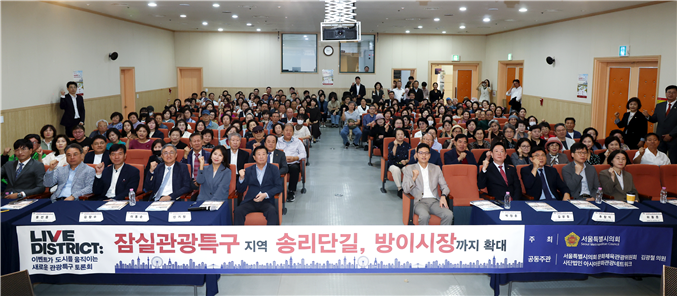
The Korea Financial Investment Association convened an emergency meeting Tuesday, summoning the CEOs of 10 major brokerages — including Mirae Asset Securities, Korea Investment & Securities and NH Investment — under the chairmanship of Hwang Seong-yeop to discuss stronger investor protections for single-stock leveraged ETFs. The gathering marked the industry's first collective response after financial regulators asked both brokerages and asset managers to draw up investor protection and market stabilization plans.
The central topic was raising the minimum deposit required to invest in single-stock leveraged ETFs. Currently set at 10 million won, the threshold is set to be lifted as the industry agreed to tighten entry requirements. Participants also agreed to strengthen mandatory pre-investment education and expand tailored risk disclosures based on investors' age and risk appetite.
Measures to reduce market volatility were also on the agenda. Acknowledging criticism that rebalancing trades concentrated just before the market close amplify price swings in underlying assets, the industry agreed to explore ways to strengthen the market-stabilizing role of liquidity providers and spread rebalancing activity more evenly throughout the trading day.
The meeting also examined the broader market impact of single-stock leveraged ETFs. Participants agreed that the effect on underlying markets should be assessed based on the actual volume of shares needed for daily rebalancing, rather than total trading value. According to the Korea Capital Market Institute, the daily equity trading required for rebalancing since the launch of these products is estimated at between roughly 700 billion won and as much as 2.1 trillion won.
The industry's move toward self-regulation reflects mounting signs of market overheating. According to Korea Exchange, trading in 16 single-stock leveraged and inverse ETFs tied to Samsung Electronics and SK Hynix reached 18.27 trillion won on Tuesday — about 39 percent of total ETF trading volume of 46.86 trillion won that day. That was more than 6 trillion won higher than Monday's figure of 12.16 trillion won.
Investor losses are also mounting rapidly. From the start of this month through Tuesday, Samsung Electronics single-stock leveraged ETFs posted an average return of minus 42.1 percent, while SK Hynix single-stock leveraged ETFs averaged minus 53.5 percent. Those losses were nearly double the declines in the underlying stocks — Samsung Electronics fell 21.26 percent and SK Hynix 27.81 percent over the same period — laying bare the amplified risks inherent in leveraged structures.
Market sideline cash is also draining quickly. According to the Korea Financial Investment Association, investor deposits peaked at 139.69 trillion won on June 4 before falling to 105.58 trillion won on Friday. They edged back up to 109.12 trillion won on Monday but remain below 110 trillion won. Analysts attributed the rapid outflow to retail investors stepping in to absorb foreign selling during the market downturn, deploying their cash into stocks at lower prices.
As the search for solutions grows more urgent, financial authorities are also accelerating work on additional measures.
President Lee Jae-myung, receiving the Financial Services Commission's work report at Cheong Wa Dae on Wednesday, directed officials to "swiftly draw up remedial measures" for Samsung Electronics and SK Hynix leveraged ETFs. Lee asked, "It seems a lot of people have been hurt recently because of the Samsung and SK Hynix ETFs — isn't Korea Exchange also in an uproar over the ETF situation?" Financial Supervisory Service Governor Lee Chan-jin replied, "As the market supervisor, we bear responsibility for this and are accepting that responsibility."
Cheong Wa Dae said in a press notice Tuesday that "matters related to leveraged ETFs are being reviewed by the F4 — the Ministry of Economy and Finance, the Bank of Korea, the Financial Services Commission and the Financial Supervisory Service — and we understand that countermeasures are also being prepared." Also on Tuesday, FSC Secretary-General Shin Jin-chang told a pre-briefing for the second-half work report that the four institutions were "deliberating and discussing measures at a market monitoring meeting, taking into account the market impact," adding that an announcement would be made "at an appropriate time once things are sorted out."
However, there is considerable debate over the direction any regulatory fix should take. While there is broad consensus on the need for tighter rules, concerns have also been raised that overly restrictive regulation could push investment demand toward similar products overseas.
Finding the right balance between investor protection and market function is proving difficult. FSS Governor Lee was quoted at a meeting with asset management CEOs on Monday as saying that single-stock leveraged ETFs present "a structural problem, making it hard to find a clear answer." Earlier, on July 7, he warned that investing with leverage beyond one's tolerance could damage not only returns but household financial health. At a press briefing on June 22, he said he personally regretted not having done more to block the products when their prospectuses were first filed, remarking, "I deeply regret that I didn't lie down in the road to stop them if I had to."
Experts say the impact of single-stock leveraged ETFs on the broader market warrants ongoing scrutiny. Jang Geun-hyeok, a senior research fellow at the Korea Capital Market Institute, said that while "single-stock ETFs are structurally prone to rebalancing trades that can amplify volatility, the recent market turbulence is the result of multiple factors acting together — including the macroeconomic environment and swings in global semiconductor stocks." He added that "it will be necessary to continuously monitor how rebalancing trades affect the market as assets under management grow and during periods of heightened volatility."

hajun825@heraldcorp.com