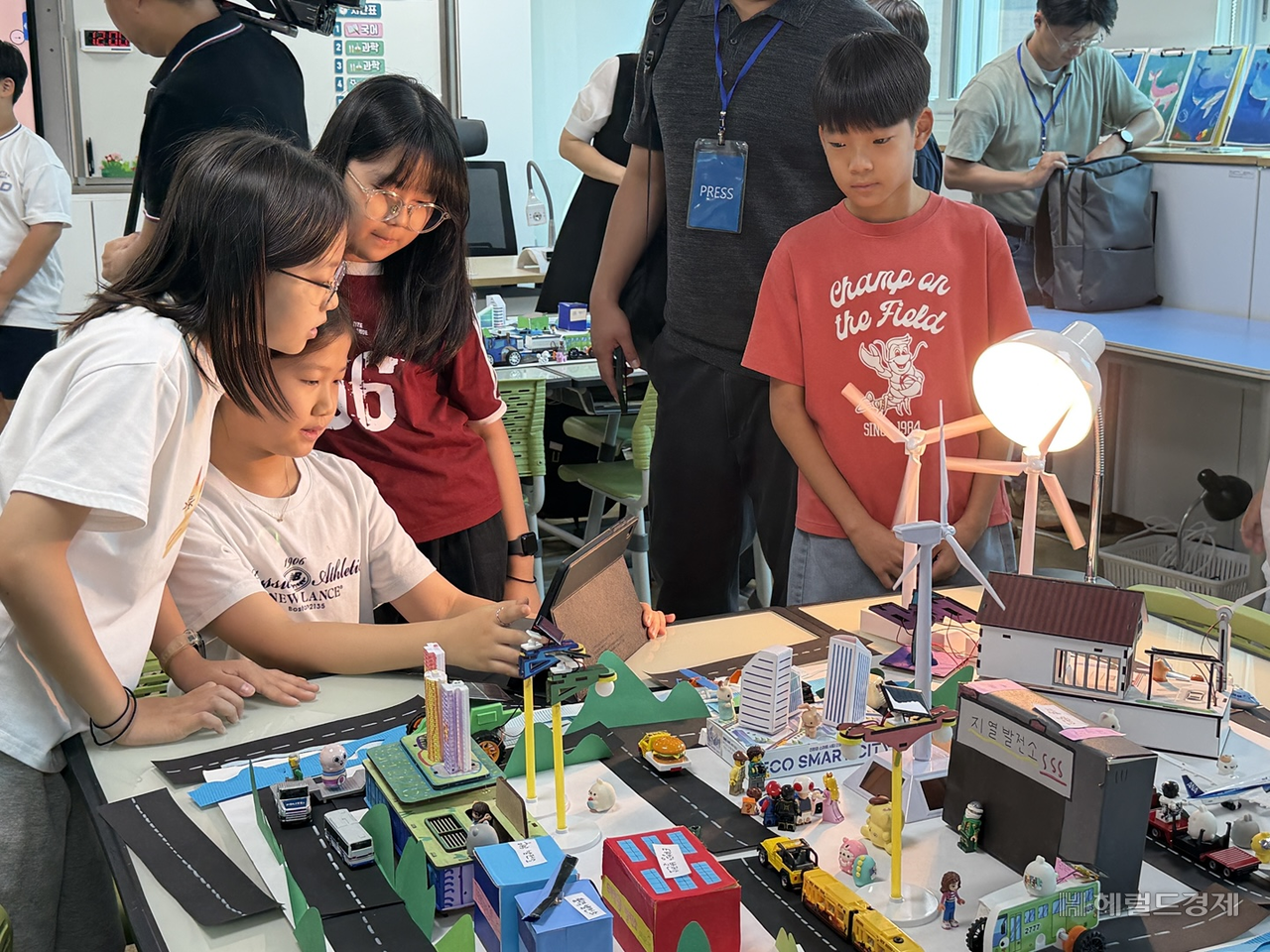
"Why should we use renewable energy?"
"To save money." "To reduce pollution."
Around 10 a.m. Wednesday, inside a fifth-grade classroom at Bokdae Elementary School in Cheongju, North Chungcheong Province, students shot up their hands without hesitation to answer their homeroom teacher's question. The class then broke into groups to design an "eco-friendly future city," selecting from solar, wind, hydroelectric and geothermal energy sources based on each region's geography and climate.
Group 4, assigned Jeju Island, announced they would use geothermal energy because the island is volcanic, marine energy because it is surrounded by sea, and wind power because of the island's strong winds. Other students explained that the right energy source differs by region depending on terrain and environment. At the end of the lesson, students pledged personal commitments to the environment — not wasting food, using reusable tumblers and cutting back on single-use products.
The Ministry of Education this year launched the Haetbit-ium School project, a solar-linked education initiative that aims to install solar equipment at all national and public elementary, middle and high schools and connect the infrastructure to ecological transition education. The goal is to transform schools from mere electricity consumers into educational spaces where energy is both produced and learned about.
![Education Minister Choi Kyo-jin inspects solar panels installed on the rooftop of the main building at Bokdae Elementary School in Cheongju, North Chungcheong Province, on Wednesday morning. [Ministry of Education]](https://wimg.heraldcorp.com/news/cms/2026/07/16/news-p.v1.20260715.a277b3e78df84ed793c3aff54ece7c8a_P1.png)
Bokdae Elementary is one of the pilot schools for the Haetbit-ium School project. When the school relocated in March 2023, it invested about 1.1 billion won ($737,000) under the New and Renewable Energy Act to build a solar power system with a total capacity of 347.8 kilowatts. The main building's rooftop holds 207 kW of conventional photovoltaic panels, while the multipurpose classroom rooftop carries 140.8 kW of building-integrated photovoltaic, or BIPV, panels. A monitor on the first floor lets students check real-time solar generation as they pass by.
On the main building's rooftop, hundreds of solar panels are arranged at a uniform angle toward the sun. On the gymnasium roof, BIPV panels serve as both the building's exterior cladding and its power source, generating electricity while functioning as the outer facade. A school official said that on sunny days generation increases significantly, and during summer the school covers more than half its electricity needs with power it produces itself.
Last year, Bokdae Elementary met about 42 percent of its electricity consumption through solar generation. From May through August, that share exceeds 50 percent. By consuming the solar-generated electricity on site, the school saves roughly 52 million won in annual electricity bills and cuts greenhouse gas emissions by about 183 metric tons a year.
Surplus electricity is sold to Korea Electric Power Corporation. Including revenue from sales through a self-use PPA arrangement, the annual value of the solar installation amounts to about 50.9 million won. The school channels the savings into support for at-risk students, educational activities and school operations.
Cutting national emissions while linking to carbon neutrality education
![Education Minister Choi Kyo-jin listens to school officials share feedback on the Haetbit-ium School pilot project during a visit to Bokdae Elementary School in Cheongju, North Chungcheong Province, on Wednesday morning. [Ministry of Education]](https://wimg.heraldcorp.com/news/cms/2026/07/16/news-p.v1.20260715.6c66b2e5f7224e08ac22f027ee864cb0_P1.png)
The push to expand solar installations at schools reflects South Korea's heavy dependence on energy imports, which stood at 94 percent last year. Fluctuations in international energy prices and supply uncertainty ripple across the broader economy. With prolonged heat waves driving up cooling demand at schools and raising electricity costs, the case for expanding on-site generation has grown stronger.
School officials raised points for improvement, however, given that the Haetbit-ium School program is still in its pilot phase. Bokdae Elementary principal Hong Ran-su said the solar installations offer significant educational value beyond cutting electricity bills by giving students hands-on experience with renewable energy. She added that management manuals need to be made easier for anyone to understand and use — a particular concern given the rotating staff assignments common in schools — and that the burden of maintenance and aging equipment must also be factored in.
The Ministry of Education plans to expand the Haetbit-ium School program in stages, starting with this year's pilot schools. Solar equipment has so far been installed at 34.6 percent of national and public elementary, middle and high schools. Going forward, the ministry will develop school-specific education models alongside further solar rollouts so that renewable energy production and ecological transition education can be naturally integrated across schools nationwide.
After observing classes at Bokdae Elementary on Wednesday, Education Minister Choi Kyo-jin said the Haetbit-ium School project is not simply about saving energy or cutting greenhouse gas emissions, but about making schools the central space for climate change and ecological transition education. He said the ministry would actively incorporate feedback from the field — including improvements to management manuals and maintenance support — to refine the program going forward.
newday@heraldcorp.com