![Travelers line up to check in at Incheon International Airport on Thursday ahead of the Constitution Day holiday weekend. [Yonhap]](https://wimg.heraldcorp.com/news/cms/2026/07/16/rcv.YNA.20260716.PYH2026071603550001300_P1.jpg)
Korean Air will cut its international fuel surcharge for the third consecutive month. With Level 14 taking effect in August, the one-way surcharge on its longest-haul routes — including New York, Dallas and Boston — will fall 84,800 won ($57) from the previous month.
Korean Air set its August international fuel surcharge at Level 14 on Thursday. On a one-way basis, the charge ranges from a minimum of 35,200 won to a maximum of 259,200 won depending on the route.
The surcharge was calculated using fuel prices recorded from June 16 through Wednesday. The average fuel price over that period was 283.48 cents per gallon, or $119.06 per barrel.
As a result, the international fuel surcharge has fallen for three straight months — from Level 33 in May to Level 27 in June, Level 19 in July and now Level 14 in August. The Level 33 applied in May was the highest since the current fuel surcharge system was introduced in 2016.
The August surcharge has also fallen below the 303,000 won recorded in April, when the Middle East crisis first drove prices higher. Compared with the peak of 564,000 won in May, the charge has dropped by more than half in three months, in effect returning to pre-crisis levels.
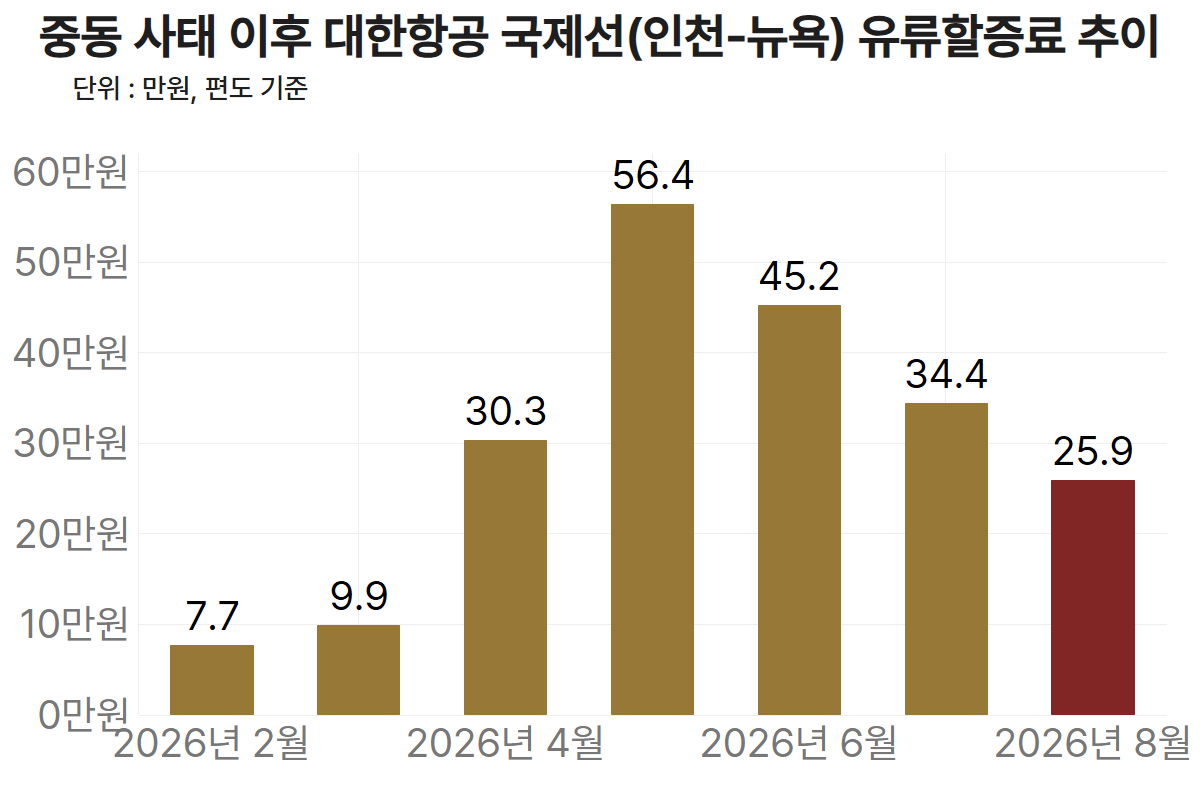
Passengers on long-haul routes will also see significantly lower costs. The one-way surcharge on the longest routes — New York, Dallas and Boston — dropped from 451,500 won in June to 344,000 won in July and will fall further to 259,200 won in August.
That represents a reduction of 84,800 won from the previous month and 192,300 won from June. On a round-trip basis, passengers will save 169,600 won and 384,600 won, respectively.
However, a full return to stability may be premature. Tensions between the United States and Iran over the Strait of Hormuz are rising again, and strategic reserves and private inventories are being drawn down rapidly, heightening concerns about further supply shortages. Because fuel price movements after Wednesday feed into the September surcharge, a renewed rise in global oil prices could push airfare costs back up.
A fuel surcharge is an additional charge airlines levy on top of the base fare to offset rising fuel costs. It is applied at the time of ticketing, not at the time of travel. Under the Ministry of Land, Infrastructure and Transport's distance-proportional system, the surcharge is set monthly based on the average MOPS price from the 16th of two months prior to the 15th of the previous month and applied on a sliding scale according to flight distance for international routes. The prevailing won-dollar exchange rate over the same period is also factored in, meaning surcharge increases are amplified during periods of dollar strength such as those seen recently.
Airlines can pass on through fuel surcharges only about half of the total increase in fuel costs. Korean Air hedges roughly 50 percent of its annual fuel consumption but must absorb the remaining cost burden itself.
The surcharge reduction is expected to support overseas travel demand during the summer holiday season. After the surcharge fell from Level 33 to Level 27, overseas travel bookings at Hanatour Service and Modetournetworkinc rose about 30 percent each from the previous week in mid-June.
kwater@heraldcorp.com