"The share of people in their 20s and 30s among low-income households has more than doubled over the past five years. Earnings are shrinking, yet 31 percent of the minimum wage is being swallowed up by rent — resolving this brutal double burden is the most urgent livelihood issue the National Assembly must tackle first," said Rep. Bok Ki-wang of the Democratic Party of Korea.
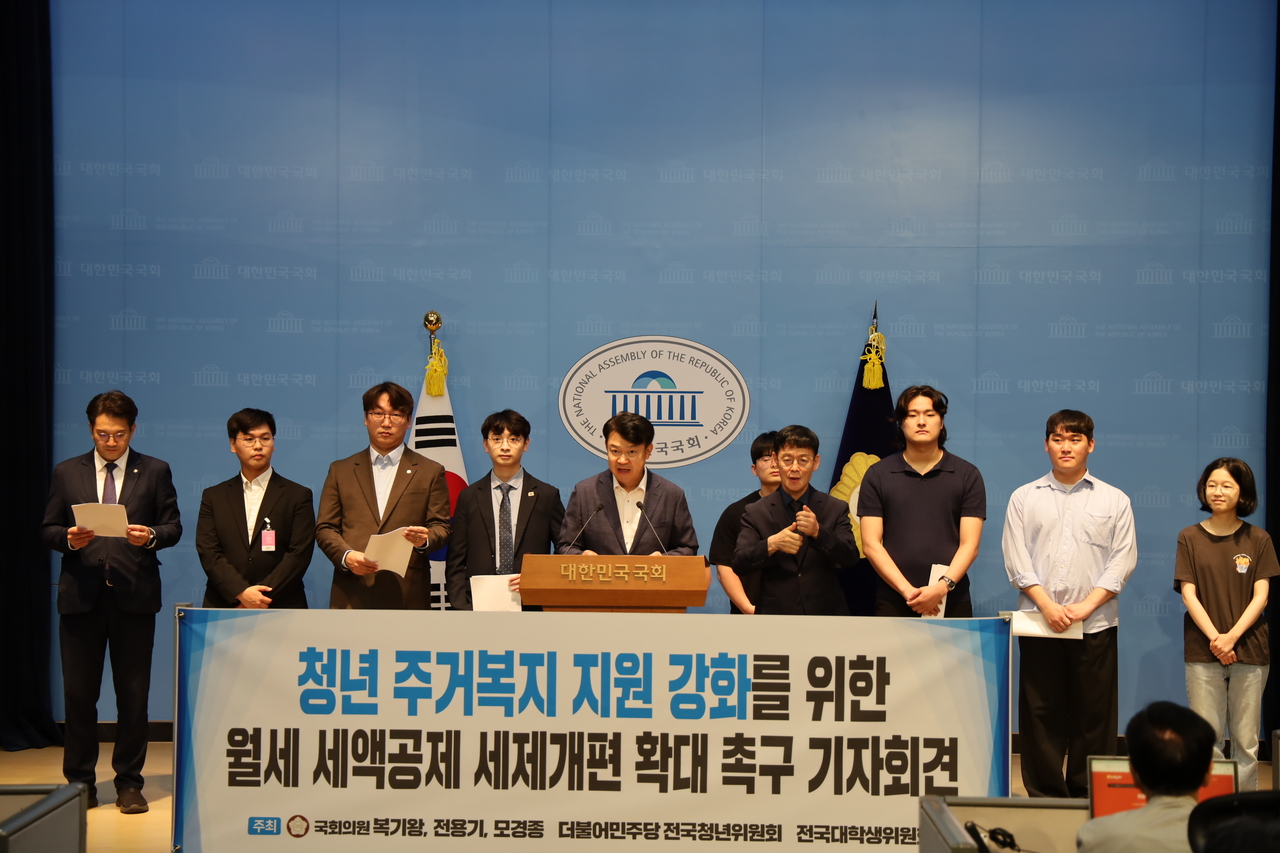
Rep. Bok Ki-wang (Asan, South Chungcheong Province), the Democratic Party's floor whip on the National Assembly's Land, Infrastructure and Transport Committee, joined fellow Democratic Party lawmakers Rep. Jeon Yong-gi and Rep. Mo Gyeong-jong — who also chairs the party's national youth committee — along with Lee Dong-won, senior vice chair of the party's national university students committee, at a joint press conference at the National Assembly on Thursday to announce a proposed amendment to the Restriction of Special Taxation Act aimed at expanding the monthly rent tax credit and easing the housing cost burden on young and non-homeowning low-income renters. They called strongly for swift tax reform.
The press conference was convened to address the housing instability facing young and low-income renters who have been pushed into the monthly rent market by prolonged high interest rates, high inflation and the fallout from jeonse fraud — a scheme in which landlords collect large deposits and fail to return them.
A recent housing survey found that 82.6 percent of young Koreans live as renters and spend as much as 31 percent of the minimum wage on housing costs including monthly rent, with growing concern that they are being driven into a de facto "rent poor" zone.
Rep. Bok said it was urgent to shift the focus of housing policy toward youth housing welfare, and announced that he was introducing the amendment to the Restriction of Special Taxation Act on Thursday.
Rep. Jeon cited National Tax Service data, noting that over the past decade the total value of monthly rent tax credits had surged 9.5-fold — from 41.4 billion won ($27.8 million) to 395.5 billion won — while the number of beneficiaries had jumped 5.4-fold, from 160,000 to 870,000. He added that roughly seven in 10 credit users, or 68.4 percent, were working-class earners with total annual wages of 50 million won or less. "Yet the current law caps the annual deduction limit at 10 million won with a credit rate of 15 to 17 percent, which bears no relation to the actual average monthly rent in Seoul and the greater metropolitan area," he said. "A paradigm shift is urgently needed."
The Democratic Party's university students committee said at the press conference that studio apartments near university campuses routinely cost close to 1 million won a month when rent and maintenance fees are combined, a level that part-time wages and entry-level youth salaries cannot keep pace with. "After paying rent each month, young people are forced to cut back not only on food and transportation but also on self-development, and they are trapped in a vicious cycle of working longer hours just to stay in school," the committee said.
The committee said the starting line for life planning — not just university life — should not differ based on where a person lives or their parents' financial means, and welcomed the bill as "a policy that guarantees opportunity" by giving young people the time and resources to focus on their studies, job preparation and future planning.
At the same time, the committee raised detailed concerns about structural gaps and blind spots in the system. It called for a package of measures to support young people outside the reach of the tax credit — including those with no income or those below the tax-exempt threshold, such as students and job seekers — encompassing direct monthly rent subsidies, expanded housing benefits, more public dormitories and measures to prevent illegal hikes in maintenance fees. The committee also called for a strict oversight system to ensure that the expanded tax credit does not get passed on to renters through landlord rent increases.
Rep. Mo pledged thorough follow-up measures to prevent the expanded tax benefit from triggering side effects such as landlords passing costs on to tenants or illegally inflating rents.
The amendment introduced by Rep. Bok centers on a three-tier income-based credit rate structure. The rate would rise sharply from 17 percent to 30 percent for earners with annual salaries of 40 million won or less, while a buffer rate of 25 percent would apply to those earning between 40 million and 60 million won, concentrating the benefit on the low- and middle-income earners who make up the vast majority of beneficiaries — 85.3 percent.
The bill also raises the annual deduction ceiling to 11 million won to better reflect real-world costs. Under the revised cap, a young earner with an annual salary of 35 million won would be eligible for up to an additional 1.6 million won in refunds per year, while a worker earning 50 million won annually could receive up to 1.05 million won more.
bigroot@heraldcorp.com