![[Generated with ChatGPT]](https://wimg.heraldcorp.com/news/cms/2026/07/16/news-p.v1.20260716.e59354207c974bf3a9460c26a1cea9c8_P1.png)
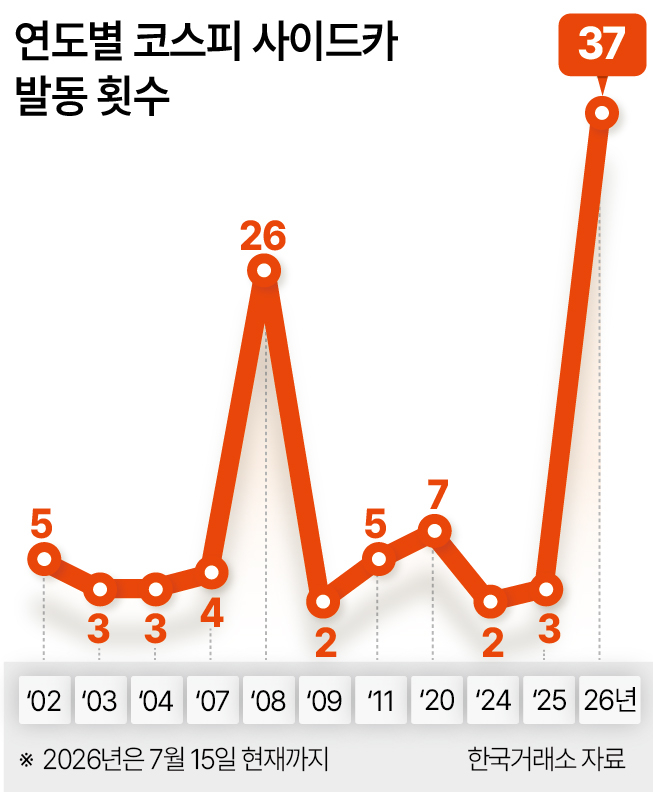
South Korea's stock market has triggered its sidecar trading curb more times this year than in any other year on record. With more than five months still remaining in 2026, the cumulative activation count has reached 37 — approaching 40 percent of all activations in the mechanism's history.
Particularly in June and July, the curb has been firing roughly once every two trading days. The relentless alternation between sharp rallies and steep selloffs has produced a level of extreme volatility that South Korean markets did not experience even during the global financial crisis.
According to Korea Exchange, the sidecar on the Kospi market had been triggered a total of 37 times as of Thursday morning. That represents 38.1 percent of the all-time cumulative total of 97 activations. The figure already exceeds by 11 the previous annual record of 26, set during the 2008 global financial crisis, and more than five months remain in the year.
A sidecar is a mechanism that suspends program trading for five minutes when futures prices surge or plunge beyond a set threshold, threatening to transmit excessive shocks to the cash market. It is one of the primary tools regulators use to dampen extreme volatility.
The concern is that volatility has been intensifying month by month. Activation data this year show a clear upward trend.
Kospi sidecar activations stood at three in February, seven in March, three in April and six in May before jumping to 10 in June. July has already recorded eight activations with roughly half the month still to go. Over the past two months, the mechanism has effectively fired once every two trading days.
Notably, the curbs have been triggered in both rising and falling markets — 18 buy-side sidecars and 19 sell-side sidecars. The figures indicate that volatility has expanded not only during sharp declines but also during rapid short-term rallies. Both greed and fear appear to be gripping the market at the same time.
Circuit breaker data tell a similar story of market stress. The Kospi market has had its circuit breaker triggered seven times this year, surpassing half of the all-time total of 13 activations. A circuit breaker halts all trading market-wide and represents a stronger intervention than a sidecar.
The circuit breaker was not triggered even during the global financial crisis. Even in 2020, when the COVID-19 pandemic roiled financial markets worldwide, it was activated only twice. This year's count has already exceeded that figure more than threefold.
Market analysts point to rapid index gains and the expansion of leveraged investment as the main drivers of heightened volatility. Securities industry analysts say that as the market has climbed sharply, profit-taking and leveraged money have been unwinding simultaneously, amplifying even small price moves into larger index swings.
Leveraged ETFs are products designed to deliver two or more times the daily return of an underlying index. The larger the index gain, the greater the profit — but losses are equally magnified on the downside.
Analysts also note that asset managers' large-scale futures trading near the close of each session — executed to hit target returns — can itself amplify market volatility. When markets surge or plunge, related trades pile up in one direction, further exaggerating index moves in what is known as a volatility-amplification effect.
Securities industry analysts said investors should exercise caution given that elevated volatility is likely to persist for now. Yeom Dong-chan, a researcher at Korea Investment & Securities, said: "In the recent expansion of Korean stock market volatility, global chipmaker volatility has been amplifying swings in the early part of the session, while ETF rebalancing demand is amplifying volatility in the latter part of the session."
However, he added that "leveraged ETFs are a factor that amplifies volatility rather than a cause of it," and that "it is difficult to attribute intraday back-and-forth volatility to leveraged ETF rebalancing demand."
th5@heraldcorp.com