The perpetual futures market, once dominated by digital assets, is rapidly expanding into real-world assets (RWA) such as stocks and exchange rates, a new report has found. Products based on Korean share prices and the won-dollar exchange rate are already trading in offshore markets beyond the reach of domestic regulators, analysts say, warning that a policy response is needed.
The Korbit Research Center, a unit of cryptocurrency exchange Korbit, published the findings Thursday in a report titled "Perpetual Futures: From Virtual Asset Markets to RWA."
Perpetual futures are derivative contracts with no expiration date. Investors can take long or short positions to bet on price movements without holding the underlying asset directly.
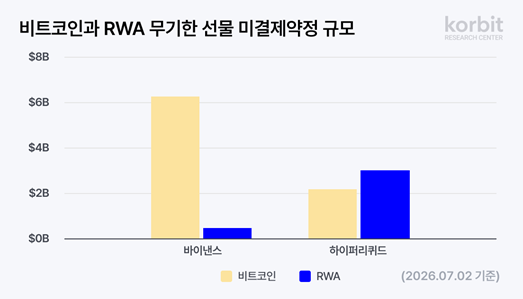
According to the report, major global centralized exchanges such as Binance are rapidly listing new perpetual futures products by leveraging offshore licenses and proprietary indexes. Decentralized futures exchanges, led by Hyperliquid, are accelerating market expansion by transferring listing authority to their protocols.
Open interest in RWA perpetual futures on Hyperliquid stood at approximately $2.9 billion as of July 2 — surpassing the roughly $2.1 billion in open interest for bitcoin perpetual futures on the same platform.
The Korbit Research Center also assessed the price reliability of RWA perpetual futures. S&P 500 perpetual futures closely tracked the underlying index and conventional futures prices during US regular trading hours, with a correlation coefficient of 0.98.
SK Hynix perpetual futures, which trade during overnight hours when the Korean stock market is closed, showed a tendency to anticipate the following day's opening price. The correlation coefficient ranged from 0.97 to 0.99.
By contrast, perpetual futures based on unlisted companies such as Cerebras and SpaceX had no comparable spot price for reference, meaning prices were formed internally within the exchange. Outside markets cannot independently verify the reliability of exchange-generated prices.
The report outlined four conditions for an asset to qualify as the basis of a regulated perpetual futures product: a continuous reference price, sufficient liquidity, a real-time arbitrage mechanism, and a transparent pricing and liquidation structure.
The report also flagged a regulatory gap in offshore perpetual futures markets tied to domestic Korean assets. Share prices of major Korean companies including Samsung Electronics and SK Hynix continue to trade around the clock in offshore perpetual futures markets even after the regular session closes. Perpetual futures products based on the won-dollar exchange rate have also emerged.
Because these markets fall outside the scope of Korea's Capital Markets Act, domestic authorities have no direct means of intervention even if price distortions or large-scale liquidation incidents occur.
"RWA perpetual futures are already operating at a scale of billions of dollars, and assets with stronger reference price infrastructure showed higher price reliability," said Jeong Ji-seong, a research fellow at the Korbit Research Center. "Since Korean asset prices are being formed in places beyond the reach of domestic regulation, we need to discuss how to monitor these markets and what to prepare for."
kyoung@heraldcorp.com