
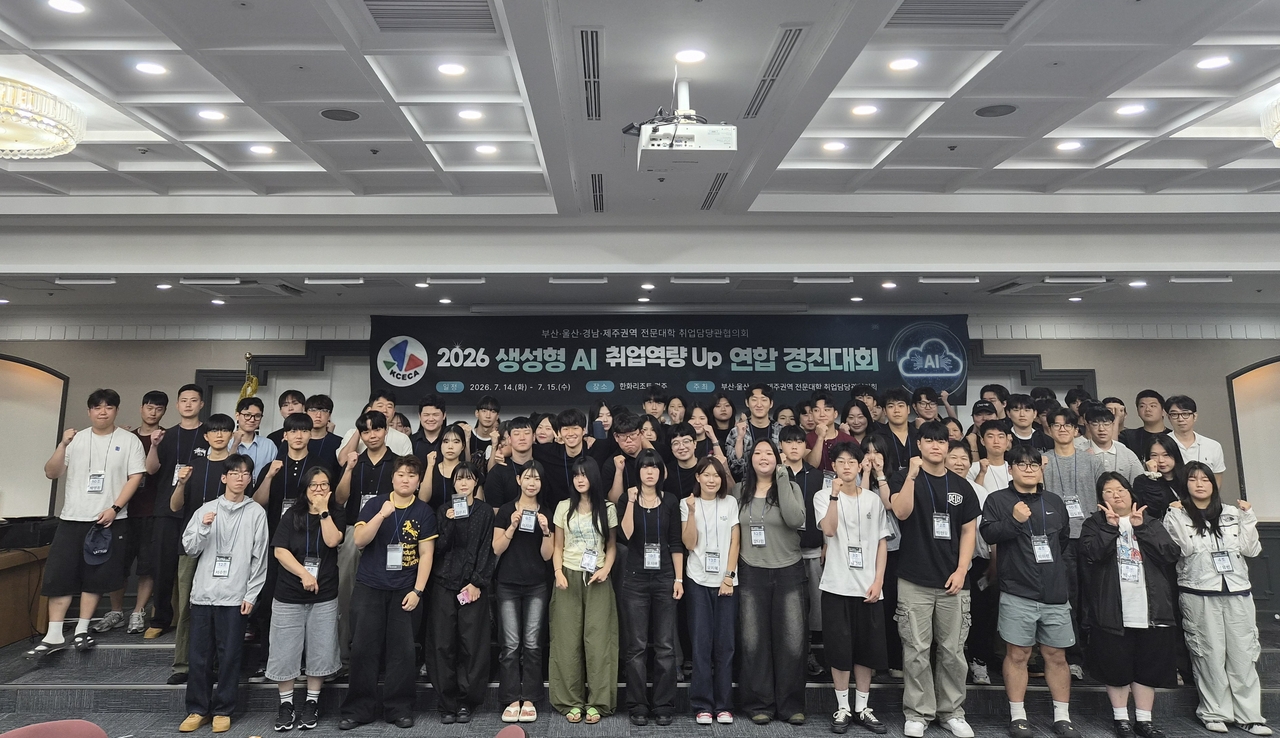
The Busan, Ulsan, South Gyeongsang Province and Jeju Regional Junior College Career Officers Association, led by President Jeong Woo-hyeon, announced Thursday that it held the "2026 Generative AI Job Competency Up Joint Competition" from Tuesday to Wednesday.
The competition was the first among regional junior college career officers associations nationwide to integrate generative AI across the entire job-preparation process, drawing 86 students from 11 colleges. It drew attention for moving beyond the conventional resume-writing and interview-coaching format, instead running as a project-based competition in which students used generative AI to independently build their own job strategies and portfolios.
Students formed cross-college, cross-major teams grouped by similar fields and completed a series of missions: verifying AI-generated responses and designing prompts, extracting key corporate insights from DART and investor-relations materials, analyzing corporate organizational and job structures using Lego, solving corporate problems through design thinking, and creating web-service prototypes and job portfolios using generative AI.
Teams also selected companies and job roles suited to their respective fields — health and welfare, engineering and technology, business and service, and content and design — and used a range of generative AI tools, including Claude and Gemini, to produce outputs directly applicable to real-world job preparation.
One participating student said the competition taught them "that generative AI is not simply a tool for getting answers, but a tool for designing questions, verifying information and giving concrete shape to a job strategy."
The final presentations covered field-specific mission results, including corporate and job-role analysis, identification of core competencies, organizational culture assessment and job-strategy development. Judges then evaluated teams on mission completion, appropriateness of AI use, and the quality and practical applicability of their outputs. Five teams that performed with distinction received university president awards, while one team received the association president's award.
An association official said the competition represented "a new model of career education that uses generative AI as a student-led tool for designing job strategies," adding that it was meaningful for "simultaneously strengthening the problem-solving skills and practical job competencies needed in the AI era."
bigroot@heraldcorp.com





