![A Homeplus store in Seoul on Thursday morning. [Herald DB]](https://wimg.heraldcorp.com/news/cms/2026/07/17/news-p.v1.20260716.c236e552bcbb480c8955981924a797eb_P1.jpg)
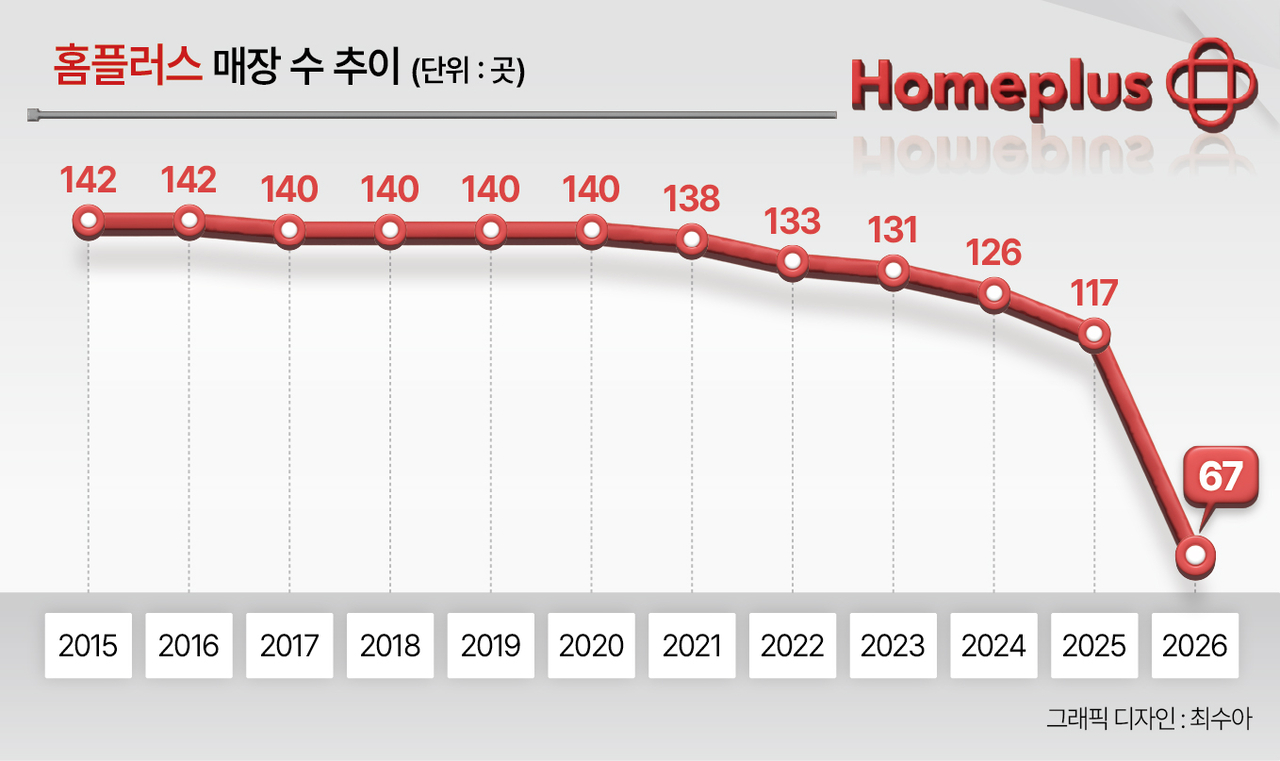
Homeplus, which marks its 30th anniversary next year, is teetering on the edge of bankruptcy. Since entering court receivership in March last year, its finances have deteriorated so sharply that a court has issued a ruling to terminate the rehabilitation process. Its store count has fallen from a peak of 142 to 67, and even those remaining locations have suspended operations. A workforce that once exceeded 20,000 has bled down to around 10,000. The sudden collapse of what was once Korea's second-largest hypermarket chain is sending shockwaves through the retail industry and local economies alike.
Within the industry, however, many say the Homeplus crisis was "a foregone conclusion from 11 years ago." The turning point, critics argue, was 2015, when private equity firm MBK Partners acquired a 100 percent stake in Homeplus. What happened after that roughly 7 trillion won ($4.7 billion) blockbuster deal?
Homeplus: once the future of Korean discount retail
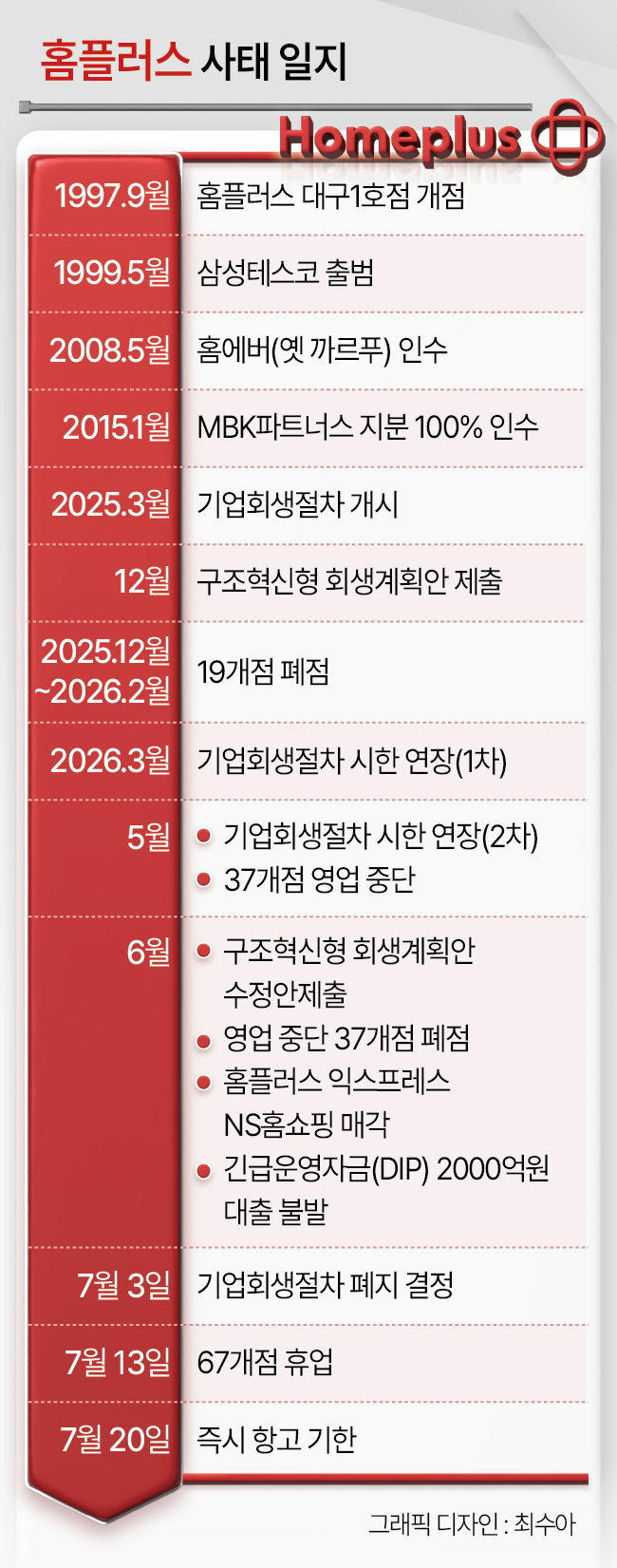
Homeplus traces its roots to Samsung Group's retail division. After Shinsegae was spun off from Samsung in 1991, the conglomerate looked to re-enter the retail sector. It opened the first Homeplus store in Daegu in 1997, then teamed up with British retailer Tesco in 1999 to form a joint venture called Samsung Tesco. Through aggressive store openings and acquisitions, the company expanded rapidly. In 2008, it acquired 33 stores from E-Land's Homever — formerly Carrefour Korea — and established itself as a direct rival to E-mart and Lotte Mart.
Tesco bought out Samsung's remaining stake in 2011 and rebranded the company under its current name, Homeplus. By 2013, Homeplus posted consolidated sales approaching 9 trillion won and operating profit of 338.2 billion won, cementing its status as the undisputed No. 2 in the industry. Its decision to bring cultural centers — previously found only in department stores — into hypermarkets was widely credited with defining the model for Korean-style discount retail.
MBK enters — and liquidates 4 trillion won in assets over a decade
MBK Partners arrived in 2015. Tesco sold its entire Homeplus stake to an MBK Partners-led consortium for approximately 7.2 trillion won — the largest domestic merger and acquisition deal in Korean history at the time. MBK Partners financed 2.7 trillion won of the purchase price through debt, using a leveraged buyout structure in which loans from financial institutions are secured against the target company's assets or future cash flows, minimizing the acquirer's own equity outlay.
Having bought Homeplus on borrowed money, MBK Partners moved to monetize assets through sale-leaseback transactions, selling 68 stores and leasing them back to repay debt. The sale-leaseback approach itself was not unusual — at the time, both E-mart and Lotte Mart were using the same method to raise cash.
But one retail industry insider who remembered the period said MBK went further. "They sold even the prime stores that any normal operator would keep as directly managed locations, just to raise cash quickly," the person said. "I thought it was a dangerous approach." According to Homeplus's audit reports, the company disposed of 3.45 trillion won in tangible assets over the decade from 2015 to 2025. Total assets monetized by MBK Partners during that period are believed to have exceeded 4 trillion won.
REIT listing failure, pandemic and e-commerce: a triple blow
The setbacks kept coming. In March 2019, Homeplus withdrew a planned stock market listing for its real estate investment trust. The company had proposed a structure using 51 stores nationwide as underlying assets, generating returns through rental income — pitched as Korea's first trillion-won-scale public REIT offering. It drew significant interest from overseas institutional investors, but deteriorating conditions for hypermarkets under government regulation caused the offering to fall flat.
MBK Partners had reportedly planned to use proceeds from the REIT listing to pay down its debt. "After the listing fell through, the sale-leaseback asset liquidation became even more aggressive," said one person familiar with the matter. "As monthly rent and interest payments piled up, the operating situation went from bad to worse."
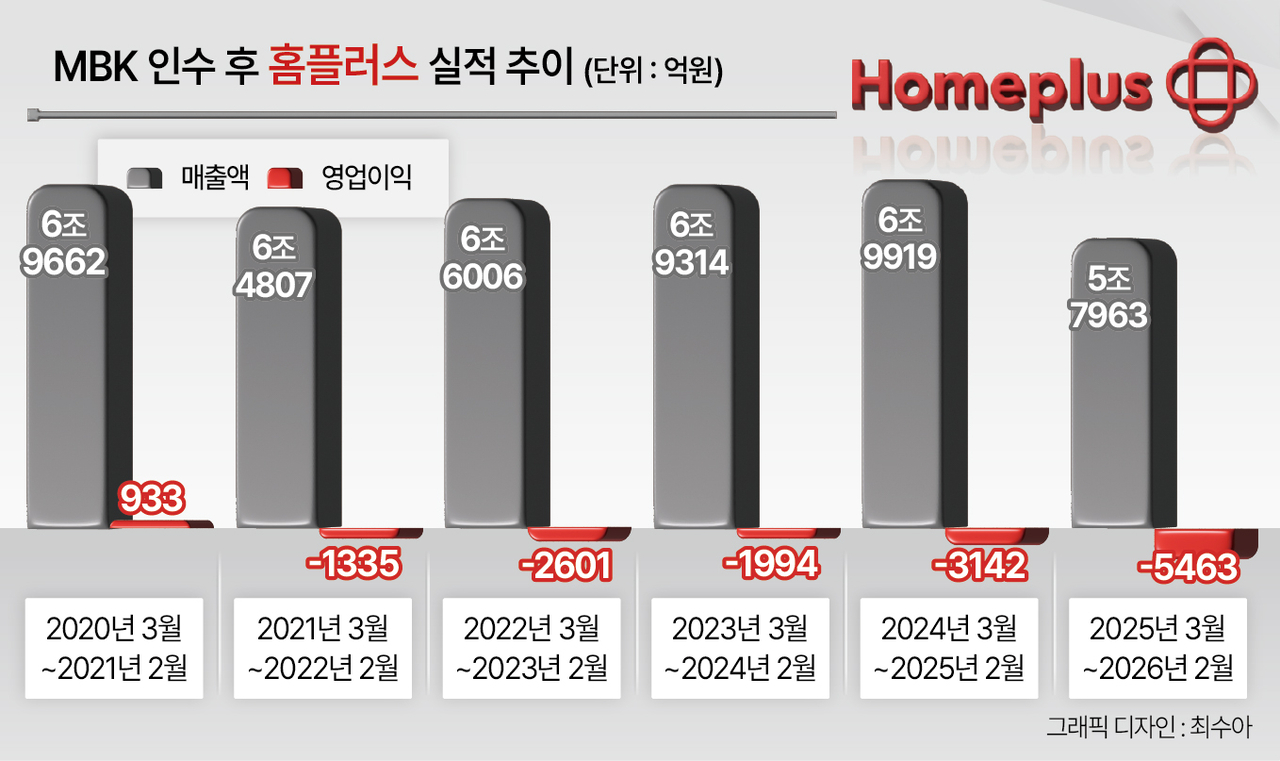
Then came the COVID-19 pandemic, which threw the world into chaos. Every time a confirmed case was linked to a store, operations ground to a halt. Repeated disinfections and the disposal of fresh food added to the financial burden. Sales, which stood at 7.66 trillion won in 2018, fell to 7.3 trillion won in 2019, 6.97 trillion won in 2020 and 6.48 trillion won in 2021. Operating profit shrank from 259.9 billion won in 2018 to 160.1 billion won in 2019 and 93.3 billion won in 2020, before swinging to an operating loss of 133.5 billion won in 2021.
![A Homeplus store in Seoul on Thursday morning. [Herald DB]](https://wimg.heraldcorp.com/news/cms/2026/07/17/news-p.v1.20260716.dc45e34085ab4e8baf5b01048f23c09a_P1.jpg)
When the pandemic receded, e-commerce — led by Coupang Inc — moved in to fill the void. While hypermarkets remained bound by the Distribution Industry Development Act's mandatory twice-monthly closures and late-night delivery bans, e-commerce platforms aggressively embedded themselves in everyday Korean life. E-mart and Lotte Mart responded by renovating flagship stores and expanding online and overseas operations. Homeplus, however, had no financial room to maneuver. Its operating losses widened to 260.1 billion won in 2022, 199.4 billion won in 2023, 314.2 billion won in 2024 and 546.3 billion won in 2025.
Homeplus filed for court receivership in March 2025. Its store count has since fallen to 67. Homeplus Express — once valued at around 1 trillion won and regarded as a prized business unit — was sold to Harim Group in May this year for around 120 billion won, a price widely attributed to the deterioration of Homeplus's balance sheet.
Industry observers and politicians watching the crisis unfold have concluded that MBK Partners' debt-driven management, compounded by a series of external shocks, stripped Homeplus of its competitiveness. The argument is that the moment a short-term-focused private equity fund chose the leveraged buyout route, the company's decline became inevitable.
According to Meritz Financial Group, which clashed with MBK Partners over debtor-in-possession financing for Homeplus, MBK's Fund III — the vehicle used to invest in Homeplus — had generated returns of around 1 trillion won as of end-2025, despite the operational failure. "The structure was one where profitability could only deteriorate over time," said one retail industry insider. "It is deeply regrettable to think that what unfolded over 10 years may have simply been MBK Partners executing its exit strategy all along."
200 billion won DIP loan offers a lifeline — but hurdles remain
Homeplus, pushed to the brink of bankruptcy this month, secured a 200 billion won debtor-in-possession loan after MBK Partners and Meritz Financial Group reached a last-minute agreement on financing terms. The deal was clinched after MBK Chairman Kim Byung-ju agreed to provide a full personal guarantee — the central sticking point — prompting Meritz Financial Group to approve the loan. Homeplus said Thursday it plans to file an immediate appeal with Seoul Bankruptcy Court on Monday reflecting the agreed terms, adding that the emergency operating funds will be disbursed once the court grants approval, completes the necessary procedures for the DIP financing and secures consent from major creditors on the rehabilitation plan.
Most of the DIP funds, however, are expected to go toward overdue store rent, utility bills and outstanding supplier payments. There are also doubts about whether all 67 suspended stores can be fully restored to normal operations. Even if the court reinstates the rehabilitation process, the prevailing view is that Homeplus cannot avoid bankruptcy without selling its remaining business units — the hypermarket division, online operations and headquarters — by September. That month marks the final deadline for court receivership extensions under current law.
In the time remaining, Homeplus is expected to seek potential buyers while simultaneously selling key assets, including closed stores, to repay debt. Proceeds of 170 billion won from the planned sale of its Daejeon Yuseong and Dong-Gwangju stores, expected to close in September, will almost certainly go to Meritz Financial Group as the primary secured creditor. Meritz, which extended roughly 1.2 trillion won in loans to Homeplus, holds 62 stores nationwide as collateral.
![Members of the Homeplus chapter of the Mart Industry Labor Union rally in front of MBK Partners' headquarters in Jongno-gu, Seoul, on Wednesday afternoon, demanding job security. [Herald DB]](https://wimg.heraldcorp.com/news/cms/2026/07/17/news-p.v1.20260715.a4ee8d1e31ee4aa383c7bbb9daab7825_P1.jpg)
'Retail must grow the pie, not play a zero-sum game'
"The retail industry must stop approaching this as a zero-sum game and start thinking about growing the pie."
Lee Seung-han, the former chairman who led Homeplus during its Samsung Tesco years, made that remark in an interview last March, saying "the company that leads the new retail order will be the market winner." His view reflects a belief that the boundaries between retail channels are collapsing, triggering a seismic shift across the industry. Lee had publicly voiced concern as far back as 2009, when discussions began in earnest over revising the Distribution Industry Development Act to impose restrictions on hypermarkets and corporate supermarkets.
His perspective remains as relevant as ever. The regulations drawn to protect traditional markets and neighborhood merchants by curbing hypermarkets ended up giving birth to the e-commerce behemoth. As the Homeplus crisis prompts calls from government and political circles for a broad overhaul of the regulatory framework, deregulation under the Distribution Industry Development Act has long been a top priority for the domestic retail industry.
Cheong Wa Dae, the government and the Democratic Party of Korea formally announced a review of the act in February this year — 14 years after the hypermarket regulations were introduced in 2012. Yet in the five months since, the National Assembly has not held a single discussion on the matter. "I worry that the deregulation debate, which was so hard to reignite, will simply be shelved," said one industry insider. "The playing field has been tilted against us for too long, and it needs to be leveled."
![A banner posted outside a Homeplus store in Seoul on Thursday morning. [Herald DB]](https://wimg.heraldcorp.com/news/cms/2026/07/17/news-p.v1.20260716.55eeeb9d1ee745338af169e3b5d99093_P1.jpg)
soho0902@heraldcorp.com