
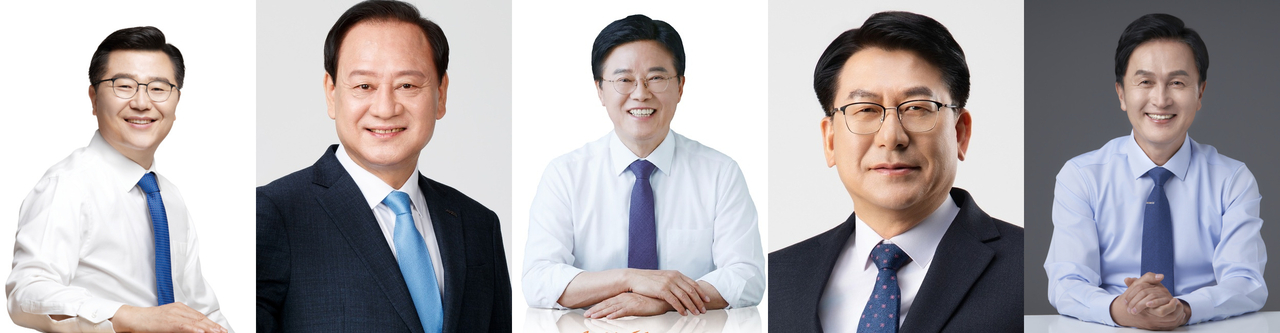
Five of Seoul's newly elected district mayors share the Ryu or Yu surname — one in five of all district mayors in the ninth round of civilian-led local government — drawing considerable public attention.
The five are Ryu Gyeong-gi of Jungnang-gu (serving his third term), Yu Dong-gyun of Mapo-gu (second term), Yu Chan-jong of Jongno-gu, Yu Bo-hwa of Seongdong-gu and Ryu Sam-yeong of Dongjak-gu — the latter three all first-term Democratic Party members. All five belong to the Democratic Party of Korea, adding to the interest.
The surname written as "Yu" can be rendered using several different hanja characters. Even within the same willow-tree character — ryu (yu) — individuals and families choose between "Yu" and "Ryu" depending on whether they apply the initial-consonant rule and on personal or family preference.
After the rules governing surname romanization changed in 2007, about 54,000 people switched their registered spelling from "Yu" to "Ryu" over the following two years.
In the 2015 census, 478,990 people were registered under the "Yu" spelling and 163,703 under "Ryu," for a combined total of 642,693 — roughly 1.26 percent of the national population.
Assuming all five mayors share this surname, it is remarkable that a family name accounting for about 1.3 percent of the population holds 20 percent of Seoul's district mayorships.
The Democratic Party won 17 of Seoul's 25 districts in the ninth round of civilian-led local government, and all five mayors rode that wave — winning their seats simultaneously, particularly in northern Seoul.
The group also reflects a mix of seasoned incumbents — Ryu Gyeong-gi and Yu Dong-gyun had already served as district mayors — and competitive candidates with deep local political or administrative experience, including Ryu Sam-yeong, Yu Chan-jong and Yu Bo-hwa, all nominated in the same election cycle.
Ryu Gyeong-gi graduated from Seoul National University with a degree in political science, passed the civil service exam and served as Seoul Metropolitan Government spokesperson, head of the administrative bureau, chief of the planning office and first vice mayor for administration. He was recruited to run in Jungnang-gu through the persistent efforts of Park Hong-keun — then the district's four-term Assembly member and now minister of the Ministry of Planning and Budget — who lobbied then-Mayor Park Won-soon on his behalf. Ryu went on to win three consecutive terms with overwhelming community support, including a margin of more than 60,000 votes in this election.
Yu Dong-gyun served as a Mapo-gu council member and Seoul Metropolitan Council member before becoming Mapo-gu district mayor in the seventh round of civilian-led local government. He lost his re-election bid in the eighth round, then worked as an aide and local office director for lawmaker Jung Chung-rae before winning the Mapo-gu mayoralty again in the ninth round.
Yu Chan-jong built a successful career in advertising before serving on the Jongno-gu council and the Seoul Metropolitan Council. He ran for Jongno-gu district mayor in the eighth round but lost, spent four years regrouping and finally achieved his goal in the ninth round.
Yu Bo-hwa graduated from Suncheon High School and entered public service as a grade-9 official at the Military Manpower Administration before transferring to the Seoul Metropolitan Government, where he rose to head the autonomous administration division, serve as policy planning officer and eventually become deputy district mayor of Seongdong-gu. He won the district mayoralty after former Seongdong-gu Mayor Jeong Won-o stepped down to run for Seoul mayor. Yu is the first civilian-elected district mayor to have risen through the deputy mayor ranks without passing the civil service exam — a rare distinction.
Ryu Sam-yeong is a graduate of the Korean National Police University who, while serving as a superintendent, opposed the Yoon Suk Yeol administration's police reform agenda and pivoted to politics. He ran in the 22nd general election but lost to lawmaker Na Kyung-won, then won the Dongjak-gu mayoralty in this local election. Ryu's path was aided by the fact that Park Il-ha, the eighth-round Dongjak-gu district mayor, failed to secure a People Power Party nomination and ran instead as a Reform Party candidate, drawing about 40,000 votes and splitting the conservative vote.
With the Ryu and Yu surname particularly well represented among Seoul's district mayors, attention now turns to what services and results these five officials will deliver for their constituents.
seouldream01@heraldcorp.com





