
![[Yonhap]](https://wimg.heraldcorp.com/news/cms/2026/07/19/news-p.v1.20260527.b2bd6d9f09bc4ae3959de167c4877eb6_P1.jpg)
Middle-aged and older Koreans retire from their primary jobs — the positions they hold longest over their careers — at an average age of 52, yet national pension benefits do not begin for more than a decade after that. The resulting income gap is pushing many to seek work well into their early 70s. Analysts say the trend reflects a labor market in which most departures are involuntary and public pension benefits alone fall short of securing a stable retirement income.
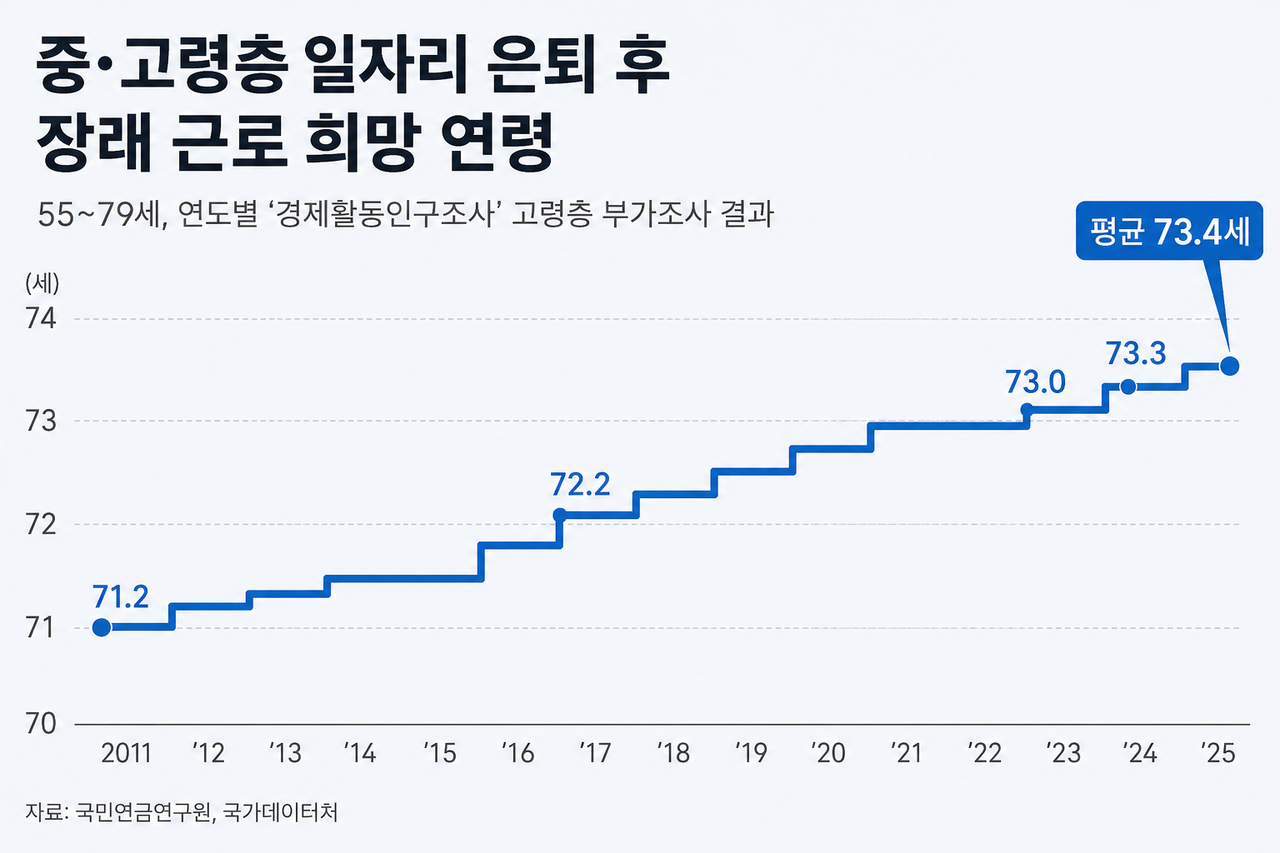
A report released Saturday by the National Pension Research Institute, titled "Analysis of Reemployment and Job Characteristics Among Middle-Aged and Older Workers After Retirement," found that as of 2025, the average age at which workers in this demographic left their primary jobs was 52.9. By contrast, the average age to which they hoped to keep working was 73.4 — more than 13 years beyond the statutory retirement age of 60.
The share of middle-aged and older workers who said they wanted to continue working reached 69.4 percent and has been consistently rising. The most common reason cited was supplementing living expenses, at 54.4 percent, followed by the enjoyment of work at 36.1 percent and a desire to avoid boredom at 4.0 percent — underscoring that financial necessity, not personal preference, is the primary driver of post-retirement employment.
The circumstances surrounding retirement were also far from voluntary for most. Business slowdowns or closures accounted for the largest share of departures from primary jobs at 28.7 percent, followed by health problems at 18.6 percent and family caregiving responsibilities at 16.0 percent. Mandatory retirement accounted for just 9.8 percent of cases, while only 2.8 percent chose to retire on their own terms. Involuntary departures — including forced resignations, layoffs and business failures — reached 75.1 percent in total.
Reemployment itself, however, has become faster than in the past. About 80 percent of middle-aged and older retirees found new work within two years of leaving their jobs, with the likelihood of securing employment rising sharply at the two-month and 12-month marks after retirement. Those who remained unemployed for more than a year after retiring faced a significantly higher risk of long-term joblessness.
While the reemployment environment has improved overall, job quality varied sharply by age group. Workers in their 60s saw broad gains in employment rates, the proportion of permanent positions, social insurance enrollment and real wages, pointing to a trend toward better-quality jobs. Those in their 70s, however, faced a different picture: contract and part-time work increased significantly while social insurance coverage declined, reflecting a relative deterioration in employment quality.
Public pension status also influenced reemployment behavior. National pension subscribers and recipients showed a stronger tendency to re-enter the labor market than those without coverage, while recipients of special occupational pensions — such as the civil servant pension — were less likely to seek reemployment the higher their pension payments. The researchers said this indirectly illustrates the reality that the national pension alone cannot adequately guarantee retirement income.
The researchers said policy support for labor market re-entry after retirement must be strengthened to secure stable livelihoods for middle-aged and older workers. They said job seekers within the first year after retirement should receive concentrated support through low-cost job matching and employment assistance, while those who remain unemployed longer should benefit from expanded vocational training and employment subsidies — tailored to the length of their job search.
fact0514@heraldcorp.com





