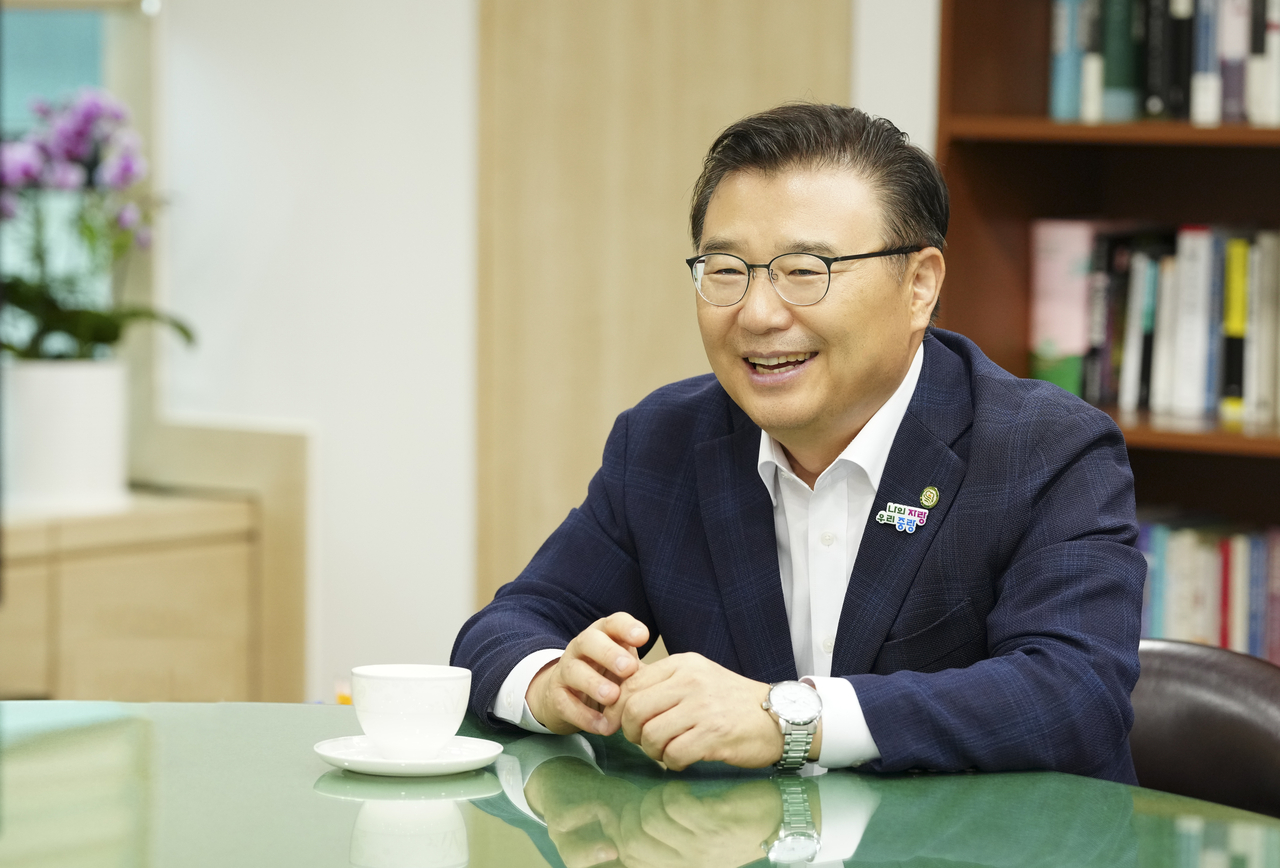
Ryu Gyeong-gi, who won a third consecutive term as Jungnang-gu district mayor after serving through the seventh and eighth elected administrations, said the past eight years were spent laying the groundwork for the district — and the next four will be spent delivering on it.
"Among Seoul's autonomous districts, we will push forward the largest housing development projects without a hitch, complete GTX-B, the Myeongmok Line and the Sangbong Station transit hub, and make Jungnang the central city of Seoul's northeastern corridor," Ryu said in an interview. "Administration is ultimately about keeping promises to residents, and I will complete Jungnang's great leap forward together with them."
The following is an edited transcript of the interview.
— You have now won the support of Jungnang residents for a third consecutive term. What are your thoughts on the victory, and what is your resolve going forward?
First and foremost, I want to sincerely thank the 400,000 residents of Jungnang-gu for again giving me the opportunity to serve the district.
It feels like only yesterday that I first pledged to work for Jungnang, yet eight years have passed and I now find myself entrusted with a third term. Time has moved remarkably fast, and I feel that residents and I have truly run without pause.
I see this election result not as a personal endorsement, but as recognition of the changes and achievements we built together over the past eight years — and as an expression of trust and expectation that we will complete an even greater future for Jungnang.
During the campaign, I met countless residents in alleyways, markets and on the streets, and confirmed again their deep desire to see the district develop. Going forward, I will listen more, meet more often and stay close to residents.
If the past eight years were a time of building pride among Jungnang residents, the next four years are a time to root that pride even more firmly and bring it to fruition.
I will complete, without fail, the projects we have prepared — the relocation of the Seoul Housing and Communities Corp. headquarters, the Myeongmok Administrative Complex Town, GTX-B and the Myeongmok Line, Jungnang as an education city, and the Jungnang Donghaekkil walkway — and repay residents' expectations with tangible results.
— You have set "completing Jungnang's great leap forward" as the governing goal for your third term. What is your policy direction, and what is the top priority?
The third term is about making residents feel the change in their daily lives, building on the eight years of groundwork we have laid in education, transportation, urban development and welfare. Delivering on those results is the most important task.
Administration is ultimately about keeping promises to residents. Having received the top rating (SA) for six consecutive years from the Korea Manifesto Practice Headquarters' campaign pledge fulfillment assessment, I will continue that trusted approach in this term as well.
Centered on the Jungnang Donghang Vision Committee, which launched this month, I will fully incorporate the views of residents and experts to strengthen the execution of campaign pledges — and make this a third term that is completed with residents, not planned unilaterally by the administration.
— Jungnang-gu is pursuing more housing development projects than any other autonomous district in Seoul. What is the strategy for success?
Large-scale housing development projects — redevelopment and reconstruction — are currently under way across 27 areas in Jungnang.
If the past eight years were about laying the foundation for those projects, the focus going forward will be on raising both speed and quality so that residents can feel real change.
To that end, we operate a housing development task force alongside a housing development support team composed of experts, providing tailored consulting and conflict mediation for each project site. We also run a housing development academy to help residents easily understand project procedures.
In this third term, we have also established a rapid-support team for apartment reconstruction. We will minimize confusion during the project process by providing accurate information from the earliest stages and offering proactive administrative support.
We will also keep pace with central government and Seoul Metropolitan Government policies to revitalize redevelopment projects — actively supporting various permit and approval procedures and making full use of regulatory improvements such as floor-area-ratio incentives to shorten project timelines and improve viability.
Ultimately, when projects move faster, financial burdens decrease — and when financial burdens decrease, resident conflicts decrease as well. We will pursue improvements to the residential environment swiftly and transparently while protecting residents' property rights.
— Expectations are high for the transportation changes that GTX-B and the Myeongmok Line will bring. What is the transportation blueprint for your third term?
Making Jungnang the transportation hub of Seoul's northeastern corridor is the core goal of this term. Transportation is not just about convenience of movement — it is the essential foundation that determines a city's competitiveness.
Jungnang is already served by subway lines 6 and 7, the Gyeongui-Jungang Line, the Gyeongchun Line and KTX. When GTX-B and the Myeongmok Line are added, the transportation landscape will change completely.
GTX-B is being developed with a target opening in 2030. Once operational, travel time from Sangbong to Seoul Station will be 10 minutes, and to Songdo 37 minutes, dramatically improving regional accessibility.
The Myeongmok Line passed a preliminary feasibility study in 2024 and a master plan is currently being drawn up. It is being developed with a target ground-breaking in 2029 and opening in 2034, and is expected to dramatically improve transportation conditions for residents in the Myeongmok area.
Once the Sangbong Station complex transit hub is built, it will become the leading transfer hub for the northeastern metropolitan area, connecting GTX-B, KTX, subway line 7, the Gyeongchun Line, the Gyeongui-Jungang Line and bus services.
When transportation changes, daily life changes — and a city's competitiveness rises. GTX-B will transform long-distance travel, while the Myeongmok Line will transform everyday movement. With the Sangbong Station integrated transit system and transit-oriented area development added to the mix, Jungnang will grow into the transportation hub representing Seoul's northeastern corridor.
seouldream01@heraldcorp.com