![Spain players lift the World Cup trophy Monday after winning the 2026 FIFA World Cup. [Reuters]](https://wimg.heraldcorp.com/news/cms/2026/07/20/rcv.YNA.20260720.PRU20260720420401009_P1.jpg)
The 2026 FIFA World Cup in North and Central America came to a close Monday with Spain defeating Argentina in the final, wrapping up a month and a half of football that captivated fans around the world. The tournament — the first jointly hosted by three nations (the United States, Canada and Mexico) and the first to feature 48 teams — was widely judged a success, with few major disruptions.
The next edition, the 2030 World Cup, will push that expansion even further. Marking the centenary of the tournament, the 2030 edition will be co-hosted by Spain, Portugal and Morocco, with three opening matches held in Argentina, Uruguay and Paraguay to commemorate the 100th anniversary. In all, six nations will share hosting duties.
Africa was by far the standout story of the group stage. The Confederation of African Football sent nine of its 10 qualifiers into the round of 32. At the 2022 World Cup in Qatar, only two of Africa's five entrants — Morocco and Senegal — advanced to the knockout rounds.
With the field expanded to 48 teams, Africa's representation grew to 10 sides, and nine of them — including South Africa, Morocco and Ivory Coast — reached the round of 32. Cape Verde, a small island nation of 500,000 people making its World Cup debut, was the tournament's biggest surprise, advancing to the round of 32 in its first-ever appearance.
Yet the final four offered no upsets: the four teams FIFA had ranked among the world's elite all reached the semifinals, keeping the tournament's competitive hierarchy intact. That outcome gave significant momentum to proposals for a further expansion of the field.
FIFA President Gianni Infantino said Monday, after the quarterfinals concluded, that a 64-team format was "certainly something to be discussed through the relevant committees once this North and Central America tournament is over."
A 64-team World Cup would produce 128 matches in total — double the number played under the 32-team format in place through the 2022 Qatar tournament.
The idea is not new. In March last year, the South American Football Confederation proposed expanding the 2030 World Cup field to 64 teams to mark the centenary.
At the time, however, the confederations of Europe, Asia and North and Central America all pushed back. UEFA President Aleksander Ceferin was blunt when the proposal emerged: "It's a bad idea. I was really surprised and I think it's out of the question," he said.
By contrast, Andrew Giuliani, executive director of the White House's World Cup Task Force, said the United States could consider bidding for the 2038 World Cup and that even a 64-team expansion would be "entirely manageable."
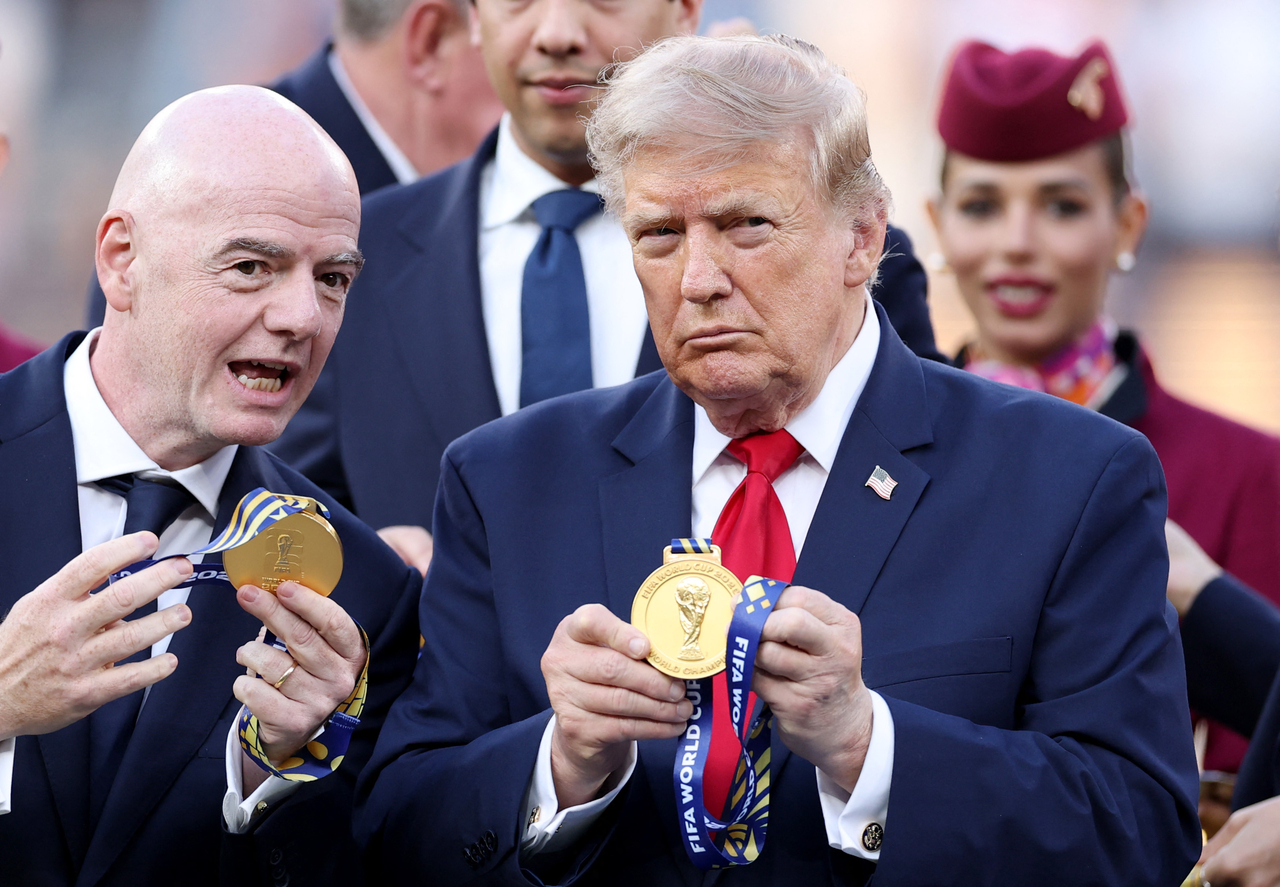
The hydration break — introduced at the 2026 World Cup amid debate — is now expected to come under review.
Arsene Wenger, the former Arsenal manager who serves as FIFA's chief of global football development, said Sunday that "the hydration breaks were not popular and don't seem to have had an impact on results," adding that FIFA would analyze their effect after the tournament, according to a BBC report.
The breaks were introduced to protect player health, but critics questioned their rationale after they were applied uniformly across all matches regardless of temperature or weather conditions. The sharpest criticism was that the stoppages effectively served as guaranteed advertising slots for broadcasters paying large sums for transmission rights.
Fox Sports, the US broadcaster for the tournament, charged an average of $200,000 to $300,000 for a 30-second advertisement during World Cup coverage. During US matches and the knockout rounds, that figure climbed as high as $750,000.
Questions about the tournament's fairness also surfaced. Alain Berset, secretary-general of the Council of Europe, sent an open letter to FIFA warning that "the next crisis has already begun — and its name is money and power."
The letter was prompted by the suspension of disciplinary proceedings against US forward Folarin Balogun. Balogun received a red card in the round-of-32 match against Bosnia and Herzegovina, which would have ruled him out of the round of 16. Donald Trump then called FIFA President Gianni Infantino to request a review, and FIFA suspended the sanction for one year. Balogun played in the round-of-16 match against Belgium, but the United States lost 4-1.
"When rules bend under pressure, every result becomes suspect," Berset said. He added that "political influence has now entered the stadium itself," pointing to the sequence in which a head of state called the FIFA president and a suspension was subsequently lifted.
The tournament also left a painful mark on South Korea. The team finished the group stage with one win and two losses and was eliminated early. After beating the Czech Republic 2-1 on June 12, South Korea lost 1-0 to co-host Mexico on June 19, then fell 1-0 to South Africa — the group's weakest side — on June 25.
The early exit triggered sharp criticism of Korean football and set off a broader push for reform. The government has launched a football innovation committee, initiated a sweeping overhaul of the Korea Football Association and begun introducing more advanced football systems. Whether South Korea can show a different face at the 2030 World Cup remains to be seen.
![Spain players lift the World Cup trophy Monday after winning the 2026 FIFA World Cup. [Reuters]](https://wimg.heraldcorp.com/news/cms/2026/07/20/rcv.YNA.20260720.PRU20260720420601009_P1.jpg)
yjc@heraldcorp.com