With the Democratic Party of Korea's Aug. 17 national convention approaching, the race for party leadership has shifted into high gear. The so-called "Big Three" contenders and their rivals are each moving to claim the mantle of party orthodoxy. Inside and outside the party, concern is growing that if the convention devolves into a factional struggle over political lineage rather than a contest of policy ideas, the party's support base could actually weaken.
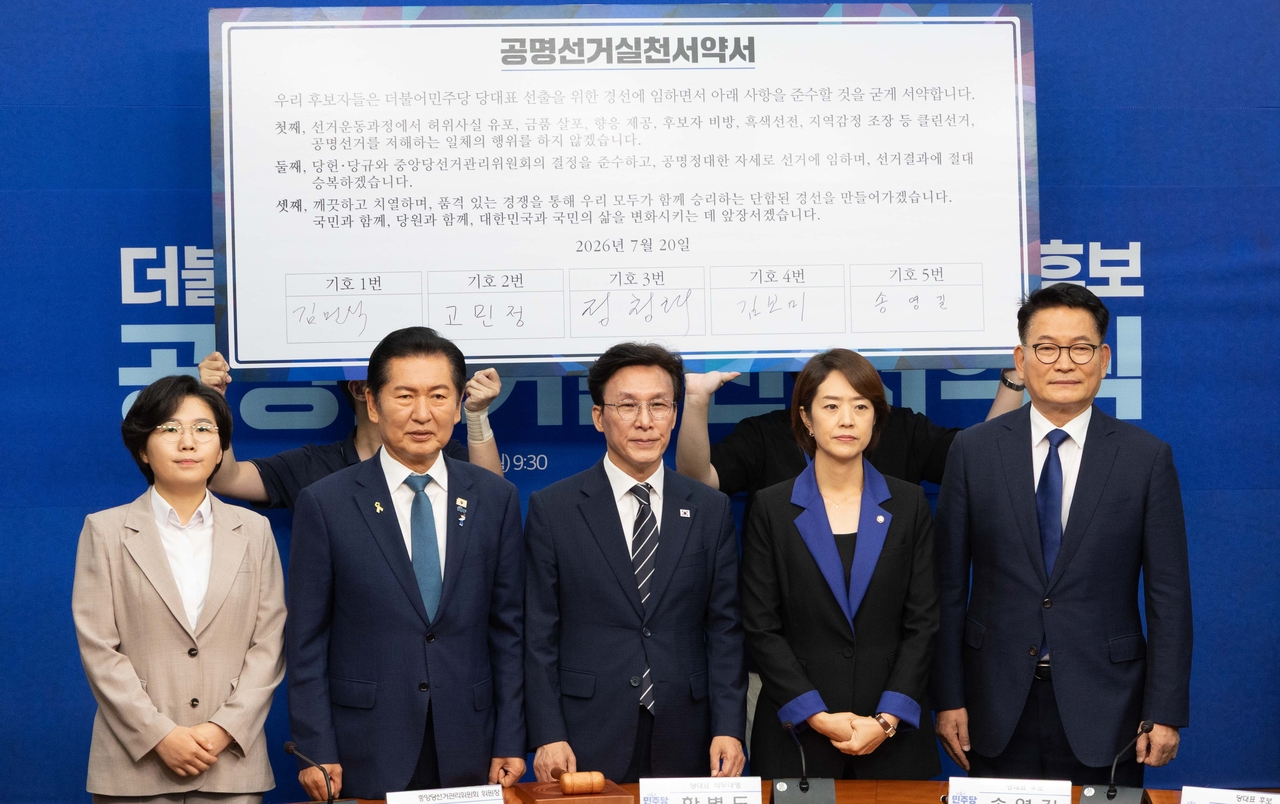
The Democratic Party held a fair-election pledge ceremony at the National Assembly on Monday morning, bringing together candidates who have completed their registration. Chairperson candidates Kim Min-seok, Ko Min-jung, Jung Chung-rae, Kim Bo-mi and Song Young-gil attended, along with supreme council member candidates Park Seon-won, Lee Geon-tae, Lee Sung-yoon, Kim Yong, Park Seong-jun, Park Seung-won, Jeong Min-cheol, Han Min-su, Seo Mi-hwa, Choi Min-hee, Kim Yeong-ho, Im Mi-ae, Sin Gye-ryun and Kim Hyeong-nam, listed in ballot order.
Han Byung-do, the party's acting leader and floor leader, urged all candidates to "compete in good faith and run positive campaigns," adding that he hoped everyone present would "play fair so that the convention can become a true festival where 1.6 million rights-holding party members are the real protagonists."
Even so, the early competition has taken on an overheated tone. During the recent holiday period, chairperson candidates each moved to highlight their ties to former Democratic-aligned presidents and party elders. The strategy is widely read as an effort to court rights-holding members, whose votes carry greater weight now that a one-person, one-vote system is being introduced for the party leader election for the first time.
Jung Chung-rae, one of the leading contenders, appeared on MBC Radio on Monday to explain his decision to run. "For us to win the general election and the presidential election, our traditional base needs to stand firmly behind the Democratic Party — but I'm seeing signs of fracture, and I feel that is increasingly being projected onto me, which gave me a sense of mission," he said.
On Sunday, Jung also posted on Facebook that the spouse of the late former Prime Minister Lee Hae-chan had agreed to chair his fundraising committee. He wrote that, given Lee's major role in helping elect presidents Kim Dae-jung, Roh Moo-hyun, Moon Jae-in and Lee Jae Myung, he had "firmly resolved to carry on that spirit and achieve my campaign slogan of '4-tong unity.'"
Rival candidate Song Young-gil stressed both party orthodoxy and his ability to broaden the tent for supporters aligned with Lee Jae Myung. On Sunday, Song visited the tomb of the late former President Roh Moo-hyun at Bongha Village in Gimhae, South Gyeongsang Province, declaring, "From the late President Kim Dae-jung through Roh Moo-hyun, Moon Jae-in and President Lee Jae Myung — I am the person who has walked that single path most faithfully." At a subsequent town hall meeting with Democratic Party members in Busan, he said, "Someone with clear party legitimacy is free to expand the tent and be inclusive," adding that he was best positioned to carry out President Lee's vision for outreach.
Kim Min-seok also put the success of the Lee Jae Myung administration front and center. On Sunday, Kim visited Andong in North Gyeongsang Province — President Lee's hometown — where, responding to a remark that "citizens are placing great hopes" in the president, he said, "The president has already planted those hopes; I am here to add water." Kim also posted on his X account, formerly Twitter, writing: "This convention comes down to a choice — success for the Lee Jae Myung administration and victory in the general election, or destabilizing the Lee Jae Myung administration and splitting the Democratic Party. The fate of the Democratic Party, the Lee Jae Myung administration and the Republic of Korea rests on every party member's vote and true member sovereignty."
Concern is nonetheless mounting, both inside and outside the party, that the leading candidates are leaning on claims of political legitimacy and appeals to fragmented factions rather than offering concrete policy platforms and a forward-looking vision. Polling has added to the unease: a new survey showed the Democratic Party's approval rating had turned downward for the first time in five weeks.
In a survey released Monday by pollster Realmeter, conducted July 15 through July 16 among 1,005 adults aged 18 and older nationwide, the Democratic Party's approval rating stood at 43.1 percent — down 1.7 percentage points from the previous survey. (The poll used an automated response method on mobile phones; the margin of error was ±3.1 percentage points at the 95 percent confidence level, with a response rate of 4.1 percent. For further details, see the National Election Survey Deliberation Commission website.)
Support among voters in their 50s — considered a core Democratic Party constituency — fell 7.7 percentage points from the previous survey to 53.7 percent, while support among those in their 60s dropped 8.2 percentage points to 38.1 percent.
Realmeter attributed the decline to a drop-off among voters in their 50s and 60s and among progressive-leaning respondents, citing media coverage of intraparty divisions over the introduction of a preferential voting system and disagreements within the party over abolishing prosecutors' supplementary investigative powers ahead of the convention.
addressh@heraldcorp.com
thanks@heraldcorp.com