![Kim Yong-beom, chief of the presidential policy office, speaks at a ministry briefing chaired by President Lee Jae Myung at Cheong Wa Dae on Sunday. [Yonhap]](https://wimg.heraldcorp.com/news/cms/2026/07/20/rcv.YNA.20260716.PYH2026071613270001300_P1.jpg)
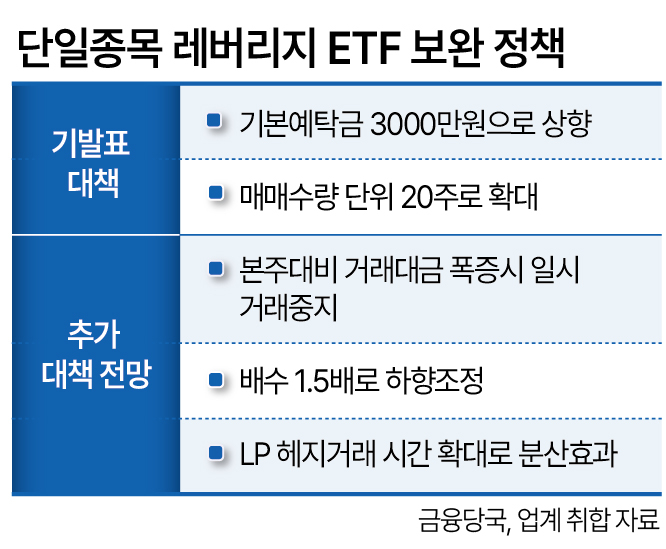
The government has unveiled tough new rules for single-stock leveraged ETFs — raising the minimum deposit requirement to 30 million won ($20,200) in cash and capping trade units at 20 shares — but market participants say the measures may do little to curb volatility.
While the higher entry barriers should reduce the flow of new retail investors into these products, critics say the rules fall short of addressing the structural causes of volatility and that additional steps are needed. One measure gaining traction as a follow-up is spreading out the liquidity provider hedging trades that now cluster in the final 30 minutes of each session, which would ease the price shock that builds near the close.
According to the financial investment industry on Monday, Kim Yong-beom, chief of the presidential policy office at Cheong Wa Dae, appeared on KBS's Ilyo Jindan Live on Sunday and said further supplementary measures were needed. "Leveraged ETFs have the effect of doubling the impact during a downturn," Kim said, adding that "regulators, asset managers and brokerages need to hold further discussions on how to minimize market disruption."
A key proposal for reducing end-of-day volatility centers on reforming how liquidity providers execute their hedging trades. Currently, LPs concentrate their buying and selling of underlying assets in the 30 minutes before the close to keep the gap between an ETF's market price and its net asset value in check. Spreading those trades across a wider window, proponents say, would ease the volatility that spikes near the closing bell.
Kim said that while minimizing the price-NAV gap remains important, "we can also discuss ways to appropriately manage the selling pressure that comes from closing that gap," adding that "we need to think about a range of measures to minimize the impact these products have on the market at specific times and during specific trading windows."
The government itself, in other words, does not believe the supplementary measures announced this time will resolve every problem stemming from leveraged ETFs.
The political sphere is also paying close attention to follow-up measures. Democratic Party of Korea lawmakers on the National Assembly's Political Affairs Committee met Monday with officials from the Financial Services Commission and the Financial Supervisory Service to review government-party policy priorities for the second half of this year. Single-stock leveraged ETFs — widely cited as a key driver of sharp share price swings — were also on the agenda.
Industry reaction has been similarly skeptical. The higher deposit threshold should reduce the number of new retail investors entering the market, and the larger minimum trade unit is likely to lower turnover, but doubts remain about whether the measures will meaningfully reduce volatility. Existing investors already make up a substantial share of the market, and it is far from certain that lower trading volume will translate directly into smaller price swings.
"The new rules may reduce the entry of small investors, but given the trading volumes already established, the effect on volatility could be limited," one industry official said.
Experts are therefore calling for reforms that go beyond improving LP hedging practices to include changes to product structure and market operating rules.
Lee Jun-seo, a business administration professor at Dongguk University, said single-stock leveraged ETFs are "not the main culprit but an accessory" to stock market volatility, pointing in particular to the excessive concentration of funds in Samsung Electronics and SK Hynix. He proposed introducing a separate volatility interruption mechanism that would temporarily halt trading in a leveraged ETF when its trading volume as a share of the underlying stock's turnover exceeds a certain threshold.
Reducing the risk embedded in the products themselves has also been raised as an option. Some argue that cutting the leverage multiplier from the current 2x to 1.5x would dampen volatility. However, there is considerable pushback that doing so would make the products less attractive and could drive capital back to overseas markets.
Some in the market argue that a more fundamental fix would be to spread the concentration of funds across a broader range of stocks. Domestic single-stock leveraged ETFs are currently focused on Samsung Electronics and SK Hynix, and expanding the eligible universe to include top-cap names such as Hyundai Motor, Naver and major financial stocks could ease the supply-demand pressure on any single issue.
Another industry official proposed additional practical remedies: a blended ETF that combines Samsung Electronics and SK Hynix in a single product, tighter rebalancing oversight for liquidity providers, and expanded market-management responsibilities for asset managers.
Calls for caution have also emerged around tightening the NAV gap standard. Asset managers warn that some degree of price-NAV divergence is unavoidable when spreading out orders before the close, and that overly strict standards could paradoxically worsen market price distortions.
The broad assessment is that while the new measures are meaningful for cooling short-term overheating by raising the investment threshold, they have limited capacity to address the structural causes of market volatility.
Industry participants say that once the measures take effect, discussions should continue on more fundamental remedies — including the introduction of a volatility interruption mechanism, adjustments to the leverage multiplier, expansion of eligible underlying stocks, and stronger LP oversight.
Calls for outright delisting, however, are being met with caution. Unwinding products already trading in the market would carry side effects that would be difficult to absorb, critics say. Kim also said that "since these products are already in the market and investor funds of more than 10 trillion won are already committed, delisting would deliver an enormous shock to the market — it is hard to even imagine."
th5@heraldcorp.com