At inauguration press conference, mayor pledges to 'prepare for next generation, not next election'
City goals: a directly connected city, a city where residents thrive, a city that grows through convergence, a city with open roads, a city where work and life coexist
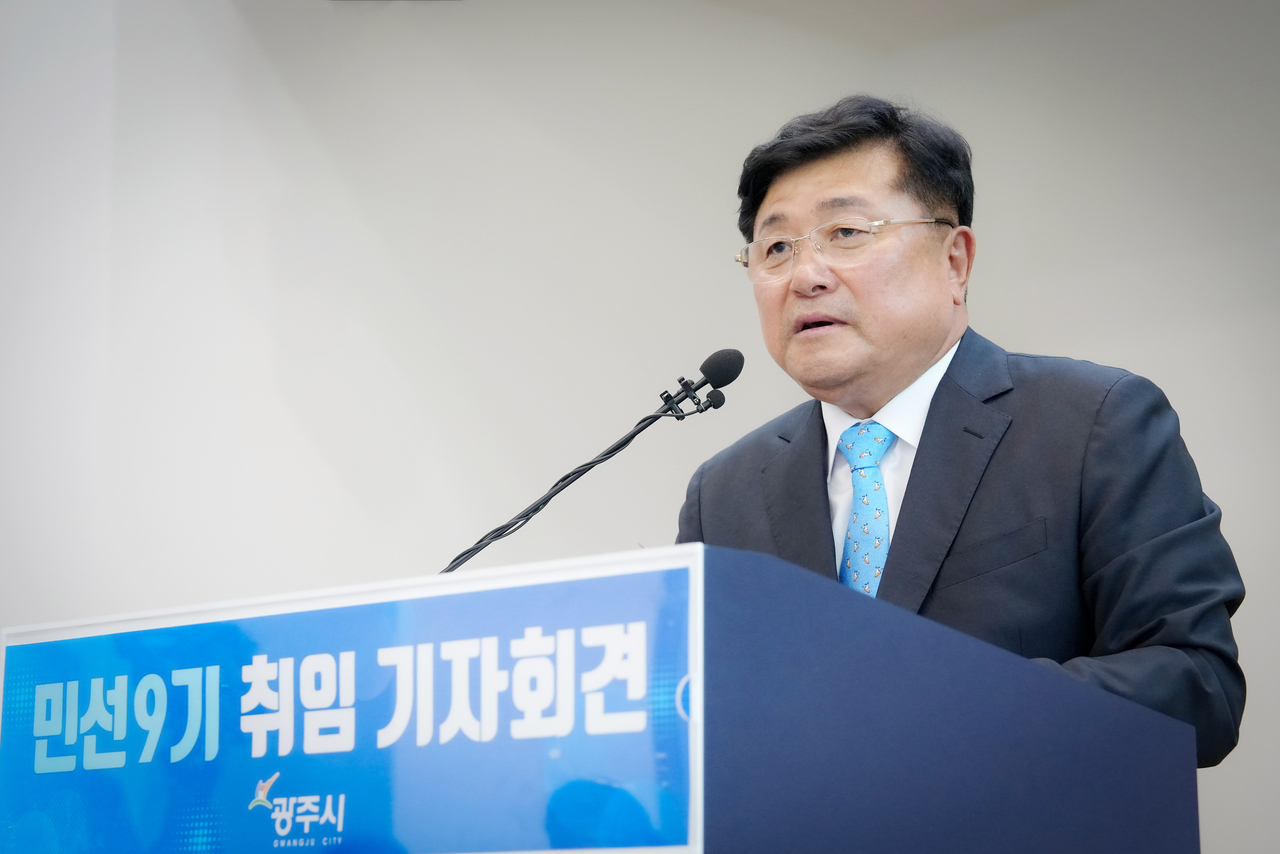
"I will be a mayor who prepares for the next generation, not a mayor who prepares for the next election."
Gwangju Mayor Park Kwan-yeol made that pledge Tuesday at an inauguration press conference for his seventh-term administration, held at Sunam Hall in the city hall.
Park said his administration would build "a city government that keeps its promises to residents and earns its evaluation through results," and went on to say he had chosen "Gwangju in Direct Contact with Its Residents" as the administration's slogan — reflecting his commitment to a city where government and residents are directly connected, where plans and on-the-ground realities are continuously fed back into each other, and where the changes residents need in their daily lives are put into practice immediately.
He promised to spend the next four years working toward five goals: a directly connected city, a city where residents are happy, a city that grows through convergence, a city with open roads, and a city where work and life coexist.
Park doubled down on his pledge to serve the success of every resident by committing to listen more, visit more sites, and conduct more research — and to prove the results without fail.
Full text of Gwangju Mayor Park Kwan-yeol's seventh-term inauguration press conference statement:
To the 420,000 residents of Gwangju,
and to the esteemed members of the press,
thank you deeply for joining us today
despite your busy schedules.
The seventh-term Gwangju city administration will build a city government that keeps its promises to residents
and earns its evaluation through results.
You are partners who watch over city governance from the closest vantage point.
Please share widely with residents the things we do well,
and do not hesitate to point out our shortcomings.
I will always listen humbly to constructive criticism
and warm advice offered in the interest of Gwangju's development.
I ask that members of the press serve as a bridge
for a directly connected Gwangju.
The seventh-term Gwangju city administration, newly launched with the hopes of its residents,
has established the core values and slogan of city governance,
as well as policy goals for each sector.
The core values of city governance are communication, results, and pragmatism.
We will communicate with residents, with the press, and across departments.
We will invest in projects that produce results, and abandon those that do not.
We will put pragmatism ahead of ideology
and deliver an administration that brings real change to residents' lives.
Gwangju stands at an important turning point.
The population continues to grow,
but the quality of life that residents actually feel
has not yet changed enough.
That is why the seventh term will prioritize
changing residents' lives over expanding the city's outward appearance.
Going forward, all policies, budgets,
and administrative standards will be aligned with communication, results, and pragmatism.
And the city's slogan has been set as "Gwangju in Direct Contact with Its Residents" —
a city where government and residents are directly connected,
where plans and on-the-ground realities are continuously fed back into each other,
and where the changes residents need in their daily lives
are put into practice immediately.
This is no longer an era in which government draws up plans
and residents follow along.
When residents raise a problem,
government creates a solution;
when residents propose a policy,
government carries it out.
I will visit the field far more than I sit in the mayor's office,
and I will listen to residents' voices far more than I read reports.
The Direct Mayor's Office and the Mobile Mayor's Office
will be the first promise to put this philosophy into practice.
Rather than an administration that receives complaints,
we will run a city government that seeks out problems and solves them.
The first goal of city governance
is a directly connected city.
Direct connection is the most important operating philosophy of the seventh-term Gwangju administration.
Rather than an administration where residents waste time searching for the right department to file a complaint,
we will build a city where the mayor and the administration are directly connected to residents.
Centered on the Direct Mayor's Office, everyday complaints will be resolved swiftly,
and important policies will first be discussed with the residents who have a stake in them
and with the council that represents those residents.
We will move away from an era in which government explains things to residents
and toward an era in which decisions are made together with residents.
The second goal is a city where residents are happy.
A city's competitiveness ultimately begins with the happiness of its residents.
We will build a Gwangju where parents raising children worry less about childcare
and where young people can prepare for their futures.
We will build a city where the elderly are respected
and where the socially vulnerable are not left behind.
We will establish a welfare navigation system
to realize welfare that "comes to find you first,"
rather than welfare you have to apply for.
From birth and childcare,
through education and employment,
to retirement and old age —
we will build a system in which government shares responsibility for a person's entire life.
We will expand late-night children's hospitals and public late-night pharmacies,
build a tightly woven care system,
and create a Gwangju where residents feel happiness in their everyday lives.
I believe happiness does not begin with grand projects
but with the small changes that transform residents' daily lives.
The third goal is a city that grows through convergence.
A single project must not achieve only a single objective.
We will run an administration that connects through cooperation rather than separation,
and horizontally rather than vertically.
AI technology and urban development must advance together;
energy and industrial complexes must be prepared simultaneously;
and new towns and jobs must occupy the same space.
We must move toward a convergence city where people study, research, and start businesses in Gwangju.
I will make Gwangju the premier AI and semiconductor innovation hub
in the southeastern part of the greater metropolitan area.
We will foster an AI smart city and advanced industries,
and build an education system that trains specialized talent in semiconductors and robotics.
We will nurture the cultural content industry and the arts
so that industry and culture do not grow separately on their own tracks
but are connected to each other
to generate an even greater engine of growth.
Convergence across industries will become Gwangju's new competitive edge.
The fourth goal is a city with open roads.
Gwangju residents spend an average of two to three hours a day
on the road.
Giving that time back to residents
is the most important task of the seventh term.
We will pursue Gyeonggang Line commuter shuttle trains,
introduce a Gwangju-style late-night bus service,
and expand the rail and road network in stages.
We will use smart traffic technology
to improve chronically congested sections
and dramatically transform the public transit environment.
When traffic changes, residents' time changes,
and when residents' time changes, their quality of life will change too.
The fifth goal
is a city where work and life coexist.
A good city is a city with jobs.
A good city is a city where people can spend time with their families
even after work.
I will transform Gwangju from a city people merely commute to
into a city where people want to work.
We will develop AI smart self-sufficient cities centered on transit-oriented areas,
and build an innovation ecosystem and industrial ecosystem
where companies, research institutes, and young entrepreneurs grow together.
Particularly, the water supply issue for the Yongin semiconductor national industrial complex
must become a new opportunity for Gwangju.
Gwangju must no longer be a city that only sacrifices for national industry
but must become a central city in the national industrial strategy.
In line with the government's three major mega-projects,
we are researching ways for Gwangju to take on
research and development functions and talent-training functions for semiconductors and AI.
We will spare no effort to bring the government's newly established future response fund
to Gwangju.
We will move toward a self-sufficient city where work and life are in balance, where young people do not leave,
and where companies come to us.
Built on the foundation of a directly connected city,
a city where residents are happy,
a city that grows through convergence,
a city with open roads,
and a city where work and life coexist —
that is the promise the seventh-term Gwangju city administration makes
for the next four years.
Esteemed residents of Gwangju,
Gwangju has been a city of sacrifice.
It has been a city that supports other cities.
Bound by overlapping regulations, it could not grow on its own
and always sacrificed for other cities.
But that must end here.
We must no longer be a city that only sacrifices
but must become a central city for the nation's strategic industries.
We have endured decades of various regulations
to protect the drinking water of greater metropolitan area residents.
And now we are under pressure to supply water
to the Yongin semiconductor national industrial complex as well.
Cooperation for the nation's industrial growth is necessary.
But cooperation and sacrifice are not the same thing.
If Gwangju cooperates for national development,
the nation must also invest in Gwangju's future.
I will not approach this as a matter of receiving a few more subsidies.
I will bring national projects that change Gwangju's future.
I will demand investment in an AI smart city of 30,000 housing units,
research and development and talent-training functions for semiconductors and AI,
and the development of a smart water industry.
I will make Gwangju not a peripheral player in the national industrial strategy
but a protagonist alongside Pangyo and Yongin.
Esteemed members of the press, thank you again.
The press plays a role in monitoring government.
But at the same time, it is also the most important partner
connecting residents and government.
I will communicate with you more going forward.
I will not fear criticism.
If it is criticism in the interest of residents, I will always listen humbly.
I look forward to becoming partners with you and Gwangju city
in building a better city together.
Esteemed residents,
I did not grow up in comfortable circumstances.
After finishing elementary school, I carried an A-frame carrier and worked in the fields to make ends meet,
and later passed the high school equivalency exam
and went on to study at university and graduate school.
I failed many times after entering politics as well.
But through that process, I learned one thing:
if you do not give up, you can rise again.
Gwangju is the same.
Gwangju has faced hardship amid countless regulations.
But now Gwangju must begin a new leap forward.
I will be a mayor who prepares for the next generation,
not a mayor who prepares for the next election.
The success of every resident
matters more than the success of one mayor.
So I will listen even more going forward.
I will visit more sites.
I will conduct more research.
And I will prove it through results, without fail.
Thank you.
pjh@heraldcorp.com